
TL;DR Summary for Those in a Hurry:
- Furnace Ignitor Troubles often show up when a furnace won’t start, turns on briefly, or blows cold air instead of heat.
- Common causes include a worn or cracked ignitor, electrical issues, dirt buildup, or normal component aging.
- Catching ignitor problems early helps restore reliable heating and prevents damage to other furnace parts.
- Basic checks can identify warning signs, but professional diagnosis ensures safe and accurate repair.
- Prompt service keeps your home warm and avoids unexpected furnace breakdowns.
Table of Contents
CRITICAL SAFETY FIRST: Your 2-Step Shutdown Procedure
Before you try to find the problem, you must guarantee your safety. Working on a furnace without completely cutting the power is extremely dangerous, so this is the one step you cannot skip. Following this two-step process ensures the unit is totally de-energized, giving you the peace of mind to look inside.
To turn off furnace power correctly, you’ll flip two separate switches. Think of this as a double-check that makes your inspection completely safe.
- The Furnace Service Switch: Look for what appears to be a regular light switch on the side of your furnace or on a nearby wall. This is the service switch. Flip it to the “OFF” position.
- The Circuit Breaker: Now, go to your home’s main electrical panel. Find the breaker labeled “Furnace,” “HVAC,” or “Air Handler” and flip it firmly to the “OFF” position.
With both switches confirmed off, your furnace has no electricity, and you can proceed with confidence.
What Am I Looking At? A Quick Tour Inside Your Furnace
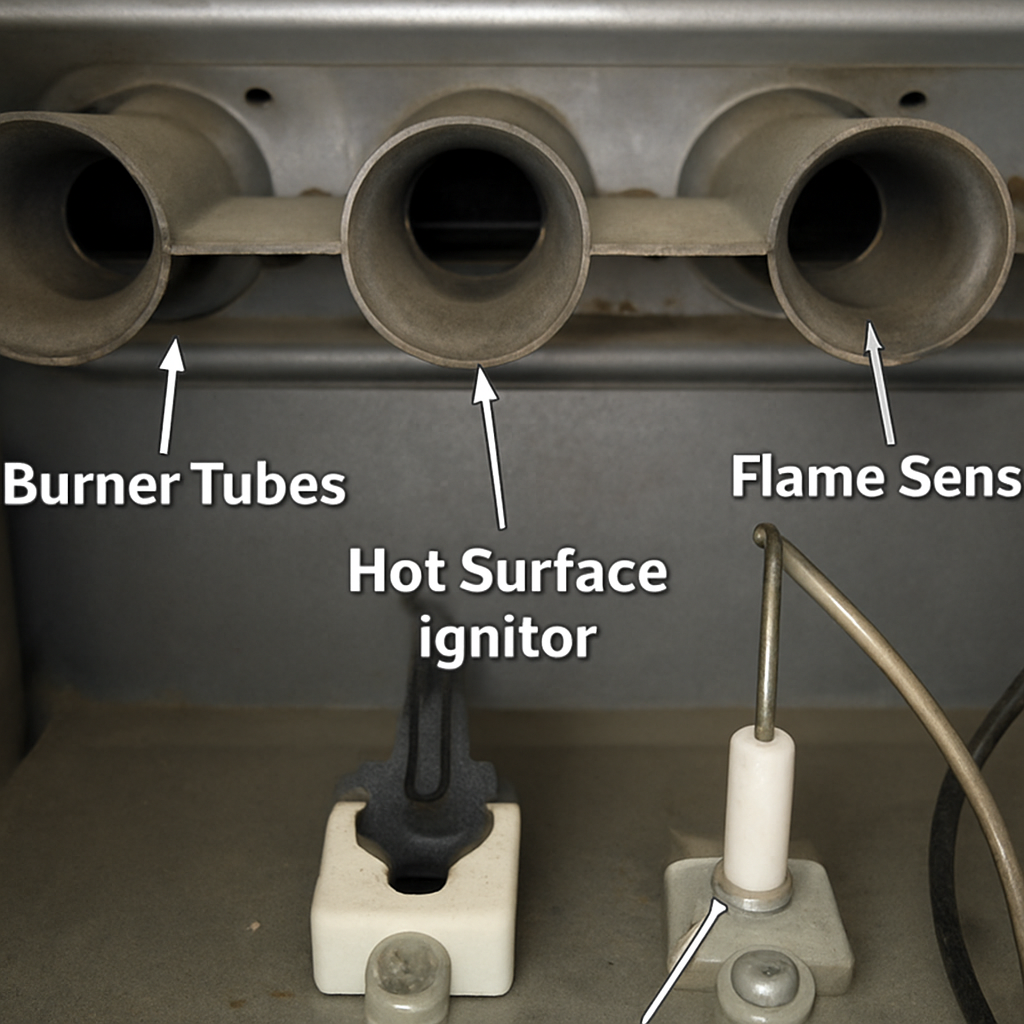
With the front panel off, you’re probably looking at a maze of wires, pipes, and boxes. Don’t worry about most of it. We’re focusing on one specific area: the burner assembly, which is the row of small, tube-like openings where the flames are born. This is the stage for our main characters.
Your primary goal is to find the furnace ignitor. Look carefully near the front of the burner tubes for a small, dark gray component, usually mounted on a white ceramic base. Most modern furnace ignitors have a flat, paperclip-like shape. Think of it as the element in a toaster; its only job is to get white-hot to light the gas. It’s extremely brittle, so it’s critical that you don’t touch it.
Often sitting opposite the ignitor is another important part: the flame sensor . It’s easy to confuse the two, but they look different. The flame sensor is just a thin, metallic rod, sometimes with a slight bend at the tip, that pokes into the path of the flame. While the ignitor starts the fire, the flame sensor’s job is to see the fire. It’s a safety device that confirms the gas has actually lit.
Now that you can tell these key furnace components apart, you’re ready to become a detective. You will safely restore power and watch them work together to figure out exactly where the breakdown is happening.
The 1-Minute Observation Test: What Your Furnace Is Trying to Tell You
With the furnace panel safely reinstalled, it’s time to play detective. Go ahead and turn the power back on at the breaker box and the service switch near the unit. Now, turn up your thermostat to call for heat. Your job for the next minute is simple: stand near the furnace and listen and watch closely. What you’re about to observe is the furnace sequence of operations—a strict safety checklist it follows every time it starts.
Think of this sequence as a four-step rocket launch. If any step fails, the mission is aborted, and you get no heat. Here is the normal order of events:
- The first thing you should hear is a gentle hum as a small fan, called the inducer motor, starts up. This clears out any old gas from the system.
- About 30-60 seconds later, the hot surface ignitor should begin to glow a brilliant orange-yellow.
- Right after the ignitor is at full brightness, you’ll hear a distinct “click” as the gas valve opens.
- Immediately, the burners should light with a soft “whoosh” sound, and you’ll see a steady blue flame.
This sequence is your single most powerful diagnostic tool. Many homeowners report that their “furnace clicks but won’t light,” which often means the process is failing at step #3 or #4. However, if the process stops before that, you’ve likely found your culprit. The key is noticing which step is the last one to happen successfully.
If you watched the startup attempt and the fan kicked on, but you never saw the ignitor start to glow, you’ve found your prime suspect. A failure at step #2 is the classic sign of a bad ignitor.
Diagnosis: The Ignitor Did NOT Glow
If your observation test ended with the fan running but the furnace ignitor not glowing, that’s a huge clue. This is one of the clearest symptoms of a weak or failed furnace ignitor. Your detective work has successfully narrowed the field of potential problems down from dozens to just a couple of highly likely culprits. You’ve bypassed the noise and are now focused on the most probable cause for your lack of heat.
This symptom almost always points to one of two things. Think of it like a lamp that won’t turn on: either the light bulb itself is burnt out (a failed part), or the lamp isn’t getting electricity from the wall (a power supply problem). In a furnace, the most common issue by far is the “burnt-out bulb”—a physically broken or cracked ignitor that can no longer heat up.
To find this “burnt-out bulb,” you need to get a closer look at the part itself. Before you proceed, repeat the safety step: turn the power to your furnace completely off at both the service switch and your home’s breaker box. Once the power is off, you can safely perform a visual inspection.
Diagnosis: The Ignitor Glowed, Then Everything Shut Off
If you saw the ignitor glow bright orange, heard the burners ignite with a satisfying “whoosh,” but then watched the flames die out after only a few seconds, you’ve stumbled upon a critical clue. While it might feel like a failure, this is actually great news from a diagnostic standpoint. It tells you that your furnace ignitor is working perfectly; its job was to start the fire, and it succeeded. The problem isn’t with ignition, but with the furnace failing to confirm that the flame is safely burning.
What you’re likely seeing is a classic symptom of a dirty flame sensor. Think of this component as a safety guard. It’s a thin metal rod positioned in front of one of the burners, and its only job is to “see” the flame and report back to the furnace’s control board that everything is working as it should. Over time, this sensor gets covered in a thin, often invisible layer of soot and residue. When it’s too dirty, it can no longer detect the flame, even when it’s present.
Sensing a “no-flame” situation, the furnace’s safety logic kicks in and immediately shuts off the gas supply to prevent unburned gas from filling your home. This is the crucial difference: a bad ignitor stops the fire from ever starting, while a dirty flame sensor causes the furnace to shut off a fire that has already started. This cycle may repeat a few times before the furnace locks out for safety. The good news is you’ve likely diagnosed the issue, and it’s not a bad ignitor.
The Visual Crack Test: Your Easiest Way to Confirm a Bad Ignitor
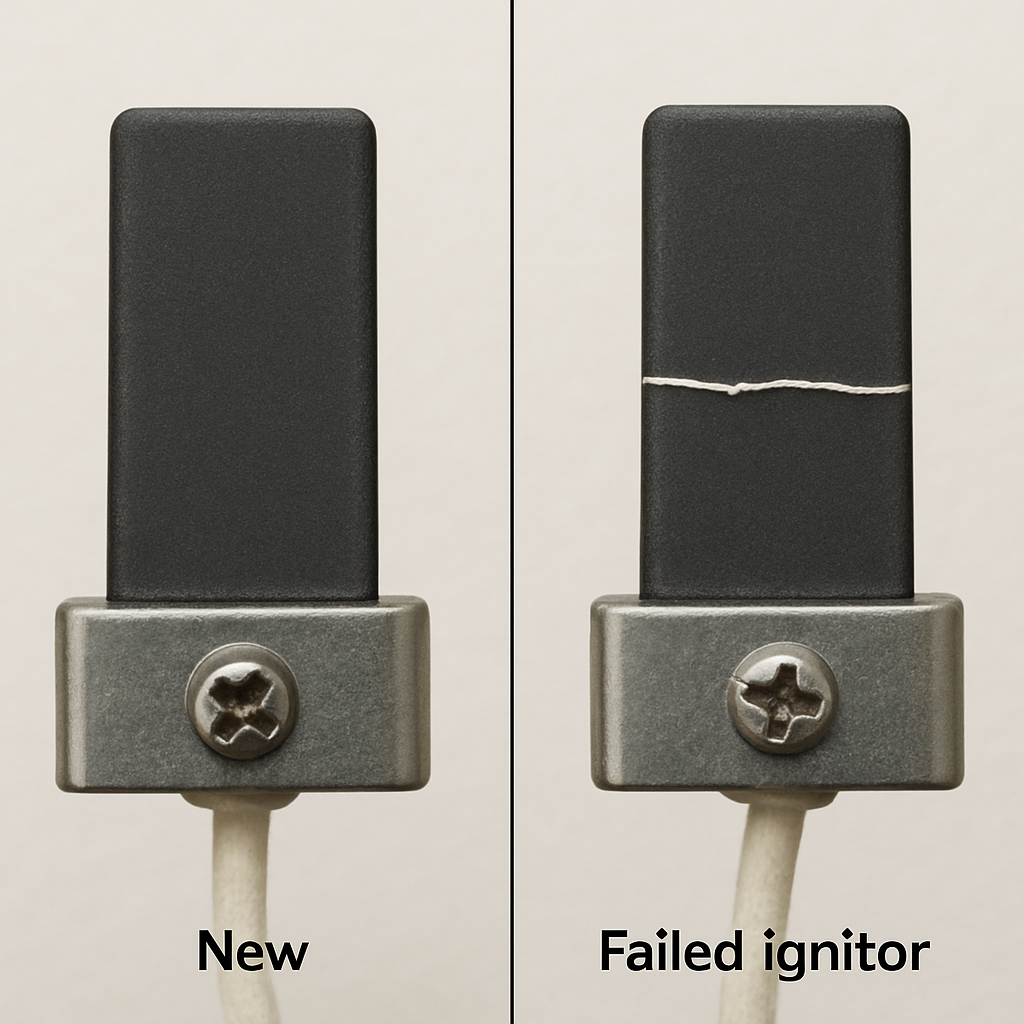
Since your ignitor isn’t glowing, the next step is a simple visual check. With the furnace power completely off, carefully look at the dark gray, blade-like part of the ignitor. You’re searching for one of the most common signs of a cracked hot surface ignitor: a hairline crack. Much like the tiny filament breaking in an old light bulb, this split breaks the electrical circuit, making it impossible for the ignitor to heat up. Look closely at the “Failed Ignitor” in the image—that thin white line is a perfect example of what to hunt for.
Beyond an obvious crack, another tell-tale sign of a bad furnace ignitor is a blistered or chalky white spot on its surface. This spot shows where the material itself has started to degrade after thousands of intense heating and cooling cycles. An ignitor showing this kind of wear, even without a visible fracture, is at the end of its operational life and is almost certain to be the culprit.
Finding a crack or a significant white spot is your “aha!” moment. You’ve just performed one of the most reliable tests for a hot surface ignitor and can be confident you’ve found the problem. This visual confirmation is often all the proof you need before buying a replacement part.
The “Glow Stick” vs. The “Spark Plug”: Is Yours a Hot Surface or Direct Spark Ignitor?
If you’ve been searching for that gray, blade-like part and come up empty-handed, don’t worry. It simply means your furnace may use a different ignition method. Most residential furnaces use one of two main systems to get the fire started, and telling them apart is straightforward once you know what to look for.
The vast majority of modern furnaces use the Hot Surface Ignitor (HSI) we’ve been discussing. Think of it as a “glow stick”—it works just like the element in an electric toaster, heating up until it’s glowing orange-hot to light the gas. The other common type is a Direct Spark Ignitor (DSI) . This system acts more like a “spark plug” in a gas grill. Instead of glowing, it creates a high-voltage spark that you’ll hear as a rapid tick-tick-tick sound right before the burners ignite.
Knowing your furnace ignitor type is critical because their troubleshooting paths are completely different. A Direct Spark system involves high-voltage components and potential issues that are best left to a professional. However, if you have a Hot Surface Ignitor that passed the visual inspection, there is one final, definitive test you can perform.
The Final Proof: How to Test a Hot Surface Ignitor with a Multimeter
Sometimes, an ignitor fails without showing a visible crack. For a 100% certain diagnosis, you can perform a simple electrical test using a multimeter. Don’t be intimidated by the name; we’ll use one setting that works like a detective, checking for a complete electrical path. This is the most reliable way of testing a furnace ignitor, and it’s perfectly safe with the power off.
The ignitor is like a tiny, closed bridge that electricity needs to cross. The multimeter’s Ohms (Ω) setting checks for continuity—a technical term for seeing if that bridge is intact or broken. If the bridge is good, the multimeter shows a low number. If the bridge is broken, the multimeter will tell you the path is open.
Ready to get a final answer? Follow these steps exactly:
- Confirm all power to the furnace is OFF at the breaker and the service switch.
- Carefully unplug the ignitor’s plastic wire connector from the furnace wiring.
- Set your multimeter dial to Ohms (Ω). If you have multiple ranges, choose the lowest one, such as 200 Ω.
- Touch one metal probe from your multimeter to each of the two metal pins inside the ignitor’s connector.
A good, healthy hot surface ignitor will show a resistance reading, typically somewhere between 40 and 90 ohms. If your multimeter screen reads “OL” (which stands for Open Loop), “I”, or just a “1”, it means the electrical path is broken and the ignitor is bad, even if you can’t see a crack. With this confirmation, you can confidently purchase a replacement. This definitive test removes all guesswork.
The Dangerous Question: Can You Manually Light a Furnace?
Now that you’ve likely confirmed a bad ignitor, a tempting thought might cross your mind: “Can you manually light a furnace with a lighter or match?” The answer is an emphatic and absolute NO. Attempting this on a modern furnace is extremely dangerous and could cause a violent flare-up or even an explosion. Your personal safety is not worth the risk.
The critical danger is a phenomenon called delayed ignition . Your furnace’s control board, its “brain,” doesn’t know the ignitor is broken. It follows its safety logic: it opens the gas valve for a few seconds, expecting the hot ignitor to light the gas instantly. When that doesn’t happen, raw, unburnt gas floods the combustion chamber. Introducing a flame at that moment can cause this built-up gas to ignite all at once.
This entire sequence is managed by the furnace’s automated safety systems, which are designed to prevent exactly this scenario by shutting down. Manually interfering with this process bypasses every safeguard built into your system. The only correct and safe solution for a bad ignitor is to replace it. It’s a simple, inexpensive repair that avoids a potentially catastrophic mistake.
The Bottom Line: Furnace Ignitor Replacement Cost vs. a Pro Visit
So, what’s this going to cost? If you’ve confirmed the ignitor is the culprit, you’re looking at an affordable repair. The furnace ignitor replacement cost for the part itself is surprisingly low—typically $20 to $50 for a common universal furnace ignitor from a local home improvement store. For less than the price of a family pizza night, you could have the component needed to restore your heat.
On the other hand, calling a professional is a valid choice. The typical HVAC service call cost for an ignitor swap ranges from $150 to $300. This fee covers the technician’s travel, their diagnostic expertise, the part, and the labor to install it safely. Essentially, you’re paying for the peace of mind that comes with a quick, guaranteed solution from an expert.
The decision boils down to saving money versus the certainty of a professional repair. If you’re confident in your diagnosis, the DIY path is very rewarding. However, that savings vanishes if the problem is more complex. If your furnace is showing other strange symptoms beyond the ignitor failing to glow, it’s a clear sign you need an expert eye.
Stop and Call a Pro: 5 Signs the Problem Is Beyond the Ignitor
Being a savvy homeowner isn’t just about fixing things; it’s also about knowing your limits. You’ve done excellent detective work, but some symptoms are clear indicators of a more complex or dangerous issue that requires an expert. If you encounter any of the following, it’s when to call an HVAC technician without hesitation.
Stop immediately if you notice one of these red flags:
- You smell gas. This is non-negotiable. Turn the furnace off, leave the house, and call your gas company and an HVAC professional right away.
- The ignitor is good, but won’t glow. If you’ve confirmed the ignitor isn’t cracked but it still doesn’t get hot, the problem is happening before the ignitor.
- You hear rapid, repeated clicking. A series of fast clicks from the furnace cabinet can indicate a faulty gas valve or control board issue.
- The furnace shows an error code. Many modern furnaces have a small light on the control board that blinks in a specific pattern to signal a problem. These furnace error codes are a direct message that it’s time for a pro.
- You feel unsure. If at any point you feel uncomfortable or out of your depth, trust that feeling. Safety is always the top priority.
These signals are your furnace’s way of telling you the issue is with a more central component. For example, a good ignitor that doesn’t get hot points to a furnace control board with no power to the ignitor—the system’s “brain” isn’t sending the right command. By recognizing these signs, you can make the safest and most effective decision for getting your heat restored.
Your Clear Action Plan for a Warm Home
Just a short while ago, the silence from your vents was a mystery, and the clicking from your furnace was a source of frustration. Now, you’ve pulled back the curtain. You know how to safely observe your furnace’s startup sequence and listen for the clues that tell its story, transforming you from a passive homeowner into an active troubleshooter.
This furnace troubleshooting summary is simple: it’s all about observation. By watching for the ignitor’s glow and listening for the gas valve’s click, you’ve learned to distinguish a simple part failure from a more complex issue. This isn’t just about saving money on a single visit; it’s about gaining a fundamental understanding of how your home works.
Your next steps are clear. If you discovered a visibly cracked or non-glowing ignitor, you have a straightforward furnace repair action plan for a DIY furnace repair. If the clues pointed elsewhere, you now possess the most valuable tool for calling a professional: precise information.
You are no longer just guessing; you are diagnosing. You’ve replaced anxiety with knowledge and helplessness with a plan. Whether you’re heading to the hardware store or picking up the phone, you are in control.
Furnace Ignitor Troubles can stop your heating system from working when you need it most. Recognizing symptoms early and calling an HVAC professional helps fix the issue safely and keeps your furnace running reliably.
FAQ:
What are common Furnace Ignitor Troubles and how do they affect my heating system?
Common issues include a furnace that won’t start, repeated clicking without ignition, or cold air blowing from the vents — all signs the ignitor isn’t lighting the burners properly.
How can I tell if my furnace ignitor is failing?
Look for symptoms such as the ignitor not glowing during startup, visible cracks or damage, short cycling, or the furnace running without producing warm air.
Why does my furnace click but not ignite?
Clicking without ignition often means the control board is trying to start the furnace but the ignitor isn’t heating up or producing a spark — a common indication of ignitor failure.
Can I check the ignitor myself before calling a professional?
You can visually check for obvious signs like cracks or lack of glowing, but diagnosing electrical or ignition issues safely typically requires professional tools and expertise.
How long does a typical furnace ignitor last?
Most modern hot surface ignitors last about 3–7 years, depending on usage and conditions — dirt, electrical stress, or frequent cycling can shorten lifespan.
When should I call an HVAC technician for ignitor issues?
It’s time to call a professional if the furnace won’t ignite, repeatedly fails to light after multiple attempts, shows error codes, or if you smell gas — these situations require expert diagnosis and safe repair.