
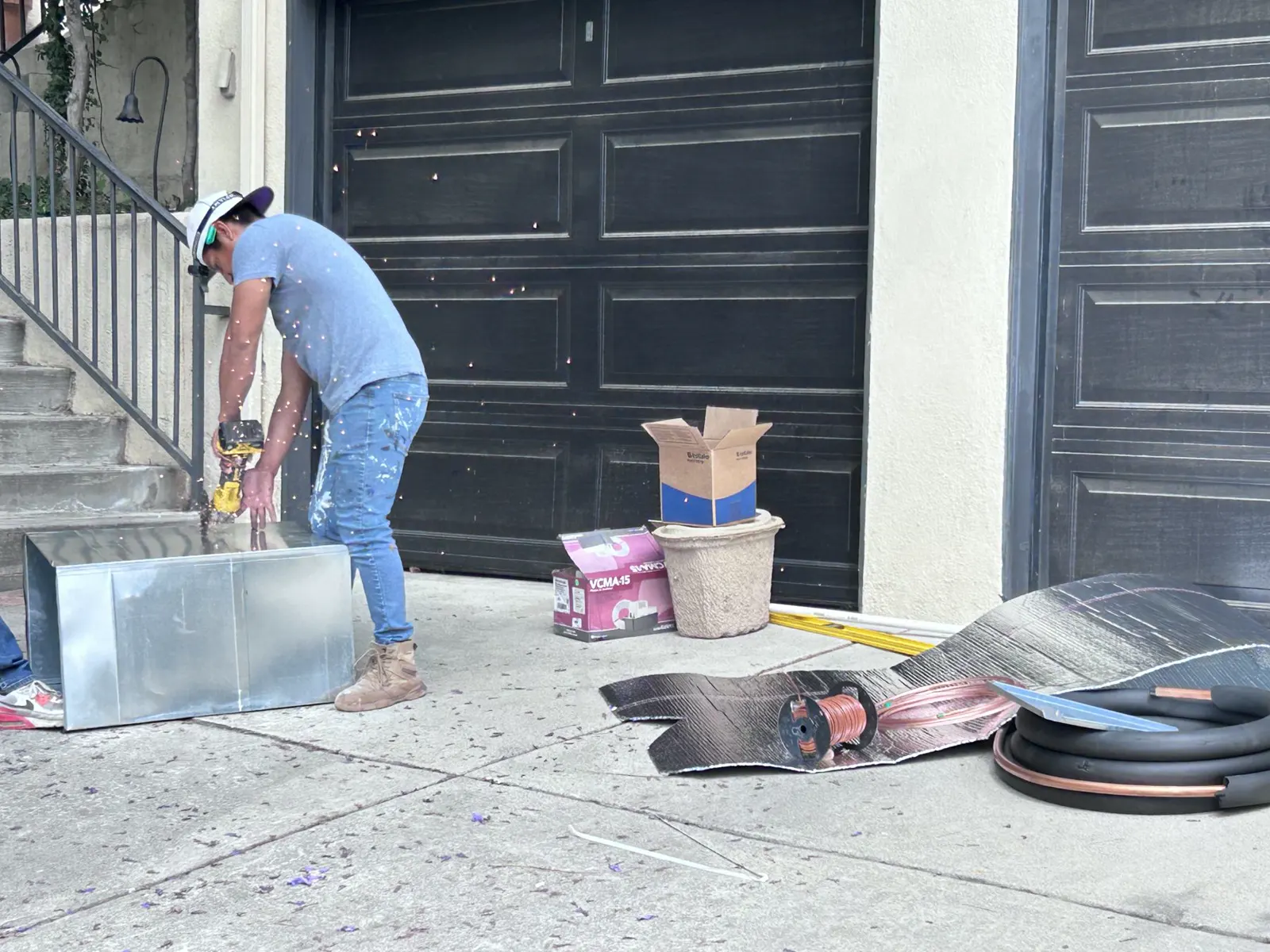
In most San Gabriel Valley and San Fernando Valley homes the ducts, not the equipment, are why one room never gets comfortable. The work to fix that is straightforward, but it is easy to sell a "duct service" that is really just a vacuum in a register. Here is what a real duct improvement job includes, so you can tell the difference on the quote.
Why ducts are usually the problem here
The typical 1950s to 1970s ranch house in Reseda, Northridge or the flats of the San Gabriel Valley has its supply ducts running through an attic that hits 130°F and higher on a summer afternoon. Every joint that has loosened, every section of flex that got crushed by someone storing boxes, every boot that pulled away from the ceiling — that is conditioned air you paid for, leaking into the hottest space in the house, and hot attic air getting pulled back in through the return side.
Older bungalows around Pasadena and Altadena have a different version of the problem. Many were never built with ducts at all, so what exists was added later, often routed the shortest way rather than the right way, with a single undersized return doing the work of two.
You feel all of this as a room that will not cool, weak airflow at the far registers, a system that runs constantly, or dust that comes back a week after cleaning.
What a proper duct job includes
Whoever you hire, the scope should look like this. Ask for it in writing before anything starts.
- Inspect the whole system, including the runs in the attic, the crawlspace and the garage. Not one register, not the first six feet from the air handler.
- Evaluate supply and return balance. Undersized returns are common in older homes, and a system that cannot get air back is choking no matter how good the supply side is.
- Repair damaged and disconnected ducts, and straighten flex that is crushed, kinked or sagging between joists. A crushed flex run is a restriction you cannot seal your way out of.
- Seal every leak and connection with mastic, UL 181 foil tape, or an aerosol-based sealant. Not cloth duct tape — in a hot attic the adhesive dries out and the tape lets go, usually within a season.
- Seal registers and grilles tight to the duct. The gap between the boot and the ceiling drywall is one of the leakiest spots in a typical house.
- Insulate ducts in unconditioned space. California's 2025 Title 24 energy code requires R-8 duct insulation on new attic ducts in our climate zones, and there is no reason to put back less than that.
- Include a new filter in the job and check airflow after the work, not just before.
- Check combustion safety. Sealing a house's ducts changes the pressures it runs at, so a gas-burning appliance that vented fine before should be confirmed to still vent fine after. A back-drafting appliance is a carbon monoxide problem.
The test California requires
This is the part homeowners rarely hear about until the permit stage. Under the state energy code, replacing an air handler, a condenser or a coil triggers duct leakage testing by a third-party HERS rater — the program was renamed ECC, but the trade still says HERS. The rater is independent of whoever did the install, which is the whole point: the person who sealed the ducts is not the person who certifies that they are sealed.
If a contractor proposes a change-out and the words "permit" and "duct testing" never come up, that is a question worth asking directly.
What you can check yourself
All of this is safe from inside the house or from the attic hatch. Do not crawl into a valley attic in summer, and do not step anywhere that is not a joist.
- Hold your hand at each supply register with the fan running. A register that is noticeably weaker than the others points to a restriction or a disconnect on that run.
- Look for grey streaking on the ceiling around register edges. That is air leaking around the boot, pulling dust with it.
- Compare rooms with a cheap thermometer. A difference of several degrees between rooms on the same system is a duct or balance problem, not a thermostat problem.
- From the hatch, shine a light along the visible runs. Obvious sags, a disconnected boot lying in the insulation, or silver tape curling off a joint are all findings you can report on the phone.
- Look at the return grille. One small return for a whole house is a common finding and a common fix.
- Note whether the system whistles at the return or the registers. That is usually a restriction.
When to call a licensed tech
Duct work above the ceiling is not a homeowner project. Attic temperatures are genuinely dangerous in summer, the wiring for the air handler runs through the same space, and sealing without checking airflow and combustion afterward can trade one problem for a worse one. Call when a room will not hold temperature, when airflow has dropped across the house, when you can see a disconnected duct, or when a system replacement is on the table and you want the duct condition assessed before the new equipment is sized. That is duct repair and ductwork work, and a maintenance visit is a reasonable way to get a first read on it.
What actually drives the price
Nobody can quote duct work from a phone call, and the things that move the number are mostly about access. How tight the attic is and how far the crawl runs. Whether the job is sealing existing ducts or replacing runs that are past saving. How much of the system has to be re-insulated to current code. Whether the return has to be resized, which sometimes means new sheet metal and a bigger grille. Permit and third-party testing when equipment is being replaced at the same time. And in some older homes, duct materials that have to be tested before anyone removes them — that testing and abatement is a separate licensed trade, not ours.
Common questions
Is duct cleaning the same as duct sealing?
No. Cleaning removes debris from inside the ducts. Sealing closes the leaks that let conditioned air escape and attic air in. A house with leaking ducts will get dirty again quickly after a cleaning, because the leaks keep pulling attic dust into the system.
Can I seal my own ducts with duct tape?
Cloth duct tape is the one thing that reliably fails at this. It bakes in a hot attic and the adhesive releases. Mastic and UL 181 foil tape are what the work calls for, and the joints that leak most are usually the ones you cannot reach without being in the attic anyway.
Do I need all new ducts, or can mine be repaired?
Often they can be repaired. Sealing, reconnecting boots, replacing individual crushed runs and adding insulation fixes plenty of systems. Full replacement makes more sense when the runs are original, the material is degraded, the layout was wrong to begin with, or the duct sizing does not match the equipment going in.
Our diagnostic is $69, quoted before we book and credited toward the work. Reach Boost Services at 818-277-5056, 6am to 10pm, seven days a week, or book online.
Written with AI assistance by Boost Services, Heating and Cooling team, and reviewed by our licensed technicians before publishing. Boost Services Heating and Cooling, C-20 #1119892.