
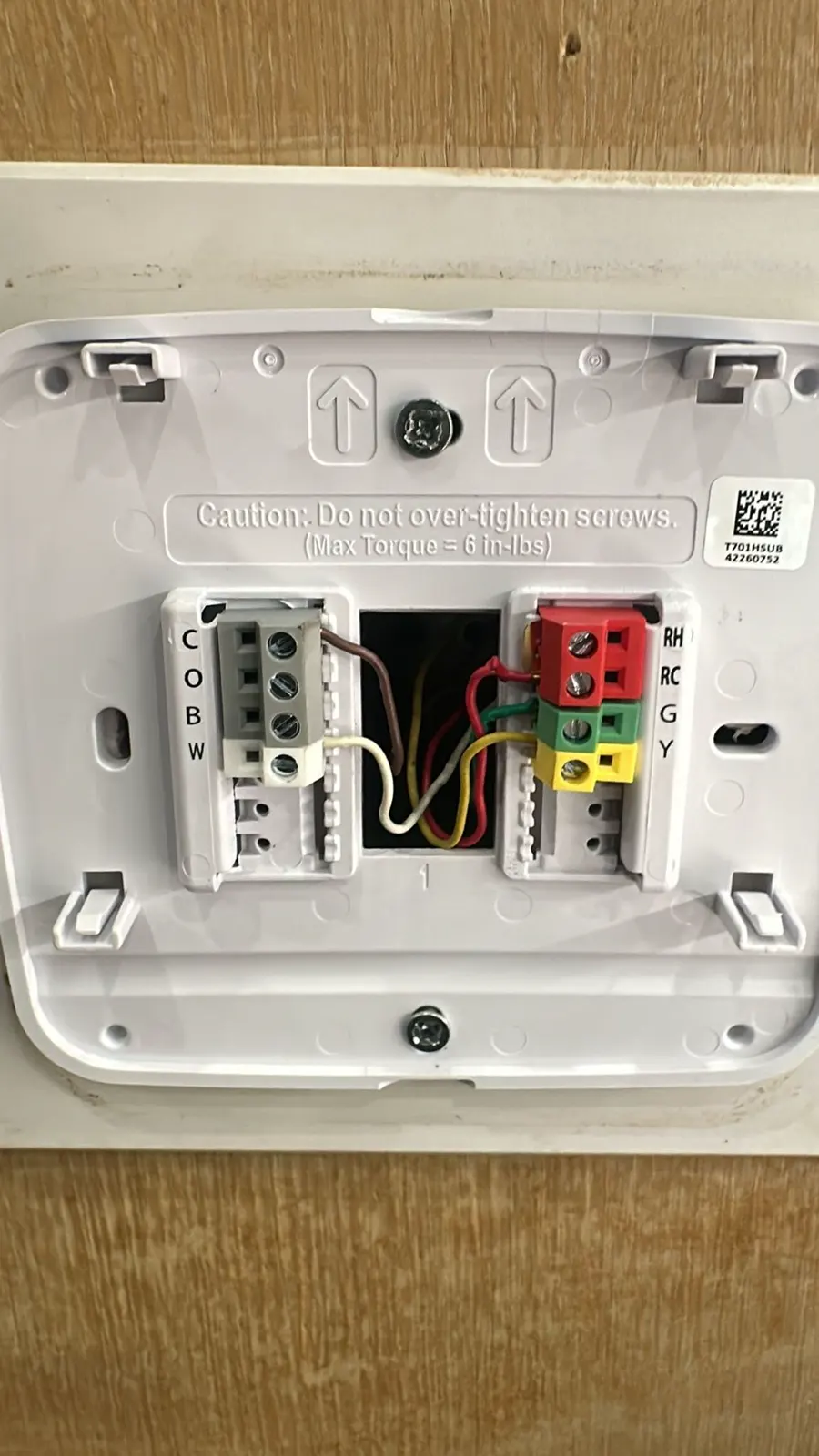
The thermostat decides how the system runs every day, and a fault in it looks exactly like a furnace or AC fault from the hallway. A lot of no-heat and no-cool calls end at the wall, not at the equipment.
We install and wire thermostats, including smart ones in older houses that were wired before anyone thought of wifi, and we sort out the ones that click, reboot or stop talking to the system.
A smart thermostat saves money only when it changes how long the system runs. There is no efficiency trick inside it; the furnace and AC burn exactly what they burned before. The saving is in setbacks you would not have done yourself.
What the thermostat wires do
The furnace or air handler sends 24 volts to the thermostat on the R wire, and the thermostat only closes switches: R to W calls for heat, R to Y for cooling, R to G for the fan. The C wire carries continuous power back, which is what a smart thermostat needs and what many older houses were wired without.
Everything we do with controls
Why people call us for thermostats
- Upgrading to a smart thermostat
- Thermostat not responding
- Wiring for a new system
- Scheduling and remote control
$69 diagnostic, credited toward the work
- Compatibility check
- Installation and wiring
- Setup and app pairing
- Schedule walkthrough
How a thermostat visit goes
The wiring gets checked first: what wires are in the wall and what the equipment supports. Older houses often lack the wire a smart thermostat needs for power, and that is where most reboot and false-click complaints come from.
The thermostat is matched to the system. Heat pumps, two-stage equipment and zoned systems need thermostats that can control them. Then it is mounted, wired, configured for the equipment and scheduled the way you live.
Both heating and cooling are run from the thermostat before the technician leaves. For a fault call, the $69 diagnostic is credited toward the work. Our labor carries a one-year warranty.







We repair, maintain and install these brands. Logos identify the equipment we work on and do not imply endorsement by the manufacturer.
Before you call
The C-wire
It is the wire that gives a thermostat continuous power. The R wire carries 24 volts from the equipment and the thermostat only closes switches; nothing in that setup powers a wifi screen. Houses wired before smart thermostats often lack it. Read more
Power stealing and false clicks
Without a C-wire some thermostats trickle power through the equipment's control circuit. On some furnaces it works. On others the trickle is enough to make the board think it has a call, so the furnace clicks and the inducer spins for a second. Read more
When a click is a problem
One soft click at the start and end of a cycle is a relay and is normal. Three patterns are not normal: rapid clicking, clicking every few seconds, and clicking the system does not respond to. Each points to a different fault. Read more
Where the savings come from
Setbacks while the house is empty, and recovery before you get home. If the house sits at one temperature all day while everyone is at work, there is money to find. If you already adjust it yourself, there is less. Read more
Clicks but the AC does not start
Then the thermostat is probably doing its job and the fault is downstream: a tripped breaker, a float switch on a full drain pan, or a failed part at the outdoor unit. Reset the breaker once; if that is not it, have it looked at. Read more
Often part of the same visit
Common questions
It is the wire that gives a thermostat continuous power. Old thermostats ran on batteries or nothing at all. Smart thermostats with wifi and a screen need it. If a new thermostat keeps rebooting, or the furnace clicks on by itself for a few seconds, a missing C-wire is usually why. Read more
Only when they change how long your system runs. If you already adjust the temperature when you leave and return, there is not much to find. If the house sits at one temperature all day while everyone is out, there is. Read more
One soft click when it calls for heat or cooling is normal. It is a relay closing. It is a problem when the clicking is rapid, repeats every few seconds, or the system does not respond to it. Read more
Then the thermostat is probably doing its job and the fault is downstream: a tripped breaker, a safety switch on the drain, or a failed part in the outdoor unit. Check the breaker once. If that is not it, have it looked at. Read more
$69, told to you before you book. It covers the visit and a written quote, and it is credited toward the work if you go ahead.
Yes. We are open seven days, 6am to 10pm.
Only one built for it. A heat pump thermostat manages the reversing valve and the backup heat strip; a plain furnace thermostat wired to a heat pump either will not heat or runs the expensive backup heat all the time. Matching the thermostat to the equipment is the first thing checked.
“Dave took care of my family and I during the heat wave! Diagnosed the problem, got it fixed, and was on his way to the next house. Great service! Thank you!”
Schedule service
Fill in the form or call. We are on the phones 6am–10pm.
818-277-5056Licensed #1119892 · Veteran-owned · Pasadena & Reseda