
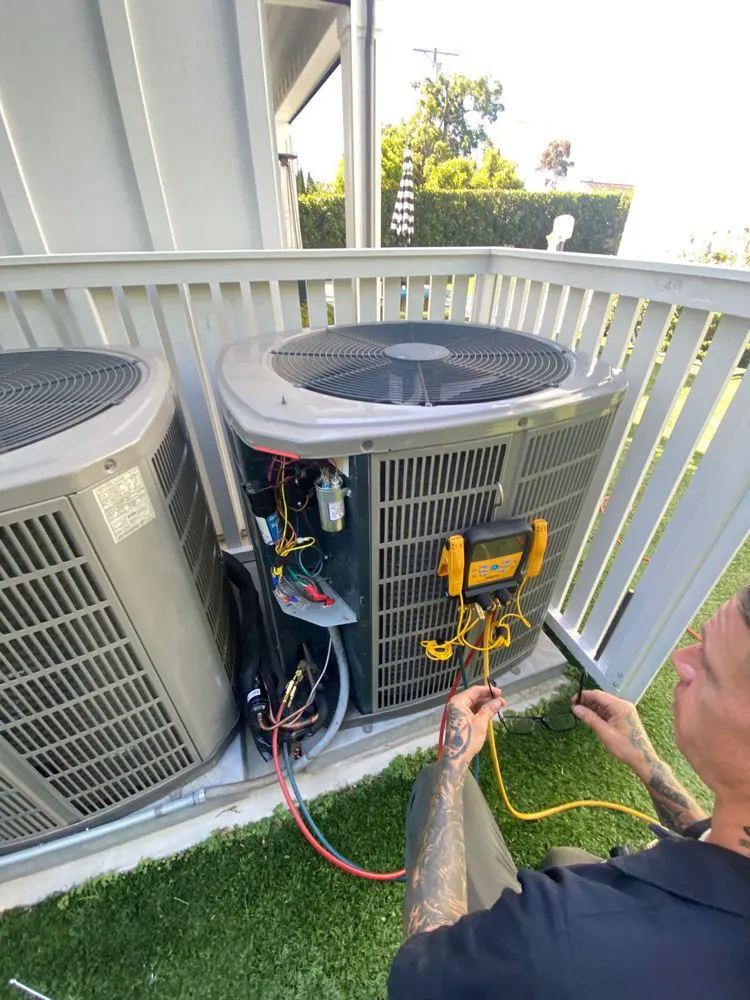
The click is good news. It is the relay inside the thermostat closing to call for cooling, which means the thermostat has power and is doing its job. The problem is somewhere between that click and the outdoor unit. In most houses around Pasadena, CA and the San Fernando Valley, it is one of about six things, and you can rule out half of them yourself in ten minutes.
How the call travels
The thermostat sends a low-voltage signal on thin wires to the control board in the furnace or air handler. That board turns on the indoor blower and passes the cooling call out to the outdoor unit, where a contactor pulls in and starts the compressor and fan. A break anywhere along that chain gives you a click at the wall and silence everywhere else.
So the question is: what is not responding? The indoor blower, the outdoor unit, or both?
- Nothing at all runs. The signal is not getting past the thermostat, or the indoor unit has lost power.
- The indoor blower runs but the outdoor unit does not. The indoor side is fine. Look at the outdoor unit's power and controls.
- The outdoor fan runs but the air is not cold. That is a different problem, usually the compressor or the refrigerant, covered elsewhere.
What you can check yourself
Work down this list in order. Everything here is safe. Stop at anything that involves opening a sealed cover.
1. Thermostat settings. Confirm it is on Cool, not Heat or Off, and set several degrees below the room temperature. On many thermostats, switch the fan from Auto to On. If the indoor blower starts, the thermostat and the control board are communicating and the problem is on the cooling side.
2. Thermostat batteries. A thermostat with weak batteries can still click and still light up while its output is too weak to hold the call. Replace them.
3. The breakers. There are usually two: one for the indoor furnace or air handler, one for the outdoor condenser. Look for one sitting in the middle or on the trip position. Reset it once, firmly off then on. If it trips again, stop and call. Repeated resets can turn a small fault into a compressor failure.
4. The outdoor disconnect. The gray box on the wall near the condenser. Make sure the pull-out or switch is seated and on. Gardeners and painters bump these.
5. The condensate float switch. On a system with the air handler in the attic, and on a lot of closet furnaces, there is a small switch on the drain line or in the overflow pan. When the drain clogs and water backs up, the switch cuts the cooling call. Look for water in the pan under the unit, or at the drain outlet outside. If there is standing water, that is your answer, and the fix is clearing the drain.
6. The furnace door. Furnaces and air handlers have a safety switch on the blower compartment door. If the door was left loose after a filter change, the board will not run. Make sure it is seated and latched. Do not remove it.
7. The filter. Not a cause of silence, but a packed filter can ice the coil and trip a safety. Change it while you are there.
8. The five-minute delay. Most systems will not restart the compressor for a few minutes after a shutdown, and some thermostats add their own delay. If you just changed a setting, wait five minutes before deciding it is broken.
If everything checks out and the outdoor unit still does nothing, or it hums without the fan spinning, the rest of the list is for a tech.
The causes that need a licensed tech
A blown low-voltage fuse. Control boards carry a small automotive-style fuse that protects the thermostat circuit. A shorted wire, a nicked cable at the outdoor unit, or a thermostat wired wrong pops it. Replacing it is simple. Finding why it blew is the actual repair, and it involves the board and the wiring, which are inside the compartment.
A failed contactor. The relay at the outdoor unit that pulls in to start the compressor. Its contacts pit and burn, or the coil fails. Symptom: the indoor blower runs, the outdoor unit is dead, and the thermostat click was the only sound. This is one of the most common single-part repairs on a split system.
A failed capacitor. If the outdoor unit hums or buzzes but the fan does not spin, or the fan spins and the compressor never starts, the run capacitor is the first suspect. Capacitors hold a charge after power is off. Do not touch them.
A failed transformer or control board. The transformer makes the low voltage the thermostat runs on. If it is dead, the thermostat may run on batteries and click while nothing downstream ever hears it.
Damaged thermostat wire. The thin cable runs through the attic and out to the condenser, and it gets chewed, nicked by a shovel, or corroded at the outdoor unit. A break in one conductor takes out one function.
A tripped high-pressure or low-pressure switch. Safety switches inside the outdoor unit lock the compressor out when the refrigerant pressure is wrong. Usually that means a dirty coil, a failed fan, or a leak.
When to call a licensed tech
Call when the breaker trips more than once, when the outdoor unit hums or buzzes, when you smell anything hot or burnt, when you find water you cannot explain, or when you have worked the list above and nothing changed. Do not open the electrical compartment on the condenser or the furnace, and do not touch capacitors or the contactor.
An AC repair visit for this complaint starts at the thermostat and follows the signal out. Most of the time the diagnosis is a single part, quoted in writing before the work starts. If the thermostat itself turns out to be the weak link, replacing it with one that matches your system is a short job.
Common questions
Why does the thermostat click but the fan never starts either?
The call is not reaching the control board, or the board has no power. Check the indoor unit's breaker, the furnace door switch, and the float switch. If those are fine, the low-voltage fuse or the transformer is the usual answer.
The outdoor unit hums but does not start. Can I wait it out?
No. A humming unit is drawing current and not moving. It can overheat the compressor. Turn the thermostat off and call. The usual cause is a capacitor, which is a quick repair when caught early and a compressor when it is not.
Could it be the thermostat itself?
Yes, and a clicking thermostat can still be the failure if its relay contacts are worn. A tech confirms it in a minute by jumpering the call at the control board. If the system runs on the jumper, the thermostat or its wire is the problem.
If you have worked the list and the AC still will not start, book a $69 diagnostic. You are told the price before we schedule, and it is credited toward the work if you go ahead. Call the Boost Services team at 818-277-5056 or send us a message and we will usually be out within a few hours to a day.
Written with AI assistance by Boost Services, Heating and Cooling team, and reviewed by our licensed technicians before publishing. Boost Services Heating and Cooling, C-20 #1119892.