
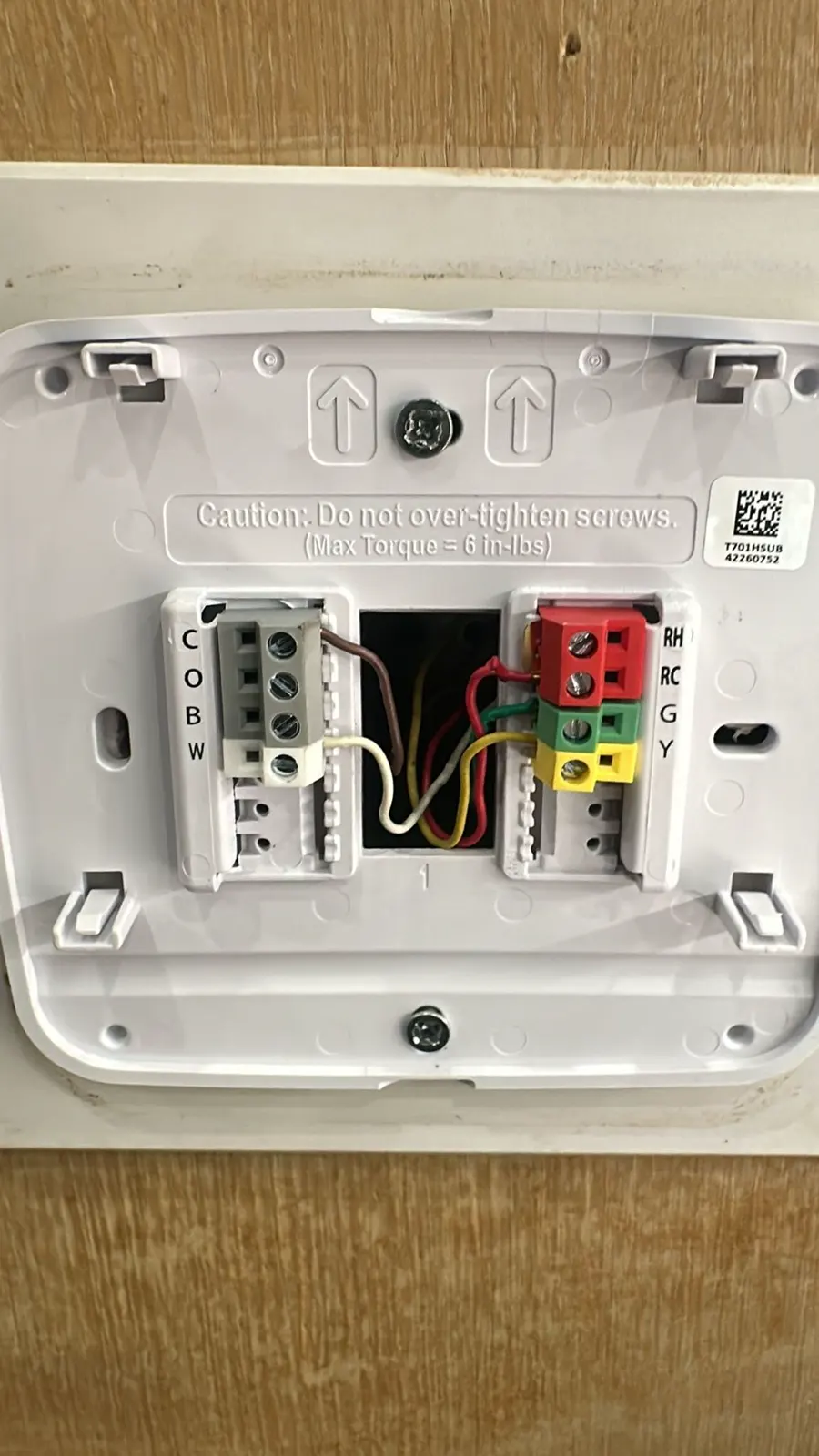
The C-wire is the wire that gives a thermostat continuous power. Old thermostats did not need one because they ran on batteries or nothing at all. Smart thermostats with wifi and a color screen do, and a lot of houses in the San Gabriel and San Fernando valleys were wired before anyone thought of that. If your new thermostat keeps rebooting, or the furnace clicks on by itself for a few seconds, this is usually why.
What the C-wire actually does
Your furnace or air handler has a transformer that puts out 24 volts for the controls. The R wire carries it to the thermostat. When the thermostat wants heat, it connects R to W. Cooling is R to Y, the fan is R to G.
Notice that the thermostat is only closing switches. Nothing in that setup powers the thermostat itself. To run a screen and a wifi radio, the thermostat needs a complete circuit: 24 volts in on R, and a path back to the transformer. The C wire, for "common," is that return path.
Without it, some smart thermostats sip power through the W or Y wire while the system is idle. That is called power stealing. On some furnaces it works. On others the trickle is enough to make the board think it has a call, so the furnace clicks, the inducer spins for a second, then stops. Or the thermostat runs its battery down on wifi and reboots. Same root cause.
Wire colors and what they usually mean
Colors are a convention, not a rule. Whoever wired your furnace may have used whatever was on the truck, so the terminal letter is the fact and the color is a hint. The usual pattern:
- Red (R, Rh, Rc): 24-volt power from the transformer.
- White (W, W1, W2): call for heat. W2 is the second stage on a two-stage furnace or the backup strips on a heat pump.
- Yellow (Y, Y1, Y2): call for cooling, or for the compressor on a heat pump.
- Green (G): indoor blower fan.
- Blue or black (C): common. The return path. This is the one you are looking for.
- Orange (O) or dark blue (B): the reversing valve on a heat pump. Which one depends on the brand.
Pull the thermostat off its base. Five or more wires with one landed on C, and you have a C-wire and can stop reading. Four wires on R, W, Y, and G with C empty is the usual picture in a 1950s or 60s ranch that got central air added later.
The unused wire trick
Before anyone runs new cable, look for a wire that is already there and not being used. Thermostat cable comes in bundles of five, seven, or eight conductors, and installers often pull a five-wire cable and only connect four. The fifth wire is folded back into the wall behind the thermostat, and its other end is folded back at the furnace control board.
If you see a spare wire at the thermostat, the other end is probably sitting loose at the furnace. Landing it on the C terminal at both ends solves the problem with no new cable. It is low-voltage work inside the furnace cabinet with the power switch off, quick for a tech, and the first thing we check on a thermostat call.
Your options if there is no spare wire
In order of how often they make sense:
- A power extender kit. The thermostat makers sell a small module that mounts at the furnace board. It uses the existing four wires to deliver both the fan signal and the common. Reliable, and no new cable through the wall. Some thermostats include one in the box.
- Repurpose the G wire. If you can live without running the fan on its own from the thermostat, the G wire can be reconnected as the C wire at both ends, with a jumper at the board so the fan still runs with heating and cooling. You lose the "fan only" setting. Not ideal if you use fan circulation on smoke days.
- Run new thermostat cable. The right answer when the old cable is damaged or the run is short. In a single-story ranch with the furnace in the attic above, it is often an easy pull. In a two-story Spanish revival with plaster walls, it is not.
- A thermostat that does not need a C-wire. Some models are designed for four-wire systems. Whether power stealing behaves depends on your furnace board, so it is a try-and-see, and the clicking symptom above is what "no" looks like.
Where a C-wire does not apply
- Wall and floor furnaces. Most of the gas wall and floor furnaces in the Craftsman bungalows around Pasadena, CA, Altadena, and South Pasadena are millivolt systems. There is no 24-volt transformer, so there is nothing for a C-wire to connect to. These take a simple battery thermostat made for millivolt, or none at all.
- Mini splits. They are controlled by their own remote or a brand-specific wifi adapter, not a wall thermostat with a C-wire.
- Line-voltage heat. Electric baseboards use a different thermostat entirely, and that wiring is a separate licensed trade.
What you can check yourself
Thermostat wiring is 24 volts and safe to look at, but turn off the furnace power switch before you touch any terminals. Then:
- Pull the thermostat off its base and photograph the wires and terminal labels. You want that photo whether you do the work or not.
- Count the conductors coming out of the wall. Look for one folded back and unused.
- Note the terminal letters, not just colors.
- If the thermostat is already installed, its settings will usually say whether it detects a C-wire.
Do not pull furnace panels beyond the filter door, and do not land wires on the board unless you know exactly which terminal is which. A wire on the wrong terminal can blow the low-voltage fuse, or the board.
When to call a licensed tech
Call if there is no spare wire and you want the power extender or the G-wire option done right, if the thermostat is installed and the furnace is clicking or cycling on its own, if the low-voltage fuse has blown, or if the furnace is in a tight attic or closet where getting to the board is a job. Also call if the wiring looks brittle or spliced. A wiring fault that only shows up in one mode is one of the things we look for on a furnace repair visit, and it is worth having the wiring checked during regular maintenance so the next thermostat swap is painless.
Common questions
Can I use the G wire as a C wire?
Yes, on most standard furnaces, if you accept losing the independent fan-only setting. It needs a jumper at the furnace board so the blower still runs with heating and cooling calls. It is a compromise, not a fix; the power extender kit is usually the better route.
Is the C wire always blue?
No. Blue and black are the most common, but any color can be landed on C. Go by the terminal letter, and if the wire at the thermostat is not on any terminal, trace it at the furnace end.
Does a heat pump need a C wire?
Same rule as a furnace. Heat pumps also use the O or B wire for the reversing valve, so they need more conductors, and a C-wire is usually expected.
If you would like the wiring checked and the C-wire sorted out, our diagnostic is $69, quoted before we book and credited toward the work if you go ahead. Boost Services Heating and Cooling answers at 818-277-5056 or reach us here.
Written with AI assistance by Boost Services, Heating and Cooling team, and reviewed by our licensed technicians before publishing. Boost Services Heating and Cooling, C-20 #1119892.