
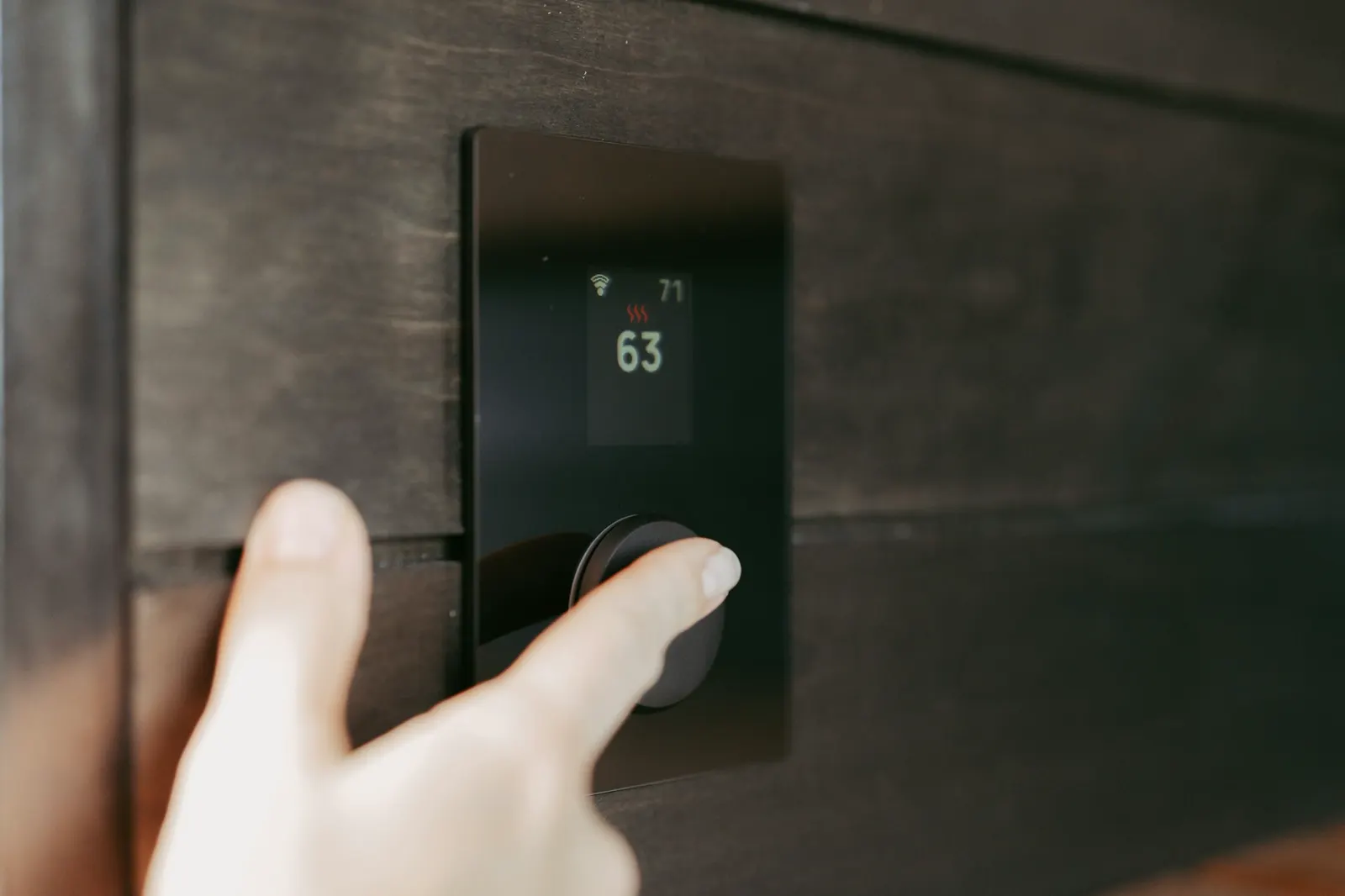
A smart thermostat saves money when it changes how long your system runs. That is the whole answer. If you already turn the AC up when you leave and down when you get home, the thermostat will not find much to save. If the house sits at 72 all day while everyone is at work, it will.
The rest of this post is about which kind of house you have, and a few situations where a smart thermostat makes things worse.
Where the savings actually come from
There is no efficiency trick inside a smart thermostat. Your furnace and AC burn exactly what they burned before. The only savings lever is runtime, and the thermostat pulls it three ways:
- Setbacks you would not have done yourself. The system coasts while the house is empty and recovers before you get back. The Department of Energy's home upgrades guidance says you can save "as much as 10% a year on heating and cooling" by turning the thermostat back 7 to 10 degrees for eight hours a day. That is an upper bound, not an average, and a schedule is the only way most people do it consistently.
- Catching the forgotten AC. A long weekend away with the AC at 74 in August. Geofencing or a vacation mode catches it.
The EPA's Energy Star program says certified smart thermostats save roughly 8 percent on heating and cooling bills on average. That is a national average that includes cold-climate houses with long furnace seasons. Your number depends on what you do now.
Why the local climate tilts it toward cooling
In Pasadena, CA and across the San Gabriel and San Fernando valleys, the cooling season runs from May into October and the heating season is short and mild. So the savings question is mostly an AC question.
That helps in one way. Cooling setbacks work well here because the dry air means the house does not get clammy while the system coasts, and a well-insulated house holds its temperature for hours. A 1960s ranch in Northridge with attic ducts is different: the attic hits 130 degrees by 2 pm and the house heats up fast once the AC stops. The thermostat still saves runtime, but the gap between "away" and "home" should be smaller, maybe 4 to 6 degrees rather than 10.
It hurts in one way too. Heat-wave afternoons are when your AC is already struggling, and a thermostat that lets the house drift to 82 while you are out is asking a system rated at 95 degrees outdoor to pull the house down at 108. On those days, a smaller setback is smarter than a big one.
Situations where it does not pay
Be honest about these before you spend anything.
- You already manage it by hand. The thermostat automates what you already do.
- Someone is home all day. A retiree, a home office, a newborn. No empty hours, no setback, no savings.
- A wall or floor furnace. Most Craftsman bungalows in Pasadena, Altadena, and South Pasadena heat with a gas wall or floor furnace on a millivolt system. Those run on a tiny voltage from the pilot and cannot power a smart thermostat. Some have no thermostat at all. A battery thermostat made for millivolt systems is what works with them.
- Mini splits. They use their own remotes or a brand-specific wifi module, not a wall thermostat. A smart thermostat does nothing for a ductless system.
- No C-wire. Many older furnaces have a four-wire thermostat cable with no common wire. Some smart thermostats work without one, some misbehave. This usually shows up as clicking or the furnace turning on for a few seconds by itself. It is fixable, but it is a wiring visit.
The heat pump warning
If you have a heat pump, the setback math changes. Heat pumps produce heat slowly and steadily. When you ask one to raise the house 8 degrees in a hurry on a January morning, most thermostats will bring on the electric backup strips to close the gap, and strip heat costs a lot more per hour of heating than the heat pump does. You can wipe out a month of savings in a few cold mornings.
The fix is a smaller setback in heating mode, 2 to 4 degrees, and a thermostat configured for a heat pump. Ask about this when you have a heat pump installed; the wrong thermostat is a common reason a new system's first winter bill disappoints.
What a smart thermostat is genuinely good at
Beyond the savings:
- Remote sensors. The thermostat lives in the hallway. The bedrooms are 5 degrees warmer at night in a two-story house. A remote sensor lets you average or prioritize the room you are in. Real comfort gain in the two-story Spanish revivals around the SGV, and in any house with a hot west-facing bedroom.
- Runtime history. If daily runtime creeps up with the same weather, something is wrong, and the graph shows it before the bill does.
- Utility programs. Some local utilities run thermostat programs that nudge your setpoint during grid peaks in exchange for a credit. Check the current program before you buy.
If your house has a hot upstairs and a cold downstairs, the sensor helps, but the real fix is usually zoning or duct work.
What you can check yourself
- Look at your current thermostat's wiring. Pull it off its base (low voltage, safe to look at) and count the wires. Five or more with one on a terminal marked C, and you are set. Four, and you may need a wiring fix.
- Check whether your furnace or air handler is a standard 24-volt system. If it is a wall or floor furnace, or a mini split, a wall smart thermostat is not the right product.
- Be honest about your habits. If you never adjust the thermostat, a schedule will save something. If you adjust it constantly, it will save less.
When to call a licensed tech
Call if there is no C-wire, if the thermostat you bought keeps rebooting or the furnace short cycles after the install, if you have a heat pump and are not sure the thermostat is configured for it, or if the system is two-stage or variable-speed and you want the thermostat to actually use those stages. A mis-set thermostat on a two-stage system will run it in high stage all the time and cost you the efficiency you paid for. Our thermostat visits cover the wiring, the configuration, and a check that the system responds correctly in both heat and cool.
Common questions
How long does it take a smart thermostat to pay for itself?
It depends on your bill and how much runtime the schedule actually removes. In a house that sits empty on weekdays with a large summer bill, it can be a season or two. In a house where someone is always home, it may never pay back on energy alone.
Will a smart thermostat work with my old furnace?
Usually, if the furnace uses a standard 24-volt thermostat and there is a C-wire or a way to add one. It will not work with millivolt wall or floor furnaces or with line-voltage electric baseboard heat.
Is a programmable thermostat just as good?
For the setback savings, yes, if you program it and leave it programmed. Most people do not. The smart thermostat's advantage is that it learns or gets set from a phone, so the schedule actually exists.
If you want to know whether your system and wiring can take a smart thermostat, we can check it during a $69 diagnostic visit, quoted before booking and credited toward any work you go ahead with. Boost Services Heating and Cooling answers at 818-277-5056 or get in touch here.
Written with AI assistance by Boost Services, Heating and Cooling team, and reviewed by our licensed technicians before publishing. Boost Services Heating and Cooling, C-20 #1119892.