
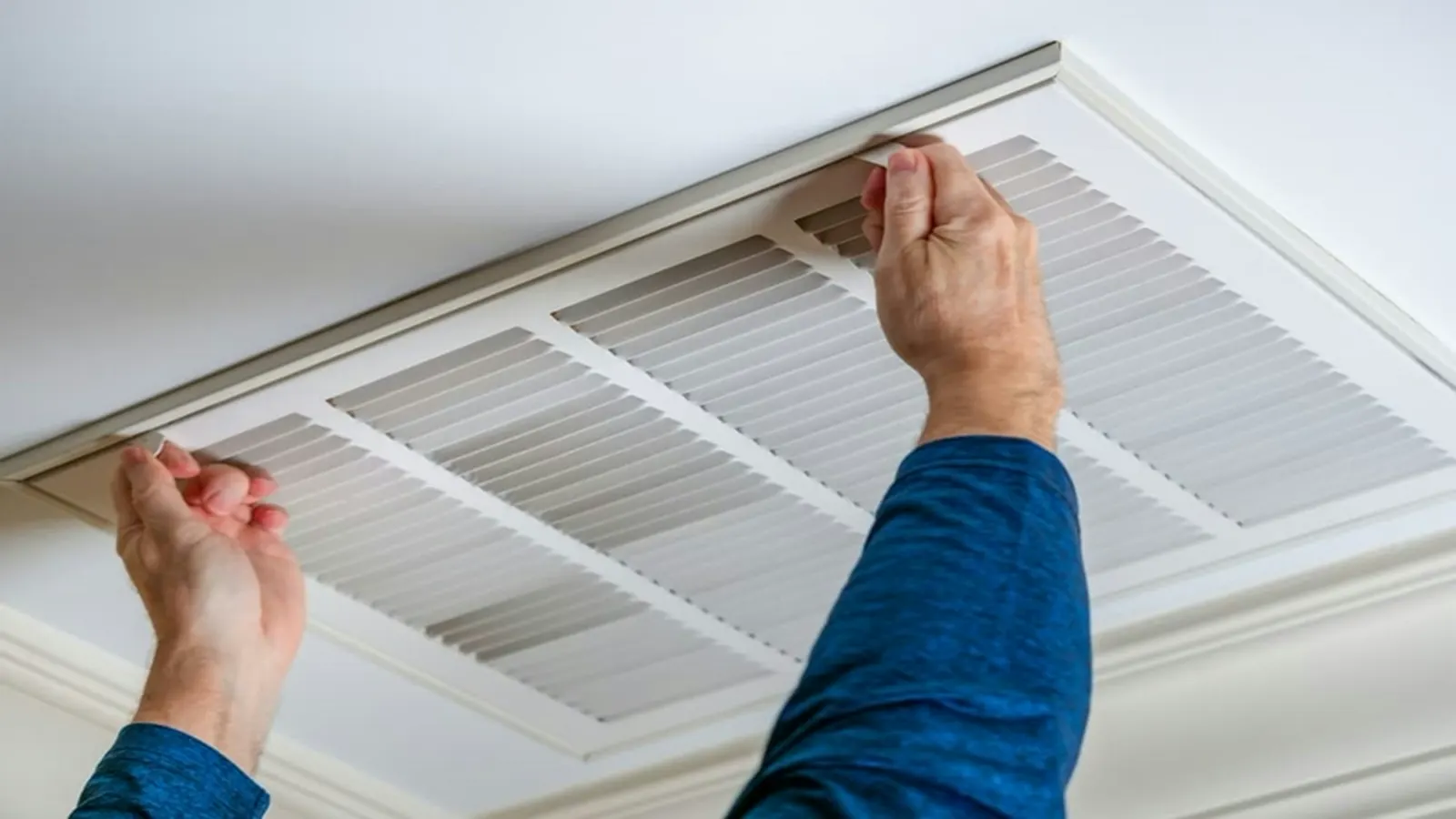
Change a standard 1-inch pleated filter roughly every one to three months, sooner on smoke days and in homes with pets, and put it in with the arrow pointing toward the furnace. That is most of it. The rest of this guide covers how to tell when a filter is done, which MERV rating your system can actually handle, and the mistakes that cost people a frozen coil in August.
Why the filter matters more than people think
The filter is there to protect the equipment first and your lungs second. Everything the blower pulls in passes through it. When it is clean, the blower moves the airflow the system was designed around. When it is packed, airflow drops, and two things happen: in cooling season the indoor coil gets too cold and ices over, and in heating season the furnace overheats and trips its high-limit switch. Both look like a broken system. Both start with a filter that should have been changed a month earlier.
Around Pasadena, CA the filter has a harder job than the box suggests. Santa Ana winds carry dust, wildfire smoke can sit over the Valley for days, and a lot of homes have the return grille pulling from a hallway right under a 130°F attic. A filter that lasts three months in a sealed house may last five weeks here in October.
How often, really
- 1-inch pleated filters: typically every one to three months. Check monthly during the cooling season, May through October, when the system runs the most.
- 4-inch and 5-inch media filters (the thick ones in a cabinet at the furnace): typically every six to twelve months. Follow the cabinet's label.
- Washable filters: rinse monthly and let them dry completely before reinstalling. A damp filter grows things.
- Sooner than the schedule if you have pets, someone with asthma or allergies, construction dust, or a smoke event. On heavy smoke days it is reasonable to check the filter weekly.
None of these numbers are a rule. They are the range most manufacturers print. The honest answer is: look at it.
Signs it is time to change the filter
- It is grey or matted, and you cannot see light through it.
- Airflow at the supply registers is weak, or the return grille whistles.
- The system runs longer than it used to and rooms do not reach the setpoint.
- Dust is collecting on the return grille and on furniture faster than usual.
- There is a musty smell when the fan starts. That can also be the drain pan or the coil, so change the filter first and see.
- The AC is icing up, or the furnace shuts off and restarts on its own. Both are airflow problems until proven otherwise.
Choosing the right filter
Size. It is printed on the frame of the one you have. Filters are sold by nominal size; the actual size is a fraction smaller, so a 16x25x1 slot takes a 16x25x1 filter even though the filter measures a bit under that. If the frame has no label, measure the slot.
MERV rating. MERV runs from 1 to 16 and tells you how small a particle the filter catches. The EPA's guidance is to choose at least a MERV 13, or as high a rating as your system's fan and filter slot can accommodate. That second clause is the important one. A MERV 13 in a 1-inch slot on an older blower can restrict airflow enough to cause the icing and overheating problems above. On most older systems in the Valley, MERV 8 to 11 in a 1-inch slot is the safe range, and the way to run MERV 13 is a 4-inch media cabinet, which has far more surface area and far less resistance. Ask at your next tune-up what your blower can take.
HEPA. The EPA defines a HEPA filter as one that can theoretically remove at least 99.97% of particles at 0.3 microns. True HEPA does not fit a standard furnace filter slot; the resistance is too high for a residential blower. It lives in a dedicated whole-home purifier or a portable unit. Anything sold as "HEPA-type" for a furnace slot is a pleated filter with a marketing name.
Skip the thin fiberglass "see-through" filters unless your equipment manual says to use them. They protect the blower from large debris and not much else.
What you can check yourself
Replacing a filter is safe. Do it this way.
- Turn the system off at the thermostat so the blower is not running while the slot is open.
- Find the filter. It is in one of three places: behind the return grille in a wall or ceiling, in a slot on the side or bottom of the furnace or air handler, or both. Some homes have two or three return grilles and a filter in each.
- Slide out the old one. Before you toss it, note the arrow on the frame. It shows airflow direction.
- Slide in the new one with the arrow pointing toward the furnace or air handler and away from the room. At a return grille that means the arrow points into the duct.
- Make sure the frame sits flat with no gap around the edges. Air takes the easiest path, and a gap lets dust straight past the filter onto the coil.
- Close the grille or the slot door, write the date on the filter's edge, and turn the system back on.
Mistakes that cause real damage
- Installing it backward. The filter still catches dust, but the pleats collapse sooner and airflow suffers.
- Forcing the wrong size and crushing the frame to fit.
- Running the system with no filter "for now." A month of that coats the indoor coil, and a coil cleaning is a much bigger job than a filter.
- Forgetting the second return. If one grille has a filter and the other does not, half the air is unfiltered.
- Leaving a "3-month" filter in for a year because the system seemed fine.
- Putting a MERV 13 in a 1-inch slot on an old system because a higher number sounded better.
When to call a licensed tech
A fresh filter should fix a filter problem. If the airflow is still weak, the coil ices again, the furnace keeps cutting out, or the dust comes back within days, the filter was not the cause. The usual suspects are a dirty evaporator coil, leaking or crushed attic ducts, a failing blower motor, or a return that is too small for the system. Those need a diagnostic, not another filter.
Common questions
Can a high-MERV filter hurt my system?
It can if the blower and slot were not designed for it. The symptom is weak airflow, an icing coil in summer or a furnace tripping on its limit in winter. If you want MERV 13 filtration, the safe route on an older system is a media cabinet, not a thicker filter jammed into a 1-inch slot.
Where is my filter if I cannot find it?
Follow the return air. Find the large grille that pulls air in (it will hold a piece of paper against it when the fan runs) and check behind it. If it is empty, the filter is at the furnace or air handler, usually in a slot where the return duct meets the cabinet.
Should I change the filter after a smoke day?
Check it. Wildfire smoke loads a filter fast, and a filter full of fine ash restricts airflow just like dust does. If it looks grey, change it. People with asthma often notice the difference the same day.
Our diagnostic is $69, quoted before we book and credited toward the work. Boost Services Heating and Cooling answers at 818-277-5056, 6am to 10pm, seven days a week, or book online.
Written with AI assistance by Boost Services, Heating and Cooling team, and reviewed by our licensed technicians before publishing. Boost Services Heating and Cooling, C-20 #1119892.