
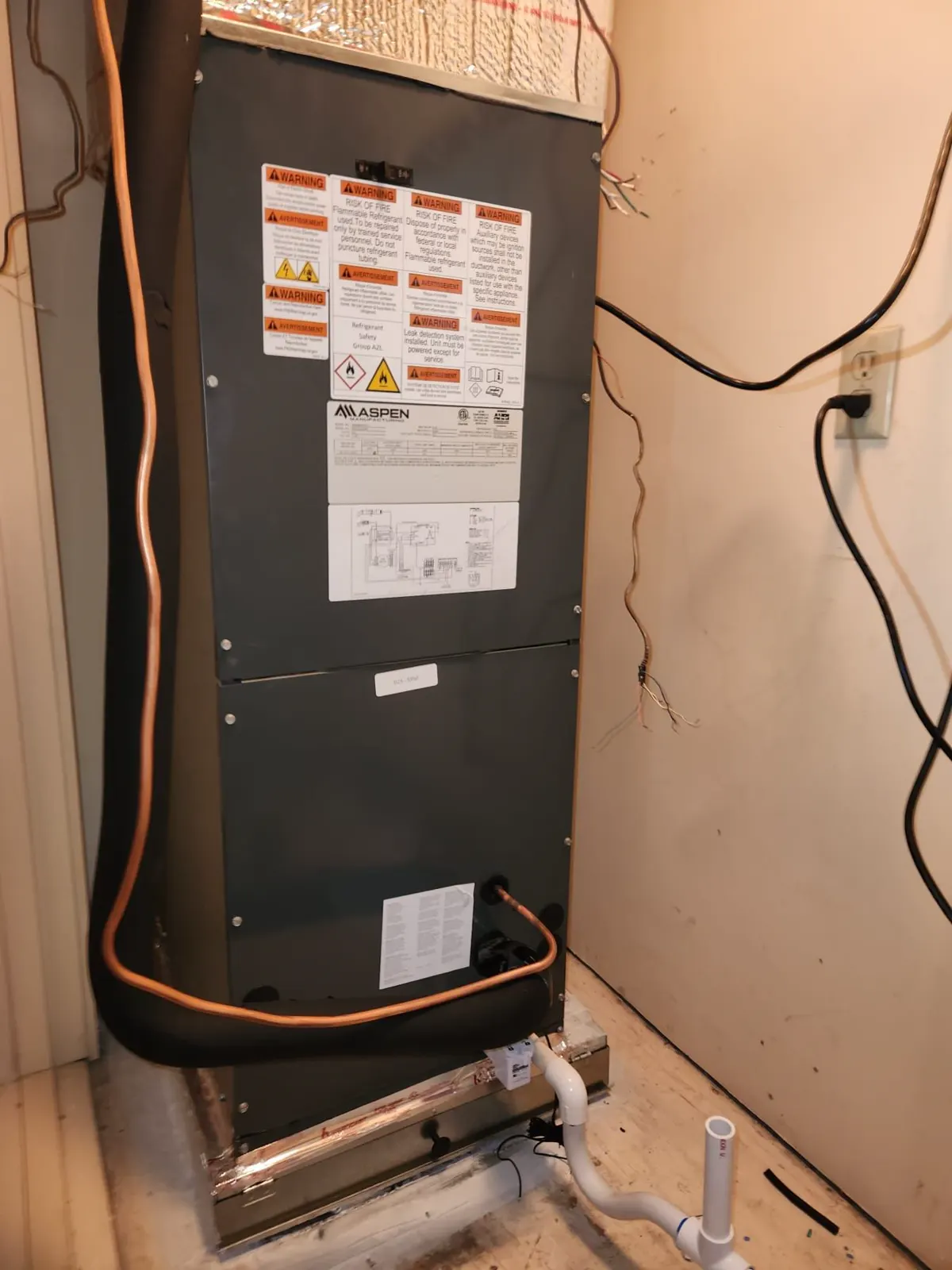
Efficient equipment is one of four things that decide your heating and cooling bill. The others are how well the house holds what you paid for, how the system was installed, and how you run it. Buy the highest rating on the shelf and drop it onto leaky ducts in a house in Pasadena, CA with original windows, and the bill barely moves. The order below is the order that pays.
Start with the house, not the box
Anything you fix in the building envelope reduces the load the equipment has to meet, which means smaller equipment, shorter run times and a smaller bill for the life of the system. Sealing air leaks, improving what sits between the conditioned rooms and the attic, and shading west-facing glass all shrink the load before you spend anything on a unit. None of those three are our work; sealing and insulating a building shell and anything to do with windows are separate licensed trades. What is ours is the duct system and the equipment.
The one piece of building work that belongs in an equipment conversation is the duct system, because it sits between the equipment and you. Air lost from supply ducts in a 130-degree attic is air you paid to cool.
Sizing decides more than the rating does
A Department of Energy guide for contractors puts sizing first: equipment sized with an ACCA Manual J load calculation, selected with Manual S, and ducts sized with Manual D. Energy Star tells homeowners the same thing, and says to ask your contractor to verify the size with Manual J.
Oversizing is the more common mistake and the expensive one. A unit too large for the load satisfies the thermostat quickly, shuts off, and starts again minutes later. Short cycles are the least efficient part of any run, they wear the compressor, and they leave the house uneven. A replacement sized off the tonnage of the old unit repeats whatever mistake was made the first time.
The labels worth reading
Two are worth reading: the ENERGY STAR mark and the EnergyGuide label. A Department of Energy home-cooling guide puts ENERGY STAR qualified air conditioners at up to 15 percent more efficient than standard models.
Two things to ask for beyond the label. First, the rating that applies to the exact combination of outdoor unit and indoor coil being quoted, not the headline number for the outdoor unit alone. Second, whether the system is single-stage, two-stage or variable capacity. A variable capacity unit runs often but at low speed, which is quieter and typically holds humidity down better in spring and fall. In a climate with a long shoulder season and a lot of mild evenings, that matters more here than the peak rating does.
If the quote is for a heat pump, the heating rating matters as much as the cooling one, since the same box does both. Heat pump installation is worth pricing alongside a straight air conditioner replacement when the furnace is also near the end.
Installation quality is part of the efficiency
The rating on the box is measured in a laboratory on a matched system with correct charge and correct airflow. Everything that pulls the field installation away from those conditions pulls the efficiency down with it. This is a good checklist to hold a quote against:
- Correct sizing by Manual J and selection by Manual S, with duct sizing by Manual D.
- Enough supply and return registers for the air to actually move.
- Ductwork inside conditioned space where possible, rather than attics or garages.
- All ducts sealed with duct mastic and properly insulated.
- The condensing unit placed where its noise will not disturb you or your neighbors, and where airflow is not obstructed.
- Refrigerant charge and airflow rate verified against the manufacturer's specification.
- The thermostat located centrally, away from windows and supply registers.
Charge and airflow get skipped most often, and they are the two that decide whether you get the rating you paid for.
What California requires when you replace
Replacing equipment brings the energy code with it. Under Section 150.2(b)1E of the 2025 Building Energy Efficiency Standards, altering a space-conditioning system by installing or replacing the air handler, the outdoor condensing unit of a split-system air conditioner or heat pump, or a cooling or heating coil requires the connected duct system to be sealed, confirmed through field verification and diagnostic testing. Ducts previously sealed and documented, systems under 40 linear feet, and asbestos-containing ducts are excepted.
Budget for the duct sealing and the verification test as part of the job rather than as a surprise, and ask for both to be itemized in the written quote.
Utility programs change. Pasadena Water & Power and LADWP have had heat-pump incentives; check the current program before you buy.
The settings that cost nothing
- Set the thermostat as high as is comfortable in summer and as low as is comfortable in winter, and change the setting when you are asleep or out.
- Run the system fan on auto rather than on, and use room fans for extra circulation.
- Change or clean filters on the schedule the manufacturer or your contractor gives you. In this climate, look at the filter monthly through cooling season and replace it when light will not pass through.
- Keep the area around the outdoor unit clear, and cut back any planting that has grown in against the cabinet.
- Use curtains and blinds against afternoon sun on west-facing glass.
What you can check yourself
- The data plate on your outdoor unit: tonnage, refrigerant type, and the manufacture year encoded in the serial number.
- Whether the filter is the right size for the slot and seated without a gap around the edge.
- Whether every room has a return path, or whether doors have to stay open for the house to stay even.
- Which rooms run warm or cold compared with the thermostat's room. That pattern is duct information, and it belongs in the conversation before you pick equipment.
When to call a licensed tech
Before you shortlist equipment. A load calculation and a look at the ducts settle the size and the type, and those two decisions outrank the rating on the label. We quote AC installation in writing with the equipment, the testing and the thermostat listed separately. If the existing system is still serviceable, an HVAC maintenance visit that restores charge and airflow often recovers more than a new label would.
Common questions
Is a higher SEER always worth the extra money?
Not always. The payback depends on how many hours the system runs, what you pay per kilowatt-hour and how long you plan to stay. In a house that cools hard from May into October, higher ratings earn more than they do in a mild pocket. Ask for the quote at two ratings and compare.
Does an efficient unit fix a hot room?
Usually not. A single room that never keeps up is almost always a duct, airflow or insulation problem. New equipment makes the same air in the same wrong quantity.
Should I replace the furnace and the AC at the same time?
If both are near the end, the matched-system argument is strong and the labor overlaps. If only one is failing, a replacement that matches the surviving half is usually the better call. Ask for both priced.
If you want the size and type settled before you shop, book a $69 diagnostic. We tell you the fee before booking and credit it toward the work. Boost Services Heating and Cooling answers at 818-277-5056 or send us a message.
Written with AI assistance by Boost Services, Heating and Cooling team, and reviewed by our licensed technicians before publishing. Boost Services Heating and Cooling, C-20 #1119892.