
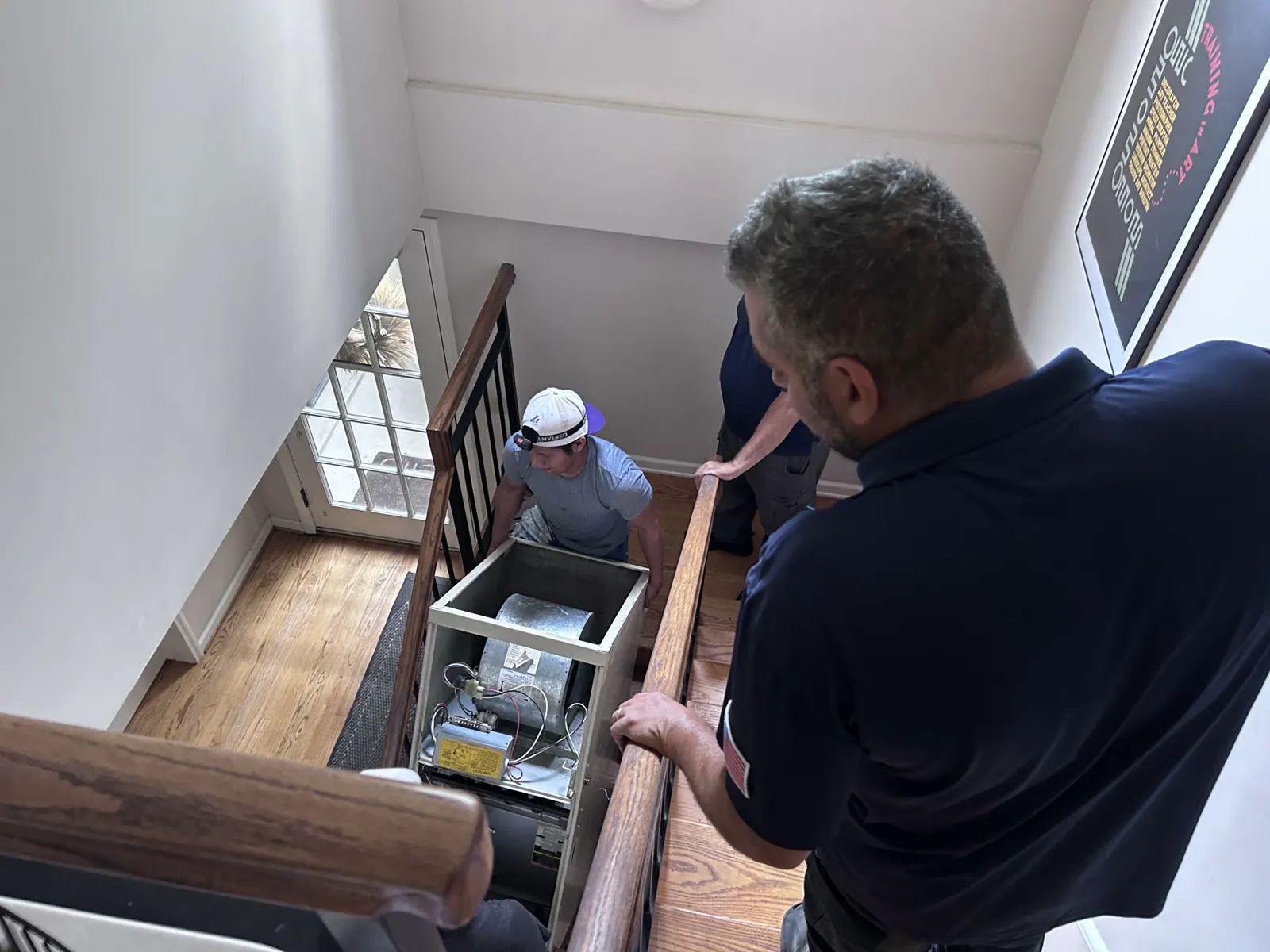
Federal efficiency standards do not set furnace prices, but they do decide what manufacturers are allowed to build, and that has a real effect on what ends up on your quote. The rule that matters for gas furnaces is the Department of Energy's consumer furnaces rule, and the part homeowners care about is what it does to the venting in an older house.
What the rule actually says
DOE published its final rule for consumer furnaces in the Federal Register on December 18, 2023, at 88 Fed. Reg. 87,502. Two product classes are covered: non-weatherized gas furnaces, which is what nearly every house around here has, and mobile home gas furnaces.
The adopted standard is a minimum of 95% AFUE for both classes. AFUE, annual fuel utilization efficiency, is the ratio the rule uses to express how much of the fuel a furnace burns actually becomes heat in the house over a season. For comparison, the federal minimum in force today for both of those classes is 80% AFUE, set by DOE's November 2007 final rule.
Two details in the text matter more than the number:
- Compliance is required on and after December 18, 2028, per DOE's own consumer furnaces page.
- The standard applies, in the rule's words, to products "manufactured in, or imported into, the United States" starting on that date. It is a rule about what gets built, not a rule about the furnace already sitting in your closet.
On technology, DOE was careful. It wrote that "the NWGFs and MHGFs that currently achieve 95-percent AFUE do employ condensing technology," while insisting the standard itself is performance-based and "do[es] not preclude new or alternative heat exchanger designs, venting systems, or materials." Read plainly: as things stand, hitting 95% means a condensing furnace.
The date is being contested
This is not settled, and anyone telling you it is has not read the docket. On February 19, 2026, DOE received a petition from the American Gas Association, the American Public Gas Association and the National Propane Gas Association asking it to move the compliance dates for the consumer furnace rule and a commercial water heating rule "until January 1, 2030, at a minimum." DOE published a notification of petition for rulemaking under docket EERE-2026-BT-STD-0001 and asked for public comment on whether to grant it.
So the honest position today is: December 18, 2028 is the date on the books, and there is a live request to push it. Neither changes what you should do about a furnace that is failing now.
What "condensing" changes in an old house
A conventional furnace sends hot exhaust up a metal flue. A condensing furnace pulls so much heat out of that exhaust that the water vapor in it condenses, which is where the extra efficiency comes from. Two consequences follow, and in Pasadena, CA housing they are usually the expensive part of the job rather than the equipment itself.
Venting. Condensing furnaces typically vent through plastic pipe out a sidewall rather than up the old metal flue, because the exhaust is no longer hot enough to rise reliably. In a 1920s bungalow with the furnace in a hallway closet, finding a legal route for that pipe to an exterior wall is real work. The old flue then has to be dealt with rather than left open, especially if another gas appliance was sharing it.
A drain. Condensate has to go somewhere, continuously, whenever the furnace runs. A furnace in a garage often has somewhere to send it. A furnace in a closet in the middle of the house frequently does not, and the answer becomes a condensate pump and a line routed to a drain.
None of this is exotic. It is just work that a like-for-like swap of an 80% furnace does not involve, and it is why two quotes for "a new furnace" on two different houses can look nothing alike.
What drives the price of the job
In order of how often it decides the number:
- Whether the furnace can vent where the old one did, or needs a new route.
- Where the condensate can go, and whether a pump is needed.
- Capacity, which should come from a load calculation on the house, not from copying the data plate on the old unit.
- The condition of the ducts. Replacing equipment on leaking ducts wastes the efficiency you just paid for, and replacing an air handler, condenser or coil triggers third-party duct leakage testing under the California energy code anyway.
- Permits and that testing.
- Access. A closet, an attic and a garage are three different days of work.
What you can check yourself
- Find the data plate on your furnace. It lists the model, the input rating in BTU/h, and usually the AFUE. That tells you what you have before anyone quotes you.
- Look at the flue. A metal pipe going up means a conventional furnace. White plastic pipe out a wall means you already have a condensing unit, and the venting question is mostly answered.
- Look for a drain near the furnace, and note whether anything else is vented into the same flue.
- Note the age. The serial number usually encodes the build year, and a manufacturer's site or a technician can decode it.
When to call a licensed tech
Sizing, venting and combustion are the three things that go wrong when a furnace is replaced badly, and all three need someone licensed looking at the actual house. Get a load calculation rather than a guess, get the venting route drawn before the work starts, and get the quote in writing. That is what a furnace installation visit is for, and if the system is on the edge rather than dead, a heating service call is the cheaper first step.
Common questions
Do I have to replace my furnace in 2028?
No. The rule governs what manufacturers may build and import from the compliance date. It does not require anyone to remove or replace a working furnace, and it does not make your current furnace illegal to repair.
Is a heat pump a way around this?
It is a different path, not a loophole. A heat pump is not a gas furnace and is not covered by this rule, and in our climate it handles both heating and cooling from one system. Whether it makes sense depends on the house, the existing ducts and what power is already available at the panel, which is worth a real conversation before a furnace dies rather than after. Heat pump installation is its own decision.
Should I buy now to get ahead of the rule?
Buying equipment you do not need yet is rarely the right call, and the compliance date may move. Replace a furnace when it is unsafe, unreliable, or costing you more in repairs than it is worth. If yours is close, the useful move is to have the venting and drain questions answered now, so the quote is not a surprise later.
Our diagnostic is $69, quoted before we book and credited toward the work. Call the Boost Services team at 818-277-5056, 6am to 10pm, seven days a week, or book online.
Written with AI assistance by Boost Services, Heating and Cooling team, and reviewed by our licensed technicians before publishing. Boost Services Heating and Cooling, C-20 #1119892.