
The price of a new air conditioner is mostly not the box. It is the size of the box, the efficiency you choose, what has to change in the house to make it work, and the labor and permitting behind a job done to code. Two houses on the same street in Pasadena, CA can get very different quotes for good reasons. This post walks through what they are, so you can read a quote line by line instead of comparing totals.
Capacity, and why bigger is not better
Systems are sized in tons. One ton is roughly 12,000 BTU per hour of cooling. A tech should size the system from a load calculation (the trade calls it a Manual J) that accounts for square footage, insulation, window area and orientation, ceiling height, and afternoon sun.
Undersizing looks like savings and oversizing looks like generosity. Both are mistakes. An oversized unit cools the air quickly and shuts off before it evens out the rooms, then starts again a few minutes later. That short cycling wears the compressor out. An undersized unit runs all day in August and never gets there.
A tonnage quoted without anyone measuring the house is a guess.
Efficiency rating
Every new system carries a SEER2 rating and has to meet a federal minimum, so the floor is already reasonably efficient. Above that floor, a higher SEER2 usually means a two-stage or variable-speed compressor, more expensive equipment, and lower running cost over the years the system is in service.
Whether that trade makes sense depends on run time. A house in Altadena that runs the AC from May to October gets more back from a high-efficiency unit than a shaded house that runs it a few weeks a year. A Department of Energy home-cooling guide puts ENERGY STAR qualified units at up to 15% more efficient than standard models.
Equipment type
- Single-stage compressors are on or off. Cheapest, adequate, and the loudest at startup.
- Two-stage compressors run at a lower speed most of the time and step up in a heat wave. Quieter and more even.
- Variable-speed systems modulate continuously. The most expensive option, and usually the quietest and most even.
- Heat pumps cool exactly like an AC and heat as well, replacing the furnace. The outdoor unit costs somewhat more than a cooling-only condenser, but it takes the furnace off the list.
Brand matters less than people think. We install and service American Standard, Bryant, Carrier, Daikin, Goodman, Lennox, Mitsubishi Electric, and York, and within a tier they are more alike than different. Installation quality matters more than the badge.
The indoor side
A split system has an indoor coil and a blower, either in a furnace or a separate air handler. If the existing furnace is newer and compatible, it can stay and only the coil changes. If the furnace is old, or the coil cannot be matched to the new refrigerant, the indoor unit gets replaced too. Attic installations cost more in labor than closet or garage ones because of access and heat.
Refrigerant plays in here. Under the EPA's AIM Act rules, residential AC and heat pump systems manufactured from January 1, 2025 must use a refrigerant with a global warming potential under 700. In practice that means newer equipment ships with refrigerants such as R-454B or R-32 instead of R-410A, and the indoor coil and line set have to be rated for it. Equipment built before that date can still be installed, which is why some quotes still show R-410A systems.
The ductwork
This is the big variable in our housing stock. The 1950s to 80s ranch homes across the San Fernando Valley and the eastern San Gabriel Valley have original attic ducts. After decades of summers in an attic that hits 130°F and up, the duct insulation has sagged, the tape has let go, and the return is often too small for a modern system. A new condenser hooked up to those ducts will not perform like a new system.
Two California code facts matter here. When a condenser, coil or air handler is replaced, the ducts are tested for leakage (the HERS test, now called ECC verification) and have to pass or be sealed. And new attic ducts in our climate zones must be insulated to R-8 under the 2025 Title 24 standards. A quote that includes duct sealing, resizing, or replacement will be higher than one that ignores the ducts. It will also be the one that works, and the one that passes inspection. Ask every contractor what they found in the attic and what they plan to do about it.
Homes with no ducts at all, like the 1920s bungalows in Pasadena and South Pasadena, are a different job: adding ducts, which is significant work, or going ductless with a mini split.
The electrical side
A new condenser needs a correctly rated circuit and a disconnect at the unit. Replacing a like-for-like unit usually reuses the existing circuit. Going to a larger unit, or adding a heat pump with electric backup, can need a bigger circuit, and sometimes the home's main panel does not have room for it. Panel work is a separate licensed trade, and a good HVAC quote will flag it rather than bury it.
The parts that are not equipment
- Permits and inspection. A system change-out is a permitted job with an inspection. It adds cost and time. A quote without a permit is a shortcut you will meet again when you sell the house.
- Refrigerant recovery. Old refrigerant must be recovered by a certified tech, not vented.
- Pad, line set, drain, and thermostat. A corroded line set or a cracked pad gets replaced, and a new system often wants a new thermostat.
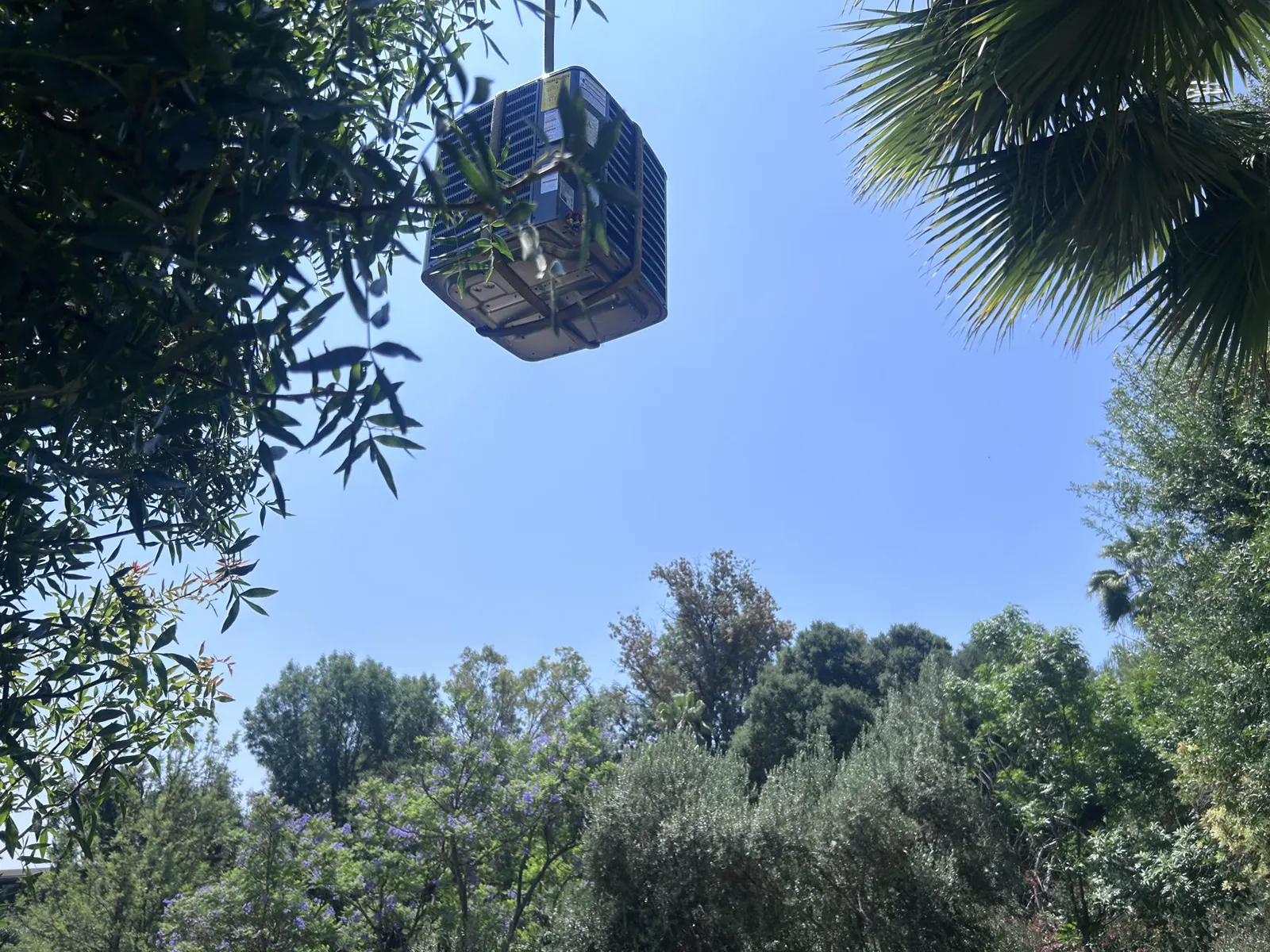
- Crane or lift for rooftop package units on flat-roof homes and small buildings across the Valley.
- Labor. A good installation is a full day or more with two people: brazing, nitrogen purge, vacuum to a proper level, charge by weight and superheat or subcooling, airflow verification, and commissioning. Every one has a shortcut, and every shortcut shows up later as a callback.
What you can check yourself
- Read the data plate on your outdoor unit for the tonnage (the model number usually carries a number like 24, 36, or 48, meaning thousands of BTU per hour) and the refrigerant type. A new quote should not simply copy the old tonnage without a reason.
- Open the attic hatch and look at the ducts. Sagging, crushed, or taped-and-peeling ducts belong in the conversation.
- Note where the furnace or air handler sits: attic, closet, or garage.
- Write down which rooms never cool. That is a duct or sizing problem to solve at the same time.
- Look at the breaker for the AC and the panel's free space. You do not need to touch anything; just note whether there is an empty slot.
When to call a licensed tech
Sizing, refrigerant, and anything inside the electrical compartments are licensed work. Get at least two written quotes from C-20 licensed contractors and compare them line by line: tonnage, SEER2 rating, stage type, what happens to the ducts, what happens to the indoor unit, permit included or not.
We give a written quote for every replacement before any work starts and walk you through each line of it. If the timing is hard, financing through Wisetack offers monthly plans on approved credit, and checking your options does not affect your credit score. Pasadena Water & Power and LADWP have had heat-pump incentives; check the current program before you buy.
Common questions
Why is one quote so much cheaper than another?
Usually one of four things: a smaller or lower-efficiency unit, the ducts left alone, no permit, or a rushed installation. Ask each contractor to explain the other's quote. A good one will do it without trashing the competition.
Is a heat pump more expensive than an AC?
The outdoor unit costs somewhat more than a cooling-only condenser. But it replaces the furnace as well, so if both are due, the total is often close. In a climate with mild winters like ours, it is worth pricing both ways.
Does the brand change the price much?
Within the same tier and efficiency, less than you would expect. The stage type (single, two-stage, variable) moves the price more than the brand name does, and the installation moves the result more than either.
If you want a real quote for your house rather than a range off the internet, start with a $69 diagnostic. You are told the price before we schedule, and it is credited toward the work if you go ahead. Call Boost Services at 818-277-5056 or send us a message and we will usually be out within a few hours.
Written with AI assistance by Boost Services, Heating and Cooling team, and reviewed by our licensed technicians before publishing. Boost Services Heating and Cooling, C-20 #1119892.