
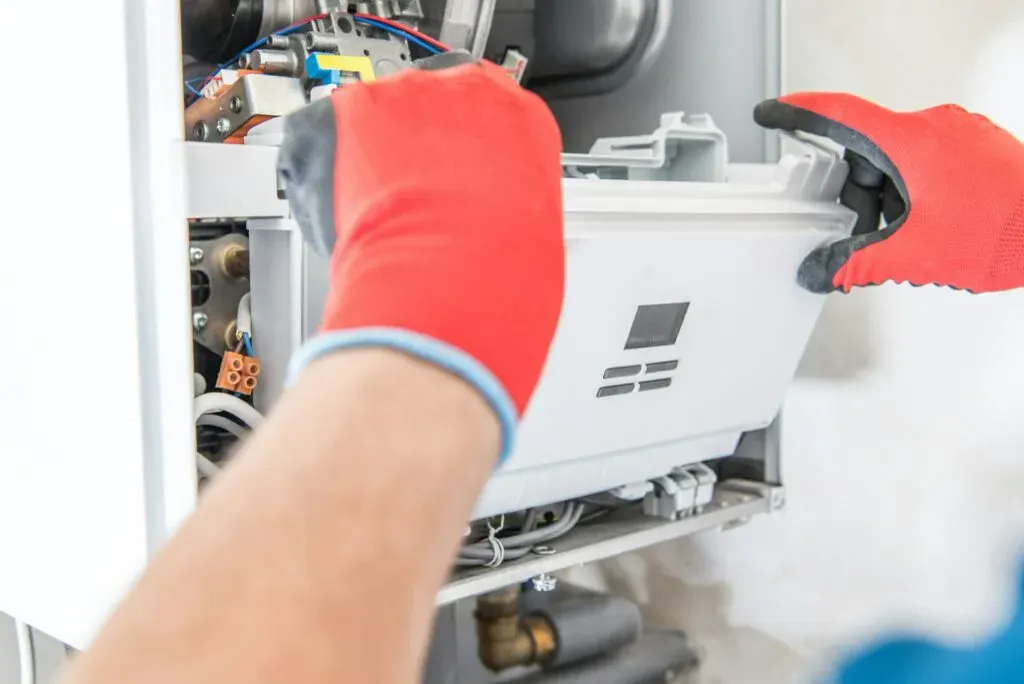
The honest answer to "what does a furnace replacement cost" is that two houses on the same street in Pasadena, CA can get quotes that differ by half, and both quotes can be right. The price is not the box. It is the size of the box, how efficient it is, what it takes to vent it, what shape the ducts are in, and what the city requires when a furnace changes. This post walks through each of those so you can read a quote and know what you are paying for.
Fuel and system type
Most homes in the San Gabriel Valley and the San Fernando Valley heat with a natural gas furnace, and a gas-for-gas swap is the simplest version of this job. Electric furnaces exist and cost less as equipment, but they heat with resistance strips and in this area the electricity bill usually makes them the expensive choice over time. Oil and propane furnaces are rare here and we do not see them.
The alternative that comes up more every year is a heat pump, which replaces the furnace and the air conditioner with one system. It is a bigger job and a different conversation, covered on our heat pump installation page. If your air conditioner is also near the end of its life, ask about it before you commit to a furnace-only quote.
Older Pasadena, Altadena, and South Pasadena bungalows often have a wall furnace or a floor furnace and no ducts at all. Those are their own category and are covered under wall and floor furnace repair.
Size, and how it should be chosen
Furnaces are sized by heat output, and bigger is not better. An oversized furnace short-cycles: it blasts, satisfies the thermostat in a few minutes, shuts off, and repeats, which is hard on the heat exchanger and uneven for the house. The right way to size it is a load calculation on the house (the trade calls it a Manual J), which accounts for square footage, insulation, windows, orientation, and duct condition. A quote that sizes by square footage alone, or simply matches whatever is there now, is guessing. Ask how the size was chosen.
Efficiency (AFUE)
AFUE is the share of the fuel that becomes heat in the house over a season. Roughly speaking, the standard-efficiency furnaces sold today are in the low 80s, and condensing furnaces are in the 90s. The oldest furnaces still running rate well below that, which is why replacing a 25-year-old unit changes the gas bill even with a standard model.
Higher AFUE costs more up front. In our climate the heating season is short, so the payback on a condensing furnace is slower than it would be in Denver. Whether it is worth it depends on how long you plan to stay and what the venting costs, which is the next item.
Venting: the item people do not expect
A standard furnace vents hot exhaust up a metal flue. A condensing furnace pulls so much heat out of the exhaust that what is left is cool enough to run through PVC pipe, and it produces water that needs a drain. That means new pipe run to the outside, a condensate line, and sometimes a condensate pump. In a closet furnace in a 1950s ranch house with no easy path to an exterior wall, the venting can be a real share of the quote. In an attic furnace it is usually easier. This is the single biggest reason two quotes for "a 95% furnace" differ.
Ductwork
The furnace pushes air through whatever ducts you have. If they leak, are undersized, or are wrapped in insulation that gave up in 1985, the new furnace will not perform, and in California the code makes this part of the job. When the air handler is replaced, the ducts have to be leakage-tested by a third-party verifier under Title 24 (HERS testing, now called ECC), and if they fail, they get sealed. New attic ducts in our climate zones go in at R-8 insulation under the 2025 Title 24. A quote that does not mention duct testing is either leaving it out or planning to skip it. Read more on our ductwork page.
Permits and inspection
A furnace change-out needs a mechanical permit and an inspection in every city we work in. The permit fee is a line item, and the inspection is what protects you: a licensed contractor's work gets checked for gas connections, venting, clearances, and the duct test above. If a quote is noticeably cheaper than the others, ask whether it includes the permit.
The smaller line items
- Thermostat. A new furnace often justifies a new thermostat, especially if you are moving to a two-stage or variable-speed model that a basic thermostat cannot control properly.
- Gas line and electrical. Usually the existing gas connection and the furnace's electrical circuit are reused. If the gas line needs modification, that is added labor. Anything at the electrical panel is a separate licensed trade.
- Haul-away and disposal. Should be in the quote.
- Warranties. The manufacturer covers parts and the heat exchanger for a term that varies by brand and by whether the unit is registered. We cover our labor for one year.
What you can check yourself
Before you get quotes, know your own house:
- The furnace's age, from the data plate inside the front panel (the serial number usually encodes the year).
- Where it is: closet, attic, garage, or crawlspace, and whether there is a clear path to an outside wall for new venting.
- The condition of the ducts you can see in the attic: crushed runs, disconnected joints, insulation falling off.
- Whether your air conditioner shares the air handler, because replacing both together is usually cheaper than two separate jobs a year apart.
When to call a licensed tech
Call when the furnace is old enough that repairs are starting to stack up, when it has been red-tagged for a cracked heat exchanger, or when you simply want a written quote to plan around. A cracked heat exchanger is not a repair-or-replace debate; it is a replacement. We give a written quote before any work starts, size from a load calculation, and include the permit and the duct test in the number. Financing on new systems is available through Wisetack, with monthly plans on approved credit, and checking your options does not affect your credit score. Details on our financing page.
Common questions
Is it cheaper to replace the furnace and AC at the same time?
Usually. They share the air handler, the ducts, and the labor day, and the duct test only has to happen once. If the AC is within a few years of the furnace in age, get the combined quote alongside the furnace-only one.
How long does a furnace replacement take?
A straight gas-for-gas swap in an accessible closet or attic is typically a day. Add venting for a condensing furnace, duct sealing, or a difficult attic, and it can run into a second day.
Are there rebates for a new furnace?
For gas furnaces, rarely. The incentive money in this area has gone toward heat pumps: Pasadena Water & Power and LADWP have had heat-pump incentives, and the current program should be checked before you buy.
For a written furnace replacement quote, or a $69 diagnostic on the one you have, call the Boost Services team at 818-277-5056 or send us a message. The diagnostic fee is told to you before booking and credited toward the work.
Written with AI assistance by Boost Services, Heating and Cooling team, and reviewed by our licensed technicians before publishing. Boost Services Heating and Cooling, C-20 #1119892.