
Heating and cooling is usually the biggest single line in a household energy bill, and in Pasadena, CA the cooling half of it runs from May to October. The useful part is that a few of the fixes cost nothing and one of them, the duct system, is usually worth more than any equipment upgrade you could buy. Here is the order that actually pays, from free to expensive.
Start with the filter
A loaded filter makes the blower work against resistance, which cuts airflow, which makes every cycle longer. In cooling it also drops coil temperature, and a coil that gets cold enough will ice over and stop cooling altogether.
Pull yours and hold it to a light. If you cannot see light through it, replace it. Note the size and depth printed on the frame first. How often depends on the filter and the house: a 1-inch filter in a home with pets and an open window habit typically wants checking monthly, while a 4- or 5-inch media filter in a media cabinet runs much longer. Write the date on the frame in marker when you install one and the guesswork disappears.
One thing not to do: fit the densest filter on the shelf into a system that was not designed for it. If airflow drops noticeably, you have traded filtration for capacity, and the fix is a bigger filter area, not a denser filter.
The ducts are where the money leaks out
This is the one most people never look at. The Department of Energy's home upgrades guidance puts it this way: "in a typical house, about 20%-30% of the air that moves through the duct system is lost due to leaks, holes, and poorly connected ducts."
Now picture where that duct system sits in a San Gabriel Valley or San Fernando Valley home. In the attic, which can run 130°F or hotter on an August afternoon. Air escaping a supply duct up there is cooling the attic. Air pulled into a leaking return up there is 130°F attic air, complete with dust, which your system then has to cool from scratch before it reaches a single room.
California's code takes the same view. Under the 2025 Energy Code (document CEC-400-2025-010-F), Section 150.2(b)1E requires that when a single-family system is altered by replacing the air handler, the outdoor condensing unit of a split system, or a coil, the connected duct system "shall be sealed, as confirmed through field verification and diagnostic testing." That test passes at total leakage of 10 percent or less of air handler airflow, or leakage to outside of 7 percent or less. The code also exempts duct systems under 40 linear feet, ducts previously sealed and verified, and ducts containing asbestos.
And if more than 25 feet of new or replacement duct goes into unconditioned space, Section 150.2(b)1D and Table 150.2-D set the insulation at R-8 in our climate zones. Old flex duct with compressed or missing insulation is doing considerably less than that.
You do not need a code trigger to benefit. Sealing and repairing leaking ducts is the highest-return efficiency work available in most houses here, and it does not involve replacing anything you already own.
Set the thermostat and then leave it alone
The Department of Energy's home upgrades guidance is specific about the payoff: "You can save as much as 10% a year on heating and cooling by simply turning your thermostat back 7°-10°F for 8 hours a day."
The eight hours are the ones you are asleep or out of the house. A programmable or smart thermostat does it without anyone remembering, which is most of its value. What does not work is the habit of pushing the setpoint far past where you want it because you think it will cool faster. It will not. The system moves heat at one rate; a lower number just makes it run longer.
Two caveats. If you have a heat pump rather than a gas furnace, a deep overnight setback can bring on the backup electric heat when it recovers in the morning, which can cost more than the setback saved. Use smaller setbacks, or a thermostat built for heat pumps. And if your house has rooms that are never comfortable, a better thermostat will not fix that. Zoning or duct work will.
Give the outdoor unit room to work
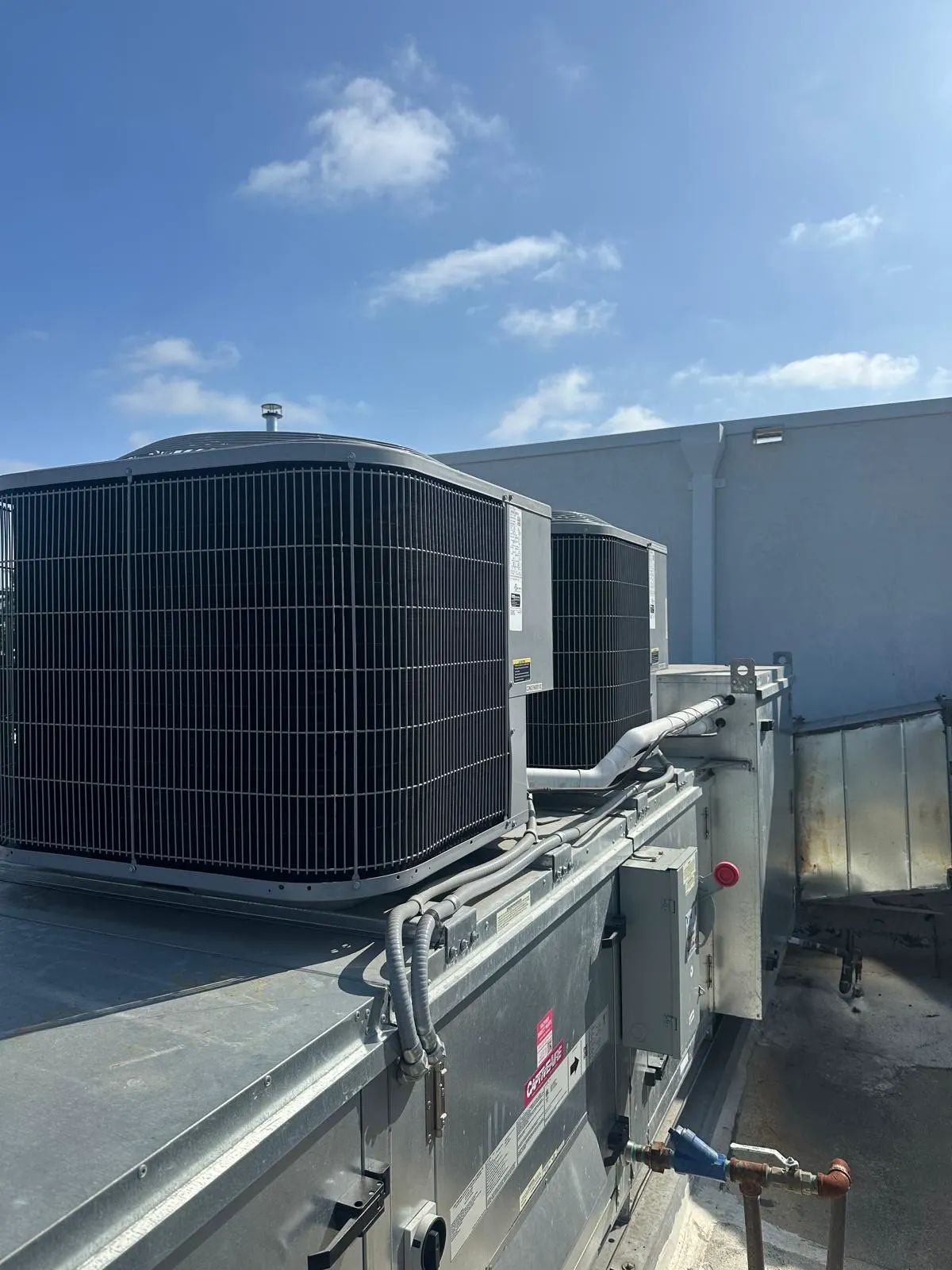
The condenser rejects the heat it pulled out of the house. It can only do that if air moves through the coil freely. In practice that means keeping a couple of feet clear on all sides and several feet above, cutting back the oleander or bougainvillea that has grown over it, and getting the leaves out of the fins after a Santa Ana wind.
Once a season, with the power off at the disconnect, rinse the coil gently with a garden hose from the outside. That is safe homeowner work. Anything requiring the top or panels to come off is not.
What a real tune-up covers
The visits worth paying for are the ones that measure rather than look. On the cooling side: refrigerant charge verified by superheat and subcooling rather than by gauge pressure alone, temperature split across the coil, static pressure in the duct system, blower amp draw, capacitor value against its printed rating, and a coil and drain that actually get cleaned. On the heating side: burners and flame pattern, heat exchanger, ignitor and flame sensor, temperature rise, and the safety switches.
A dirty evaporator coil and a dirty blower wheel cost capacity quietly, year after year, and no filter change reaches them once they are loaded. That is what maintenance is for.
When efficiency is a hardware problem
Everything above is about getting the system you have to perform at its rating. Past a point, the rating itself is the limit.
Efficiency shows up on a quote as SEER2 for cooling and HSPF2 for heating, and higher-rated equipment costs more up front and less to run. Whether that trade works out depends on how many hours a year the system runs, which in our climate means it is the cooling number that carries the argument. ENERGY STAR certification is a shortcut for identifying the higher tiers.
One warning about upgrades: a high-rated system installed on leaky ducts, with the wrong charge, or two sizes too big will not deliver its rating. Sizing is done with a load calculation on your house, not a rule of thumb per square foot. Fix the ducts before you spend on equipment, not after.
What you can check yourself
- Check the filter monthly and write the install date on the frame.
- Set a thermostat schedule with a setback for the hours you are asleep or out.
- Walk the house and open every supply register; clear the return grille.
- Clear two feet around the outdoor unit and cut back anything growing into it.
- Rinse the outdoor coil with a hose once a season, power off at the disconnect.
- Open the attic hatch and look for crushed, disconnected or bare duct runs.
When to call a licensed tech
Call when a room will not hold temperature no matter what the thermostat reads, when the system runs constantly on a normal day, when bills jump with no change in habits, when airflow feels weak at every vent, or when you can see duct problems in the attic. Anything involving refrigerant, sealed compartments or gas is licensed work.
Common questions
Does closing vents in unused rooms save energy?
Generally no. It raises static pressure in the duct system, which makes existing leaks worse and can push the blower out of its range. If you want room-by-room control, zoning does it properly.
Is it cheaper to leave the AC on all day or turn it off?
Setting it back while you are out costs less than holding a temperature all day. The house gains heat more slowly the closer it is to outdoor temperature, which is exactly why the setback works.
Will a new thermostat lower my bill?
Only by making the setback happen consistently, which is real but modest. It cannot make a leaky duct system or a dirty coil efficient. Order matters here: filter, ducts, tune-up, then equipment.
If you want the duct and airflow side measured rather than guessed at, book a $69 diagnostic. You are told the price before we schedule, and it is credited toward the work if you go ahead. Reach Boost Services at 818-277-5056 or send us a message. We are open 6am to 10pm, seven days.
Written with AI assistance by Boost Services, Heating and Cooling team, and reviewed by our licensed technicians before publishing. Boost Services Heating and Cooling, C-20 #1119892.