
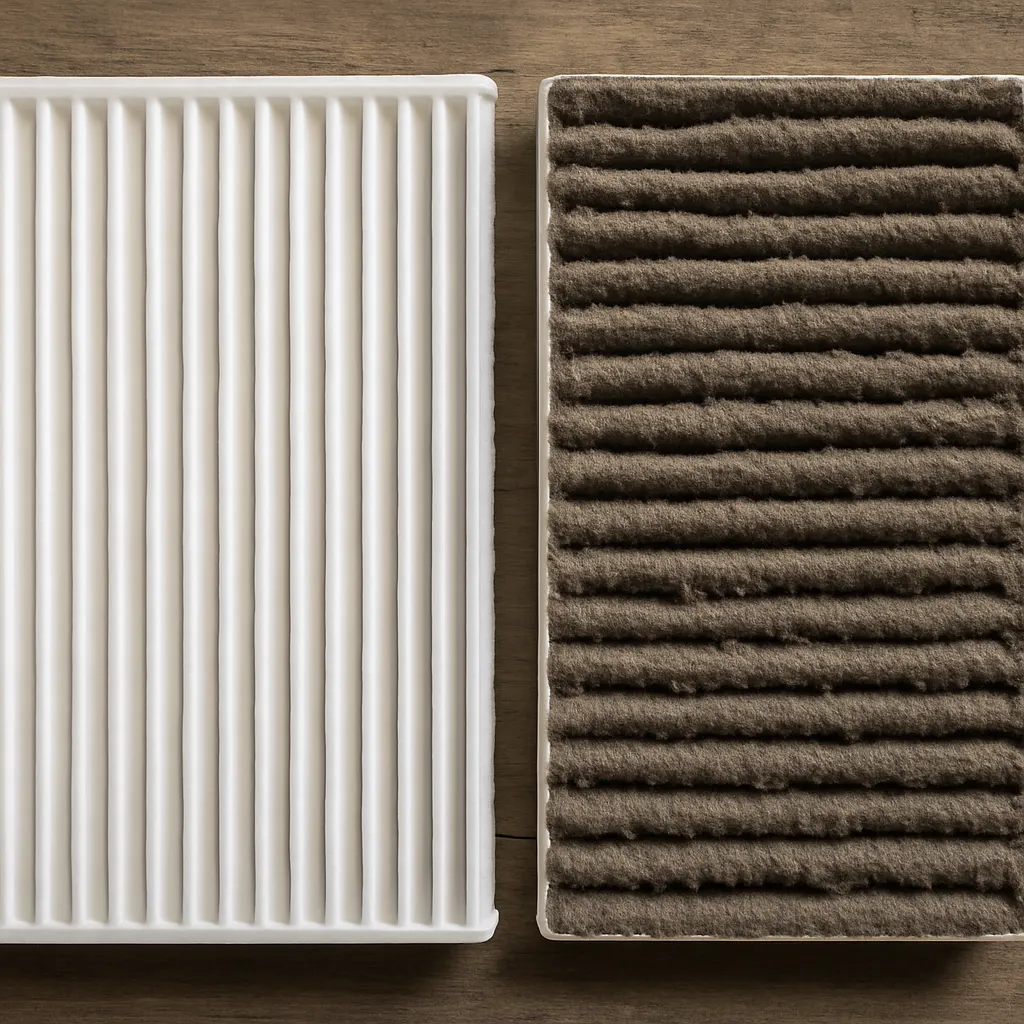
Most of the comfort problems we get called for in August started months earlier with something a homeowner could have done in ten minutes. The filter, the outdoor unit, the drain line, the thermostat and the vents are the five things you can safely handle yourself. Everything inside the cabinets is ours. Here is the short list, in the order that matters.
Check the filter every month
A clogged filter is one of the first things we look at, and often it is the whole problem. It chokes airflow, so the coil cannot deliver its capacity in summer and the furnace overheats and cycles off in winter. Homes with pets, heavy dust, or a system that runs all day load a filter faster. In the San Gabriel Valley, wildfire-smoke days and Santa Ana winds load one fast too, so look at it monthly and replace it when you cannot see light through it.
Use the size and rating the system was designed for. A very dense filter in a system built for a thin one restricts airflow as badly as a dirty one. If you want higher filtration for smoke season, ask us whether your return can take it.
Give the outdoor unit room to breathe
The condenser in the side yard dumps all the heat the system pulled out of the house. Leaves, grass clippings, cottonwood fluff and dust on the coil make it work harder and longer. Keep the area around it clear and cut back any planting that has grown in against the cabinet, so air can reach the coil on every side.
Turn the power off at the disconnect box on the wall next to the unit first. Then clear debris by hand and rinse the coil gently from the outside with a garden hose. Never use a pressure washer; it flattens the fins and that is a repair. Once or twice a year is enough. Chemical coil cleaning and straightening bent fins are tech jobs, and we do them as part of coil cleaning.
Clear the condensate drain line
The indoor coil pulls moisture out of the air, and that water leaves through a PVC drain line. When algae clogs it, the water backs up. The signs are water around the indoor unit, a float switch shutting the system off, or a musty smell from the vents. In a closet or attic air handler that backup can reach the ceiling below.
Find where the line exits outside, usually a small PVC pipe near the condenser or dripping off the eave. Seal a wet/dry vacuum hose over the end and run it for a minute. That pulls most clogs out. If it keeps clogging, the trap or the pan needs a look.
Set the thermostat and leave it
Cranking the thermostat down to 65 does not cool the house faster. The system runs at one speed; it just runs longer. Find a setpoint you can live with and hold it. The Department of Energy's home upgrades guidance puts the payoff at a saving of as much as 10% a year on heating and cooling for turning the thermostat back 7 to 10°F for eight hours a day. A programmable or smart thermostat does that for you: warmer while you are out, cooling back before you get home. In a heat wave, pre-cool in the morning while the outdoor air is cooler and let it drift up in the afternoon.
Walk the vents
Take two minutes and look at every supply register and return grille. Rugs, couches and beds end up over them. Open every register, including the rooms you do not use. Closing vents does not save money on a forced-air system; it raises the pressure in the ducts, pushes air out of every leak in the attic, and can trip the furnace's high-limit switch.
What you can check yourself
- Filter monthly; replace when you cannot see light through it.
- Outdoor unit clear of plants and debris, coil rinsed gently with the power off at the disconnect.
- Drain line vacuumed clear at the outlet.
- Thermostat batteries fresh, schedule set, fan on AUTO.
- Every register open, every return uncovered.
When to call a licensed tech
Some symptoms are the system telling you a part is on its way out. Grinding, squealing or banging from either unit. A burning smell. Weak airflow with a clean filter. Short cycling, where it runs a minute or two and stops. Air that feels sticky even when the AC is running. A breaker that trips: reset it once, and if it trips again, call. A capacitor or contactor caught early is a small repair; the same fault ignored can take the compressor with it.
A real tune-up is more than a glance. Under HVAC maintenance a tech checks the refrigerant charge, tightens electrical connections, tests the capacitor and contactor, cleans the coils, checks the blower and the drain, and checks the gas side of the furnace in the fall. Refrigerant is licensed work by federal rule; nobody without certification should touch it. Twice a year, AC in spring and heating in fall, is the usual rhythm, and a maintenance plan puts both visits on the calendar so nobody forgets.
Common questions
How often should I change my HVAC filter?
Look at it monthly. Homes with pets, dust, smoke days or a system that runs all day need it more often. Replace it when light does not pass through.
Can I clean the outdoor unit myself?
Yes, gently. Power off at the disconnect, clear debris by hand, rinse from the outside with a hose. No pressure washer, no chemicals, no bending fins back yourself.
Is a tune-up worth it?
The visit costs less than the parts it catches. The failures that end a compressor, a weak capacitor, a dirty coil running hot, low charge from a slow leak, are all things a tune-up finds early. Some manufacturer warranties ask for documented annual maintenance, so check yours.
If something on the list above is beyond a rinse and a filter, book a $69 diagnostic. You are told the price before we schedule and it is credited toward the work. Call the Boost Services team at 818-277-5056 or send us a message.
Written with AI assistance by Boost Services, Heating and Cooling team, and reviewed by our licensed technicians before publishing. Boost Services Heating and Cooling, C-20 #1119892.