
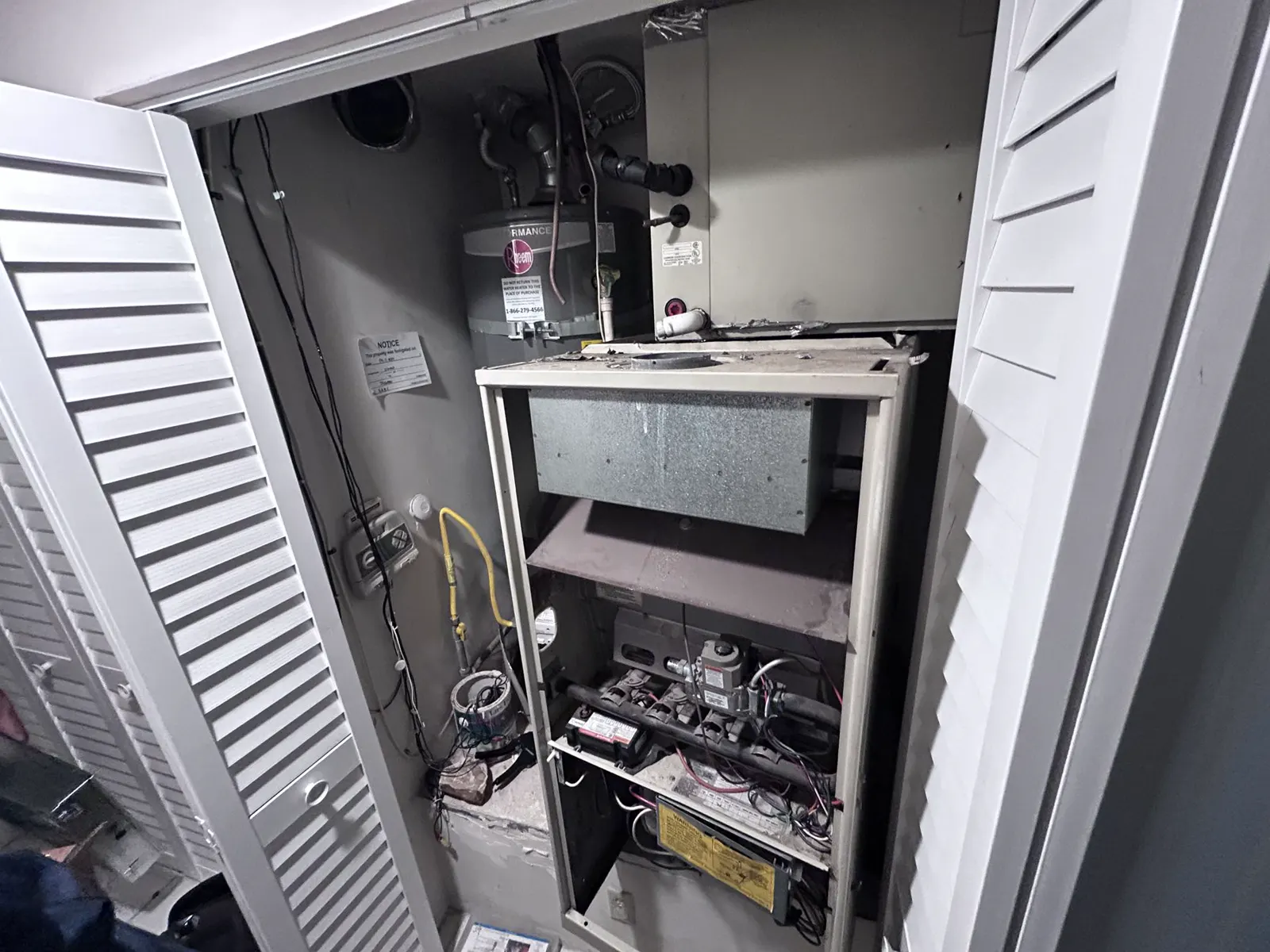
A furnace in Pasadena, CA does almost nothing between May and October, then gets asked to run on the first genuinely cold night in November. That idle stretch is the problem. Dust settles on the burners, a blower bearing dries out, a thermostat battery dies quietly, and none of it shows up until the night you need heat. Everything below is what to do in October, in the order that catches the most problems.
Why the first cold night is when everything breaks
Our heating season is short and back-loaded. Clear winter nights in the San Gabriel Valley drop fast after sunset, so the first real call for heat tends to arrive on the same evening for the whole neighborhood. A system that has been sitting since spring gets its annual startup exactly when every heating company in the valley is booked.
Running it once in October, on a mild day, moves that discovery to a week when it is an inconvenience instead of a cold night.
Change the filter before you turn it on
Six months of cooling loads a filter. Starting the heating season on that filter means restricted airflow across the heat exchanger, which is the condition that trips a high-limit switch and makes a furnace cycle on and off without ever warming the house.
Pull it, hold it up to a light, and if you cannot see light through it, replace it. Note the size and the depth printed on the frame before you go buy one. How often after that depends on the filter and the house, but a thin 1-inch filter in a home with pets typically wants checking monthly, and a 4-inch media filter lasts a good deal longer.
Run it once, before you need it
Set the thermostat about five degrees above room temperature and let the system run for fifteen or twenty minutes. What you are listening and looking for:
- A burning-dust smell the first time it runs. Normal. It is dust on the heat exchanger burning off, and it should fade.
- A smell that does not fade, or smells like something electrical. Shut it down and call.
- Grinding, squealing, or a rattle that builds with the blower. A bearing or a blower wheel, not something to run through the winter.
- It lights, runs a few minutes, then shuts off and restarts. Short cycling. Often airflow, sometimes the flame sensor, occasionally something more serious.
- It never lights at all. The ignitor, the flame sensor, the control board, or the gas supply.
- Warm air that never gets properly warm. Worth a look before December.
Do not open the burner compartment, take apart a gas valve, or poke at the flame. That is licensed work, and it is the part of a furnace where mistakes are dangerous.
Clear the space around the unit
Furnaces in older homes here end up in a hall closet, a garage, or the attic, and closets in particular collect storage. Give the unit its clearance back. Nothing stacked against it, and specifically nothing flammable: paint, thinners, gasoline, aerosols, stacks of paper and cardboard. A garage furnace also needs its combustion-air openings clear, so do not block the louvers in the door with boxes.
While you are there, look at the vent pipe running up out of the furnace. It should be intact, sloped upward, and firmly connected at every joint. A disconnected vent is how combustion gases end up in the house rather than above the roof.
Walk the vents and the returns
Supply registers get covered by furniture, rugs and curtains over a summer of rearranging. Open them all, move whatever is on top of them, and leave them open. Closing registers in unused rooms does not save much and can raise pressure in the duct system enough to make leaks worse.
The return grille matters more than people expect, because that is the only path air has back to the furnace. Vacuum the face of it and keep the couch off it.
If some rooms never get warm no matter what the thermostat says, the problem is usually in the duct system rather than the furnace, and it is worth solving before you spend another winter with a space heater in the back bedroom.
Thermostat: batteries, schedule, setback
Replace the batteries if yours takes them. A dying battery in a thermostat produces exactly the symptom people describe as "the furnace died" — a blank or frozen screen and no call for heat.
Then set the schedule. The Department of Energy's home upgrades guidance puts the payoff plainly: "You can save as much as 10% a year on heating and cooling by simply turning your thermostat back 7°-10°F for 8 hours a day." Overnight and the hours the house is empty are the easy eight.
One caveat for anyone with a heat pump rather than a gas furnace: a deep setback can bring on the backup electric heat when it recovers, which costs more than it saves. Smaller setbacks, or a thermostat designed for heat pumps, are the way there.
Wall and floor furnaces in older homes
A lot of Pasadena, Altadena and South Pasadena bungalows never had ducts. They heat with a wall furnace or an old floor furnace, and those units need a different checklist: keep furniture, curtains and rugs well back from the grille, keep the floor grille itself clear and unobstructed, and never dry laundry on or over one. These units are often decades old, and parts availability is the usual reason one gets replaced rather than repaired. Wall and floor furnace work is its own specialty.
Carbon monoxide alarms
Anything that burns gas can produce carbon monoxide if it is not venting properly, and a cracked heat exchanger is the failure people worry about. Put working CO alarms outside the sleeping areas and on each level of the house, test them in October along with the furnace, and check the date on the back. Manufacturers typically print a service life on the sensor, often somewhere around seven to ten years, and an expired alarm that still chirps is not doing the job.
If an alarm sounds, get everyone outside first and call from there.
What you can check yourself
- Replace the filter and write the date on the frame.
- Run the heat for twenty minutes in October and listen.
- Clear storage away from the furnace and out of its combustion-air path.
- Open every supply register and clear the return grille.
- Replace thermostat batteries and set a schedule.
- Test the CO alarms and check their expiration date.
- Reset a tripped breaker once. If it trips again, stop and call.
When to call a licensed tech
Call for anything you can smell, anything that will not light, short cycling, a noise that builds, a vent pipe that looks disconnected, or a CO alarm that has gone off. Call too if the system simply has not been looked at in a few seasons. A furnace tune-up covers what you cannot: the burners and flame pattern, the heat exchanger, the ignitor and flame sensor, gas pressure, the blower wheel, the safety switches and the temperature rise across the unit.
Common questions
When should I schedule furnace maintenance in Southern California?
October, before the first cold snap. The work is the same in December, but the schedule is not, and a problem found in October is a repair rather than a cold weekend.
My furnace smells like burning dust every fall. Is that bad?
Usually not, if it fades within a few hours of the first run of the season and does not come back. A smell that lingers, smells acrid or electrical, or returns every cycle is worth a visit.
Do I need a tune-up every year if I barely run the heat?
The parts that fail here mostly fail from sitting, not from running, so light use does not really buy you an exemption. Every year is the trade standard; if your heat runs only a handful of nights, every other year with a filter change and a test run in between is a defensible compromise.
When you would rather have someone look at it properly, book a $69 diagnostic. You are told the price before we schedule, and it is credited toward the work if you go ahead. Call Boost Services, 818-277-5056 or send us a message. We are open 6am to 10pm, seven days.
Written with AI assistance by Boost Services, Heating and Cooling team, and reviewed by our licensed technicians before publishing. Boost Services Heating and Cooling, C-20 #1119892.