
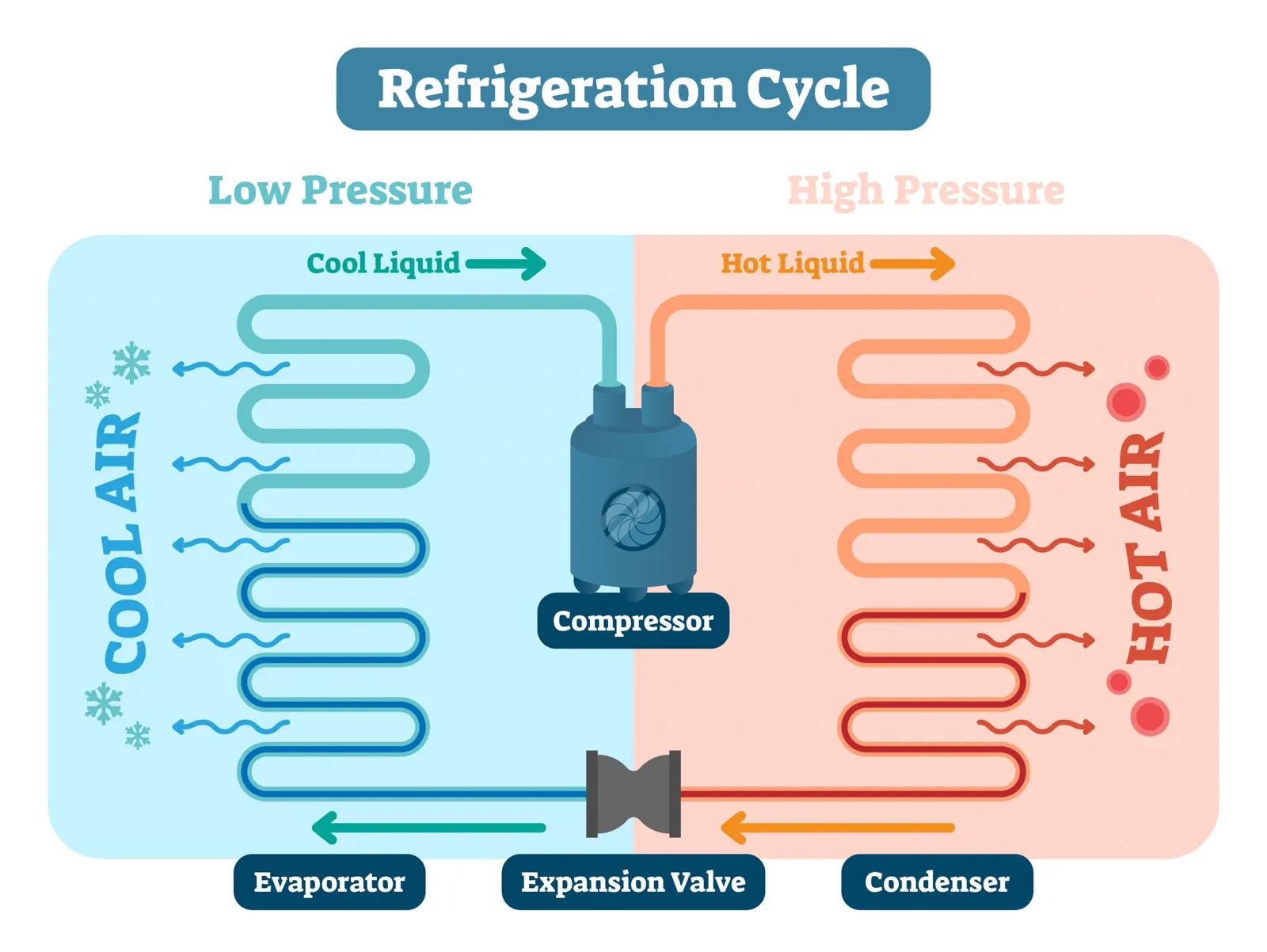
An air conditioner is a refrigerator without the insulated box. It does exactly what your fridge does, except it takes the heat out of your rooms and dumps it in the side yard instead of your kitchen. It does not make cold. It moves heat from a place you do not want it to a place you do not care about, over and over, using a fluid called refrigerant and four parts: a compressor, an outdoor coil, a tiny opening, and an indoor coil. Here is the loop, in plain English.
The bicycle pump: the compressor
Start where the refrigerant enters the compressor, which sits inside the outdoor unit. The refrigerant arrives as a cool, low-pressure gas that has just picked up heat from the air inside your house. The compressor squeezes it hard.
Squeezing a gas makes it hot. You have felt this at the end of a bicycle pump: push the handle down and the barrel gets warm, because all the heat that was spread through a big volume of air is now packed into a small one. The refrigerant leaving the compressor is the same story, a high-pressure gas that is now far hotter than the air outside, even on a 100°F Pasadena afternoon.
The radiator: the outdoor coil
That hot gas runs through the coil that wraps around the outdoor unit while a big fan pulls outside air across it. This is a car radiator doing a car radiator's job. Because the refrigerant is hotter than the outdoor air, heat flows out of it and into the air, and the fan blows that air away. That warm breeze you feel standing next to a running condenser is the heat from your living room leaving.
As the gas gives up heat it condenses into a liquid, the same way steam turns back to water when it cools. So the fluid leaving the outdoor coil is a high-pressure liquid that has had most of its heat forced out of it. This coil is called the condenser for that reason.
The tiny opening: the expansion valve
The liquid travels through the smaller of the two copper lines back into the house, to the indoor coil. Right at the entrance is a very small opening, a metering device or expansion valve. It does two jobs at once. It holds the pressure back on the outdoor side, which is what lets the compressor build pressure there in the first place. And it lets only a trickle of liquid through into the indoor coil, where the compressor is pulling hard on the other end and keeping the pressure low.
When high-pressure liquid squirts through a tiny opening into a low-pressure space, it flashes: part of it turns to gas instantly, and the whole mixture gets very cold. This is the compressor's trick run backward. The heat left in the refrigerant now has to spread itself across a much bigger volume of gas, so the temperature drops hard. The refrigerant entering the indoor coil is colder than anything else in the house.
The radiator again: the indoor coil
The indoor coil sits in your air stream, inside the furnace cabinet or the air handler in the attic, the garage, or a closet. The blower pushes warm house air across it. Radiator effect again, in reverse: the air is warmer than the coil, so heat flows out of the air into the refrigerant, and the air comes off the coil cooler and drier. The ducts carry that air to the rooms. The moisture that condensed on the cold coil drips into a pan and out a drain line, which is where the water comes from when an AC "leaks."
Meanwhile the refrigerant has absorbed the heat from your rooms, boiled back into a gas, and is heading down the larger, insulated copper line to the compressor, where the whole thing starts again. This coil is called the evaporator, because the refrigerant evaporates inside it.
A word about "freon"
People call the refrigerant freon the way they call tissues Kleenex. Freon is a brand name that became attached to R-22, the refrigerant in most systems installed before about 2010. Production and import of R-22 ended in 2020, so a leak on one of those systems is a bigger decision than a leak on a newer one. The data plate on your outdoor unit says which refrigerant yours uses. Newer systems use R-410A, and the newest use R-454B or R-32. They all do the same job in the loop above.
What this means for your house
Almost every AC problem is one of the four steps failing.
- The compressor does not start. Usually the capacitor or contactor that gives it its push, sometimes the compressor itself. The outdoor fan may spin while nothing gets cold.
- The outdoor coil cannot shed heat. Fins caked in dust or lint, plants grown against the unit, or a dead outdoor fan. Pressures climb and the system trips off on hot afternoons.
- Too little refrigerant. It leaked. The indoor coil runs too cold, ices over, and the air goes warm. Refrigerant does not get used up, so "topping it off" without fixing the leak just repeats the visit.
- Too little air across the indoor coil. A packed filter, closed registers, a dirty coil, a weak blower, or crushed attic ducts. Same result as low refrigerant: ice, then warm air.
That is why the two things a homeowner controls, the filter and the outdoor unit, fix so many "AC not cooling" calls, and why the other two need someone with gauges.
What you can check yourself
- The filter, replaced if you cannot see light through it.
- The outdoor unit, cleared and rinsed gently with a hose, with the power off at the disconnect.
- Every register open, every return clear.
- The thermostat on cool, fan on auto.
- The copper lines at either end, for frost.
- The breaker, reset once if it tripped.
Do not open the electrical compartment on the outdoor unit or touch the refrigerant lines' fittings. Adding or removing refrigerant legally requires EPA Section 608 certification.
When to call a licensed tech
Call when the outdoor unit hums without the fan spinning, when there is ice on the lines, when the breaker trips twice, or when the air is still warm after the checks above. A repair visit measures pressures and temperatures at both coils and tells you which of the four steps is failing. Dirty coils get cleaned. If the compressor is gone on an old R-22 system, the honest conversation is about a new system rather than a new heart in an old body.
Common questions
Why does the outdoor unit blow hot air?
Because that is the heat from inside your house. If it is blowing warm, the loop is working.
Why does my AC make water?
The indoor coil is colder than the dew point of the room air, so moisture condenses on it like a cold glass in summer. It drains outside through a small pipe. Water on the floor means that pipe is clogged.
Can an AC cool the house on any day, however hot?
A properly sized system is designed around a hot design day for the area. On a 110°F day it may run without stopping and hold the setpoint, or fall a couple of degrees short. Running continuously on such a day is normal; running continuously on an 85°F day is not.
If your loop has stopped working somewhere, book a $69 diagnostic. You are told the price before we schedule, and it is credited toward the work if you go ahead. Reach Boost Services at 818-277-5056 or send us a message and we will usually be out within a few hours to a day.
Written with AI assistance by Boost Services, Heating and Cooling team, and reviewed by our licensed technicians before publishing. Boost Services Heating and Cooling, C-20 #1119892.