
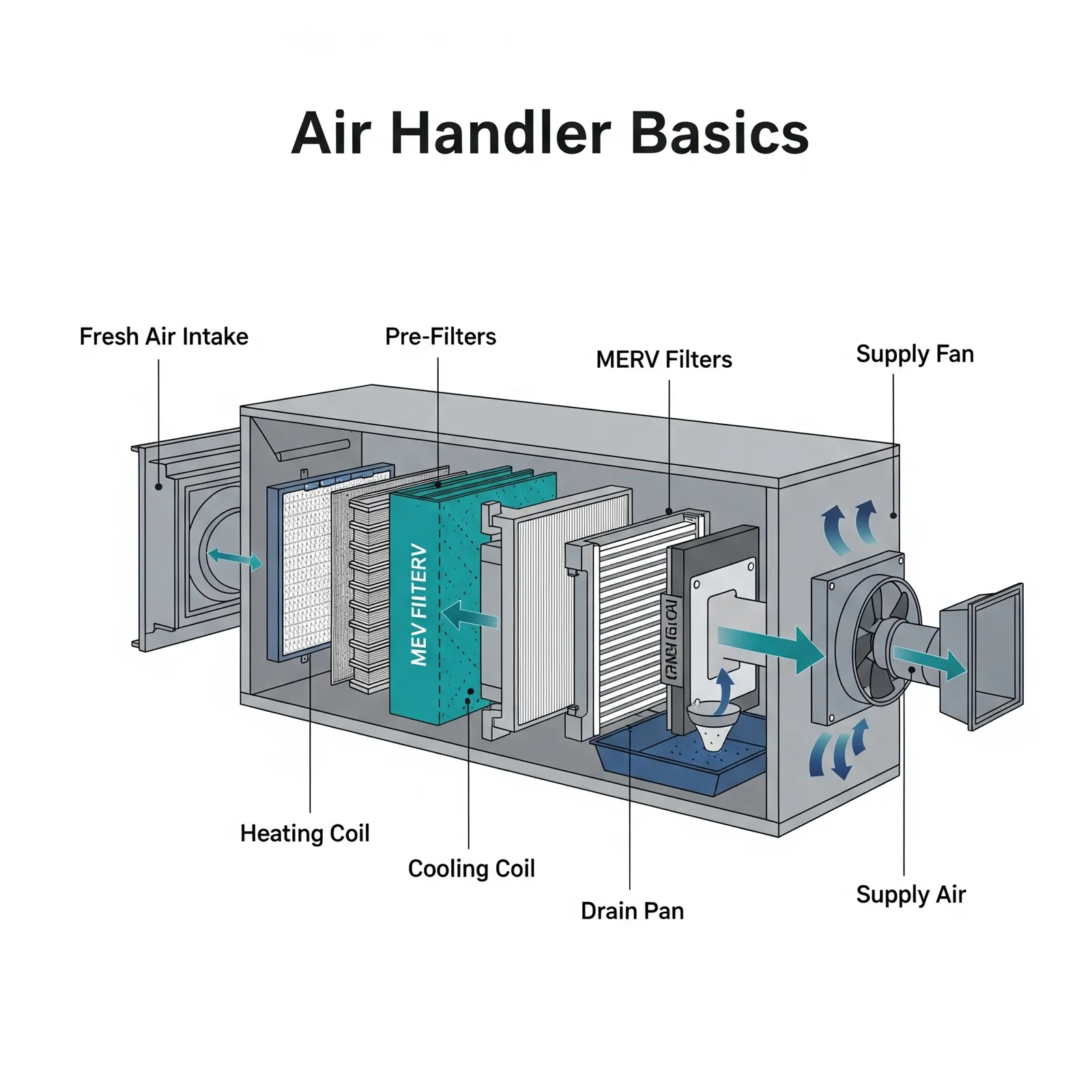
An air handler is the indoor half of a split heating and cooling system: a metal cabinet with a blower, a coil, and a filter rack that moves house air across the coil and out through the ducts. If your home has a heat pump, or an air conditioner with no gas furnace, the box in the closet or attic is an air handler. If you have a gas furnace, the furnace does the same job and the AC coil sits on top of it. Knowing which one you have makes every conversation about your system shorter.
Air handler or furnace?
The confusion is fair, because they look alike and sit in the same places. The difference is what makes the heat.
- A furnace has burners and a heat exchanger. It makes heat by burning gas, and its blower also serves the AC coil bolted to it in summer.
- An air handler has no burners. In a heat pump system the coil inside it heats in winter and cools in summer. In an AC-only system it just cools. Some air handlers carry electric resistance strips as backup or as the only heat, which is common in all-electric condos and ADUs.
In the San Gabriel Valley and San Fernando Valley, most 1950s-to-80s ranch homes have a gas furnace with a coil case on top, in a hall closet, garage, or attic. Air handlers show up in all-electric homes, in heat pump conversions, and in newer construction. A rooftop package unit on a flat-roofed Valley house or small commercial building has everything, including the blower, in one outdoor cabinet, so there is no separate indoor unit at all. A mini split's wall-mounted head is a small air handler too.
What is inside
- Blower. The fan that moves air. Single-speed blowers run flat out or not at all; variable-speed blowers ramp up and down, run quieter, and hold a steadier temperature.
- Coil. The indoor refrigerant coil where heat is picked up (cooling mode) or released (heating mode on a heat pump). Air handlers use copper or aluminum coils.
- Filter rack. Usually at the return side of the cabinet or at a return grille in a hallway ceiling. This is the part you touch most.
- Drain pan and condensate line. In cooling mode the coil pulls moisture out of the air, which drips into a pan and drains outside. Attic units also get a secondary pan under the cabinet with a float switch that shuts the system off if the primary drain clogs.
- Electric heat strips. Optional. They draw a lot of power, which is why a heat pump system is set up to use them as little as possible.
- Control board and wiring. Low-voltage thermostat wiring, the blower relay, and the transformer.
Dampers, if your system has zoning, sit in the ductwork rather than inside the cabinet.
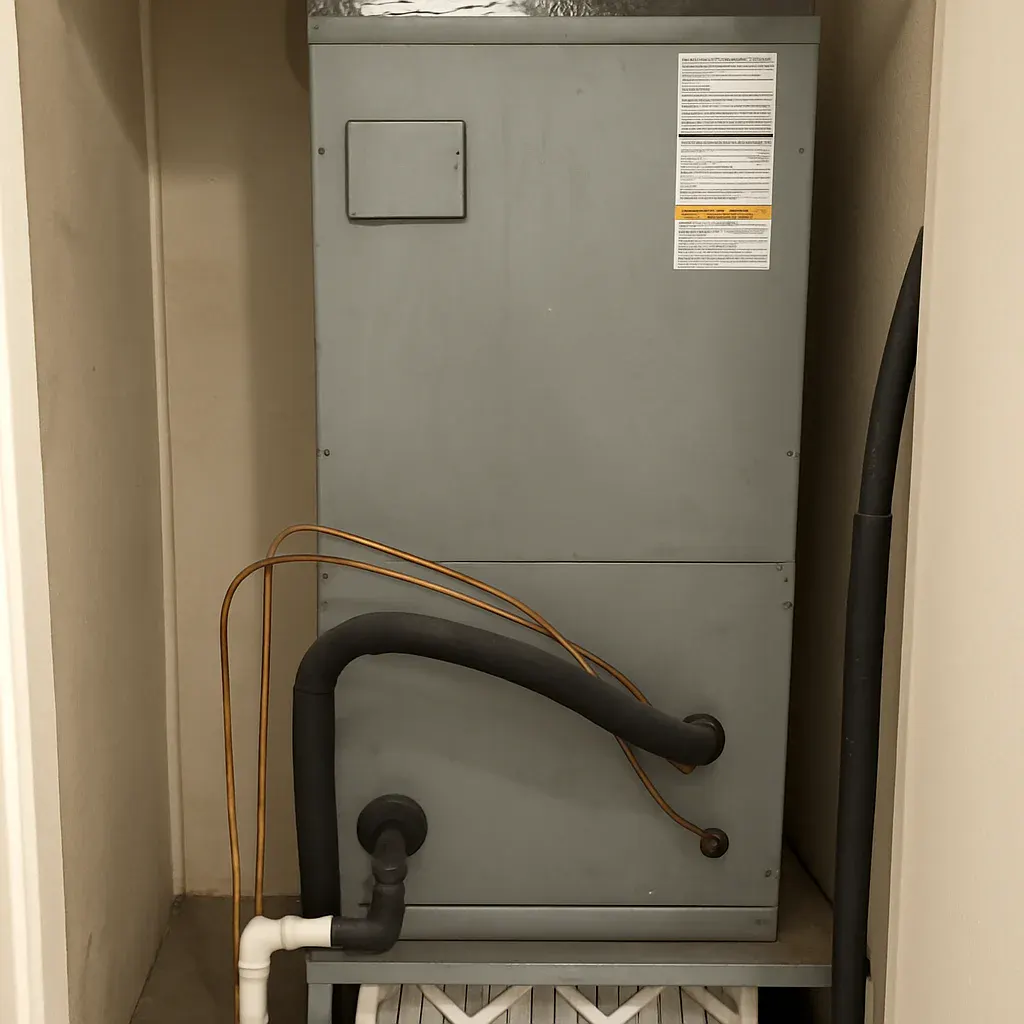
Where to find it
Look in these places, roughly in order of how often we find them locally:
- A hall or utility closet with a louvered door.
- The attic, reached through a hatch or pull-down ladder. Common in the Valley ranch homes, where the ducts are also in the attic.
- The garage, mounted on a platform or hung from the ceiling.
- A crawlspace under a raised-foundation house, less common here but not rare in older Pasadena neighborhoods.
Follow the biggest duct or the return grille and it leads there. Attics here reach 130°F or more in summer, which is hard on the cabinet, the wiring, and anyone working on it, and it is why the duct insulation matters so much up there. Title 24 requires the connected ducts to be sealed and verified when the equipment is replaced, with a few exceptions.
How a cycle works
The thermostat calls. On a heat pump, the outdoor unit starts and refrigerant flows to the indoor coil. The blower pulls air from the return grille, through the filter, across the coil, and pushes it into the supply ducts. Warm or cool air comes out of the registers, the thermostat reaches its setpoint, and everything stops. The whole system is only as good as the airflow through that cabinet, which is why a clogged filter or a dirty coil shows up as poor heating, poor cooling, ice on the coil, or a blower that runs constantly.
Why it matters when you replace equipment
The air handler and the outdoor unit are matched by the manufacturer. Putting a new outdoor unit on an old mismatched indoor unit costs capacity and efficiency, and the efficiency rating on the quote only applies to the matched pair. When an AC installation or heat pump replaces the whole system, California requires a duct leakage test (HERS, now called ECC) because the air handler, condenser, or coil was replaced. That test is a good thing for you: it catches the attic duct leaks that would otherwise eat the new system's output.
Sizing comes from a load calculation of the house, not from the old unit's label. Bigger is not better; an oversized system short-cycles and never dehumidifies properly.
What you can check yourself
- Change the filter. Every one to three months in the cooling season, more often on wildfire-smoke days or with pets. Write the date on the frame.
- Look at the drain. In summer, the condensate line should drip outside when the system runs. A dry line on a humid day, or water in the secondary pan, means a clog is forming.
- Listen to the blower. A rattle, a squeal on startup, or a hum with no air movement is worth a call before it becomes a no-cool day in August.
- Keep the closet clear. Boxes against a louvered door choke the return air.
- Check the thermostat fan setting. "On" runs the blower nonstop; "Auto" runs it only with heating or cooling.
Leave the cabinet closed. The blower compartment has a door switch for a reason, and the capacitor inside holds a charge even with power off.
When to call a licensed tech
- Airflow at the registers is weak with a clean filter.
- The coil is icing, or there is water on the closet floor or in the attic pan.
- The blower runs but the air is not heating or cooling.
- The float switch has shut the system down.
- A musty smell comes from the registers when the blower starts. The coil probably needs a coil cleaning, and attic duct repair if a return leak is pulling attic air in.
- You are replacing the outdoor unit and want to know whether the indoor unit can stay.
Common questions
Do I have an air handler or a furnace?
Open the closet or look in the attic. A gas line and a vent pipe leaving the cabinet mean furnace. No gas line, refrigerant lines only, means air handler. If your thermostat has an "emergency heat" or "aux heat" setting, you almost certainly have a heat pump with an air handler.
Can I replace just the outdoor unit and keep the air handler?
Sometimes, if the indoor coil matches the new refrigerant and capacity. Often not, and the system rating then does not apply. A tech can read the model numbers and tell you before anyone quotes.
How long does an air handler last?
Roughly as long as the outdoor unit it is paired with, often 15 years or so, less in a 130°F attic with a neglected filter. The blower motor and capacitor are the parts that usually go first, and both are repairable.
Our diagnostic visit is $69, told to you before booking and credited toward the work. Reach Boost Services at 818-277-5056 or contact us here.
Written with AI assistance by Boost Services, Heating and Cooling team, and reviewed by our licensed technicians before publishing. Boost Services Heating and Cooling, C-20 #1119892.