
For a renter in an apartment without central air, the choice is a window unit, a portable unit, or asking the landlord about a mini split. Which one depends on your lease, your windows, the size of the room and what the wiring will support. Here is what a tenant or a landlord in Pasadena, CA or the San Fernando Valley should know before buying anything. No product names and no rankings; the right unit is the one that fits your room and your building's rules.
Start with the lease and the window
Many buildings restrict window units, for the look of the building or because a unit that is not braced properly can fall. Read the lease, then ask in writing. If window units are out, a portable is the renter's answer. If the landlord is open to a permanent fix, skip to the mini split section; it is the better answer for everyone if the building can take it.
Then look at the window. A double-hung sash window takes a standard window unit. A slider or a casement (crank) window usually does not, and that pushes you toward a portable with a slider kit, or a unit made for sliders.
Window units versus portable units
Window units give the most cooling for the electricity used. The hot side of the machine hangs outside, so the heat and the condensate leave the room. The trade-offs: the window is blocked, the unit needs a support bracket and a secured sash, and the gaps around the side panels need sealing with foam or the unit pulls in hot air all day.
Portable units sit on the floor and push heat out through a hose to a window kit. Nothing hangs outside and they move between rooms. The trade-offs: they take floor space, the exhaust hose itself gets hot and radiates back into the room, and they are less efficient. A dual-hose portable is worth the extra money over a single-hose one: a single hose uses room air to cool the machine and blows it outside, which pulls hot outdoor air in through every gap in the apartment. A dual-hose unit draws its cooling air from outside.
On the label, portable units now carry a SACC rating (seasonally adjusted cooling capacity) that comes out lower than the old BTU number on the box. Compare SACC to SACC between portables; do not compare a portable's headline BTU to a window unit's.
What size you need
A common rule of thumb is roughly 20 BTU of cooling per square foot of room, adjusted up for a west-facing window, a top-floor unit under a hot roof, or a kitchen, and down for a shaded room. Measure the room: a 12-by-15-foot bedroom is 180 square feet.
Bigger is not safer. An oversized unit cools the air quickly and shuts off before it has run long enough to pull moisture out, then starts again a few minutes later. Our climate is dry so the clammy feeling is less of an issue than it is in a humid climate, but short cycling still wears the unit and wastes electricity. An undersized unit runs all afternoon and never gets there. On a 100°F day in a top-floor Reseda apartment, no window unit will hold 72°F; the realistic goal is a room that is comfortable, not cold.
Power: check before you buy
Small window units and most portables run on an ordinary outlet. Larger window units need a 230-volt outlet, and adding one is a separate licensed trade, not something to run off an adapter. Two things to check on any unit: the amps on its data plate against the circuit it will share, and whether that circuit already carries a fridge, a microwave or a space heater. Older Pasadena buildings with original wiring trip breakers for exactly this reason. Never run an air conditioner on an extension cord.
Drainage and water
A window unit is meant to drip outside; make sure it is tilted slightly toward the outdoors so the water leaves. Water inside means the tilt is wrong or the drain hole is clogged. A portable collects condensate in a tank or evaporates it out the exhaust. In our dry air the self-evaporating models rarely need emptying; on a humid August week they will.
Noise and efficiency
The yellow EnergyGuide label shows a CEER number. Higher means less electricity for the same cooling; that is the number to compare between two units of the same size. Units with an inverter compressor run at a steady low speed instead of cycling on and off, which makes them quieter and easier on the bill, and they are what to look for in a bedroom. Noise ratings are in decibels; lower is quieter, and the difference between models is real at night.
When a mini split is the better answer
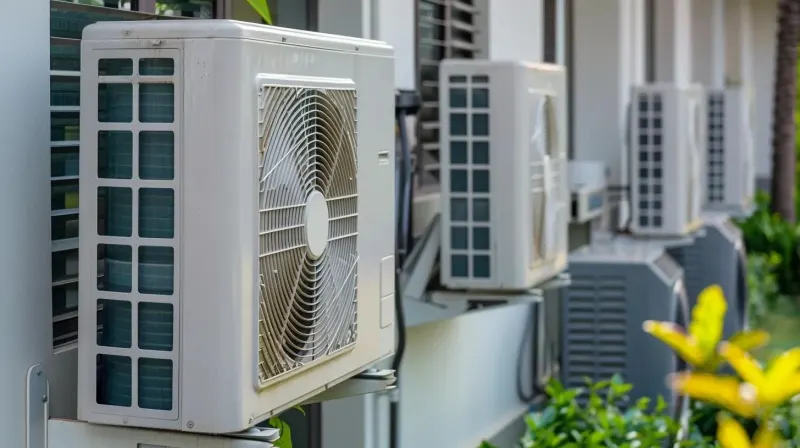
If the landlord is willing, or you own the building, a ductless mini split beats both options. One outdoor unit on the wall or the roof, a quiet indoor head high on the wall, no window blocked, and it heats in winter too. It is far more efficient than a portable and quieter than a window unit. A single outdoor unit can serve several rooms, or several small apartments, with a multi-zone system.
It is a permanent installation: refrigerant lines through the wall, a dedicated circuit, a permit, and a licensed C-20 contractor. That is why it is a landlord decision, and why it is the standard answer for ADUs and garage conversions across the Valley. For a landlord weighing it, the pitch is simple: tenants stop hanging unsupported window units off the building, and the unit outlasts a string of portables. Our mini split installation page covers what the job involves.
What you can check yourself
For a window or portable unit you already own:
- Rinse the mesh filter behind the front panel monthly during summer. A clogged filter is the usual reason a unit "stopped cooling."
- Check the tilt on a window unit and clear the drain hole.
- Re-seal the side panel gaps with foam each season.
- Straighten the exhaust hose on a portable and keep it as short as the kit allows. A kinked or stretched hose halves the cooling.
- Keep the outside of a window unit clear of vines and debris.
When to call a licensed tech
Window and portable units are sealed appliances. We do not repair them, and neither does most of the trade; a refrigerant fault in one usually costs more to fix than the unit is worth. If a unit trips the breaker, smells hot, or ices up after the filter is clean, unplug it and replace it.
Call a licensed tech for the mini split conversation: sizing, placement, the electrical circuit, which is a separate trade, and the permit. If the building already has a mini split that is not cooling, that is a proper service call.
Common questions
Can my landlord refuse a window unit?
In most leases, yes, and the reason is usually liability for a unit falling. Ask what they will allow. A portable with a window kit is rarely refused, and some landlords will consider a mini split if you raise it.
Is a portable AC good enough for a bedroom?
A dual-hose portable sized to the room will keep a bedroom comfortable at night. It will not match a window unit or a mini split on a 100°F afternoon, and it is louder than either because the compressor is in the room with you.
What size mini split does a studio need?
That is a load calculation, not a square-foot guess: window area and direction, insulation, ceiling height, and what floor the unit is on. A licensed contractor sizes it; an oversized mini split short cycles just like an oversized window unit.
Our diagnostic is $69, quoted before we book and credited toward the work. Reach Boost Services at 818-277-5056, 6am to 10pm, seven days a week, or book online.
Written with AI assistance by Boost Services, Heating and Cooling team, and reviewed by our licensed technicians before publishing. Boost Services Heating and Cooling, C-20 #1119892.