
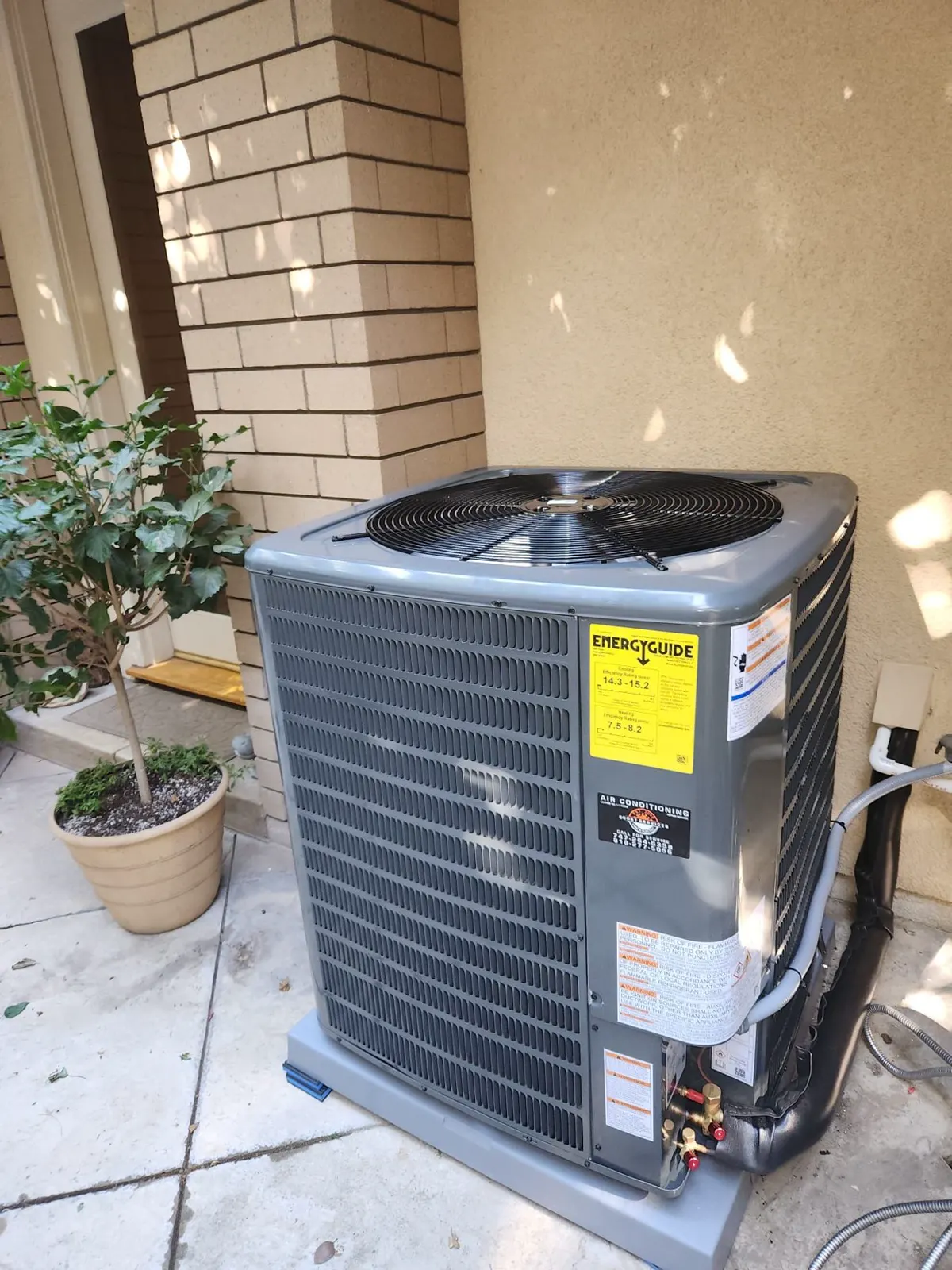
Every air conditioner has a metal or foil plate riveted to the outdoor unit that tells you the manufacturer, the model, the serial number, the refrigerant, and the electrical ratings. From those you get the age, the capacity in tons, and whether the refrigerant is obsolete. Knowing those three things before you call anyone in Pasadena, CA or the San Fernando Valley makes every repair or replacement conversation shorter.
Where the plate is
On a split system, the plate is on the outdoor condenser, usually on the side near the refrigerant line connections or the electrical disconnect. On a rooftop package unit, common on flat-roof homes and small buildings across the Valley, it is on the side of the cabinet, and you will need safe roof access or a photo from whoever last serviced it.
There is a second plate on the indoor furnace or air handler, and a third on the indoor coil. The outdoor plate answers most questions. Take a clear photo of it with your phone.
The brand and model number
The brand is printed at the top. The model number is a string of letters and numbers with information packed into it.
Capacity is usually in the model number. Look for a two-digit number that is a multiple of six: 18, 24, 30, 36, 42, 48, or 60. That is the nominal capacity in thousands of BTU per hour. Divide by 12 to get tons.
- 24 = 24,000 BTU/h = 2 tons
- 36 = 36,000 BTU/h = 3 tons
- 48 = 48,000 BTU/h = 4 tons
- 60 = 60,000 BTU/h = 5 tons
So a model number with "36" in the middle is almost always a 3-ton unit. A few brands use a different code, but the multiple-of-six pattern covers most equipment we see from American Standard, Bryant, Carrier, Daikin, Goodman, Lennox, Mitsubishi Electric, and York.
Efficiency is sometimes in the model number too, as a two-digit number like 14 or 16 near the front. On older units that is the SEER rating on the old scale. New units are rated in SEER2, which is a tougher test, so the numbers are not directly comparable.
The serial number and the age
The serial number is where the manufacture date hides, and every manufacturer encodes it differently. A few patterns cover most of what is out there:
- Year and week in the first four digits. Something like 2319 for the 23rd week of 2019, or the year first as 1923. Several major brands use one of these.
- Year and month as the first four digits. 1905 for May 2019.
- A letter for the month and two digits for the year somewhere in the string.
- A code you need the manufacturer's table to decode. Some brands use plant codes and letters that mean nothing without the key.
Do not guess from a partial match. The manufacturer's website usually has a serial number decoder, or send us the photo and we will read it. The manufacture date is not the install date, either. Equipment sits in warehouses, and a unit is often months younger than its plate.
If the plate is faded past reading, which happens after years of Valley sun, the model and serial are often repeated on a sticker inside the electrical compartment cover. That cover is for a tech to open. Ask them to read it at the next service.
The refrigerant
The plate states the refrigerant type. This is the most useful fact on it:
- R-22. The old refrigerant. Production and import ended in 2020. A system on R-22 is old by definition, and a refrigerant leak on it is a replacement conversation rather than a repair one.
- R-410A. The standard from the mid-2000s until recently. Still available for servicing existing equipment.
- R-454B or R-32. The current refrigerants on new equipment.
The plate also gives the factory charge in pounds and ounces, which a tech uses when weighing in a recharge.
The electrical ratings
Two lines of the electrical data are worth understanding:
- RLA (rated load amps) is the compressor's normal running current. A tech compares the actual reading against this to judge the compressor's health. A compressor drawing well above its RLA is on its way out.
- Max fuse or breaker size and minimum circuit ampacity tell an installer what circuit the unit needs. If you are looking at a replacement, these numbers on the new unit versus the old tell you whether the existing circuit will do.
You are reading, not touching. Leave the disconnect and the breaker alone.
What the three facts tell you together
With age, tonnage, and refrigerant in hand:
- Old, R-22, any tonnage: plan the replacement. Any leak forces it.
- Mid-age, R-410A, and cooling fine: a system worth maintaining and repairing.
- Any age, and the tonnage seems wrong for the house: a 5-ton unit on a small ranch house, or a 2-ton on a large two-story, explains a lot of comfort complaints and short cycling. A load calculation at replacement time fixes it.
- Young and already failing: something in the installation is wrong, often airflow, charge, or ducts, and a diagnostic should find it.
What you can check yourself
- Photograph the outdoor plate, the indoor furnace or air handler plate, and the coil plate if it is visible without removing covers.
- Write down brand, model, serial, refrigerant, and the capacity number.
- Decode the serial on the manufacturer's site, or send it to us.
- Check whether the indoor and outdoor units match in age and brand. If not, one was replaced alone.
- Note the tonnage against your house size. Rules of thumb for square feet per ton are often wrong, which is why load calculations exist, but a big mismatch is worth asking about.
When to call a licensed tech
Call when the plate must be read from inside the electrical cover, when you want compressor amperage checked against the RLA, when the plate says R-22 and the system has ever needed a recharge, or when the tonnage and the house do not add up. A diagnostic visit covers the electrical readings and the refrigerant charge, and if the plate has already told you the system is on its last legs, a replacement quote starts with a load calculation rather than copying the old number. If the system is mid-life and healthy, put it on a maintenance schedule and keep it there.
Common questions
The plate says 3 tons but the tech said the house needs 4. Who is right?
Possibly both. The old unit may have been undersized from the start, or the house may have changed: an addition, a converted garage, new west-facing windows. A load calculation answers it. Never size the new unit by copying the old plate.
How old is too old?
Roughly 12 to 17 years is the typical central AC lifespan, and the Valleys tend toward the low end. Age alone does not condemn a unit. Age plus R-22, or age plus a repair every summer, does.
Can I tell the SEER from the plate?
On older units the outdoor plate or the yellow EnergyGuide sticker often lists the SEER. Rated efficiency depends on the matched indoor coil, though, so the outdoor number alone is nominal.
If you have your plate photo and want to know what it means for your system, book a $69 diagnostic. You are told the price before we schedule, and it is credited toward the work if you go ahead. Call Boost Services, 818-277-5056 or send us a message and we will usually be out within a few hours to a day.
Written with AI assistance by Boost Services, Heating and Cooling team, and reviewed by our licensed technicians before publishing. Boost Services Heating and Cooling, C-20 #1119892.