
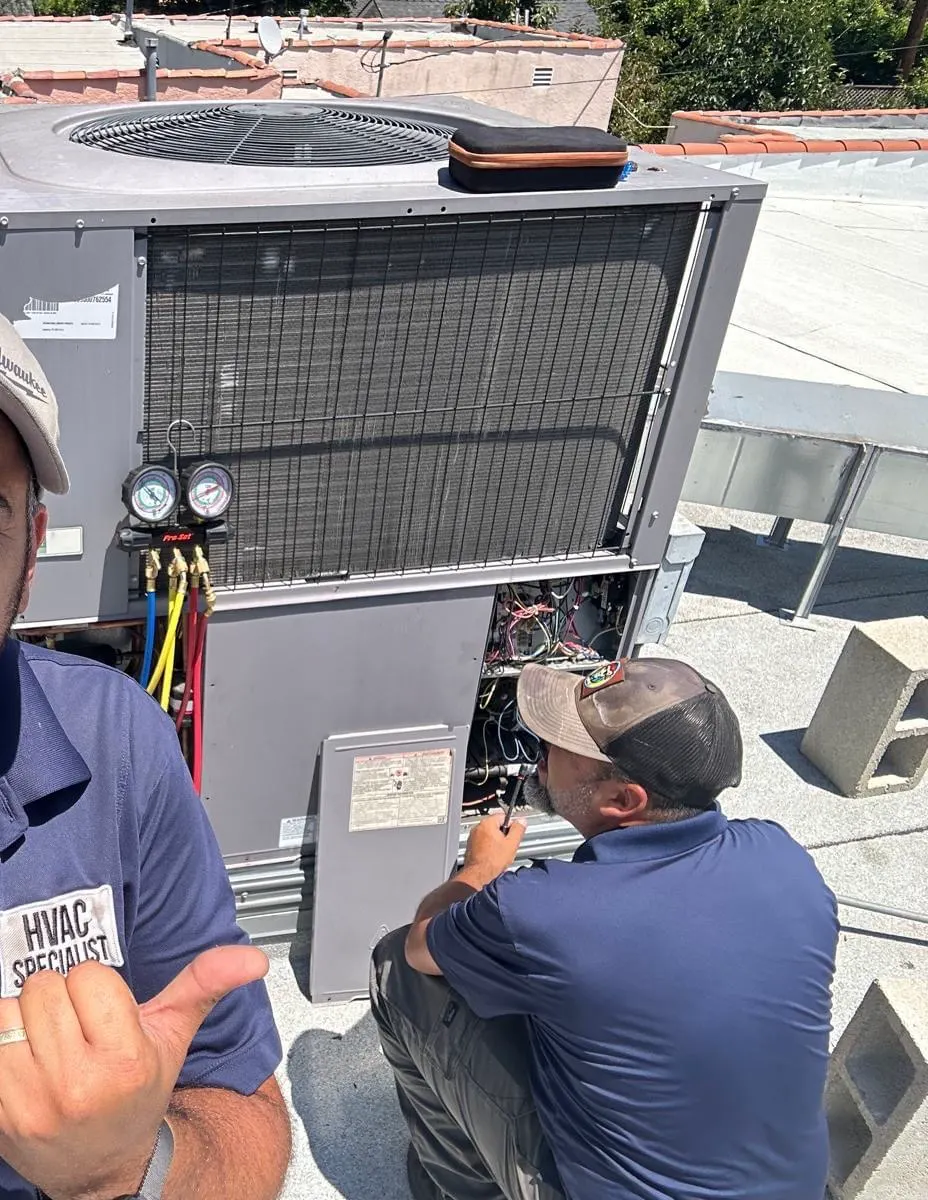
The $69 diagnostic is the visit where we find out what is wrong and put the fix in writing. You are told the price before we book, it covers the tech's time and the testing, and it is credited toward the work if you go ahead with it. This post walks through what happens between the phone call and the quote so nothing on the day is a surprise.
Before we arrive
An owner answers the phone. We will ask what the system is doing, what changed and when, the brand if you know it, and where the equipment lives: attic, hallway closet, garage, side yard, roof. That tells us what to bring.
You will hear the $69 and what it covers before anything is scheduled. We are open 6am to 10pm, seven days, and we usually get to you within a few hours to a day.
Things that make the visit faster:
- Clear a path to the equipment. Boxes in front of the closet furnace, a car over the attic hatch pull-down, patio furniture against the condenser.
- Know where the breaker panel is.
- Note any error codes, lights, sounds, or smells, and when they happen.
Step 1: the conversation
The first few minutes are questions. When did it start. Does it happen all day or only in the afternoon. Did anyone change the filter, adjust the thermostat, or have other work done in the house recently. Has this system had this problem before.
A cooling complaint that only shows up after 3pm in a west-facing Pasadena, CA bungalow is a different problem from one that started overnight. The history narrows it down before a tool comes out.
Step 2: the cheap stuff first
Thermostat settings, mode, batteries, and the wiring at the thermostat base. Filter condition and fit. Airflow at the registers and the return. A temperature reading at the return and at a supply register to see what the system is actually delivering.
This step rules out the things that cost nothing to fix. If a wrong setting or a collapsed filter is the whole story, that is what you will be told.
Step 3: the equipment
What gets checked depends on the complaint and the equipment, but the ground covered looks like this.
At the furnace or air handler: blower operation and amperage, capacitor readings, control board diagnostic codes, the ignition sequence on a gas furnace including the igniter, flame sensor, pressure switch, and limit switch, the condensate drain and float switch, and the condition of the indoor coil.
At the outdoor unit: capacitor, contactor, fan motor, compressor amp draw against its rating, coil condition, the disconnect, and the line-set insulation. On a cooling complaint, refrigerant pressures and temperatures, which tell us whether the charge is right and whether the coil and airflow are doing their part.
Heat pumps: the above, plus the reversing valve and the defrost control.
Mini splits: error code history, filters, coil and blower wheel condition, the drain, and the flare fittings at the outdoor unit.
Rooftop package units: the same checks in one cabinet, plus the economizer damper and the roof-curb ductwork where it meets the building.
We photograph the data plate. It gives us the model, the serial, the refrigerant type, and the manufacture date, which matter for parts and for the replace-or-repair conversation if that comes up.
Step 4: the written quote
Before any work starts, you get it in writing: what is wrong, what fixing it involves, and the price. If the equipment is old or the repair is large, you get a replacement option next to it so you can compare the two with the same facts in front of you. If replacement comes up, financing on new systems is available through Wisetack, with monthly plans on approved credit, and checking your options does not affect your credit score.
Nobody has to decide on the spot. If you say yes and the part is on the truck, the repair often happens on the same visit. If not, it gets scheduled. Repairs carry a 1-year labor warranty. We service American Standard, Bryant, Carrier, Daikin, Goodman, Lennox, Mitsubishi Electric, and York.
If you say no, you still leave with a written record of what was measured and found.
What the diagnostic is not
- It is not a tune-up. A diagnostic chases a problem. A maintenance visit goes through the whole system on a checklist whether anything is wrong or not. That is a separate HVAC maintenance service.
- It is not the repair. Parts and the repair labor are quoted separately, in writing, before they happen. The $69 comes off that total if you go ahead.
- It is not an estimate visit for a new system. If you already know you want a quote on replacement rather than a repair, say so when you call. That is a different kind of appointment.
- It is not a duct leakage test or a permit inspection. Those are their own jobs with their own equipment.
What you can check yourself
Before you book, a few things are worth trying. They solve the problem often enough to be worth five minutes.
- Thermostat: right mode, setpoint on the right side of room temperature, fresh batteries.
- Filter: pull it and hold it to the light. Replace it if it is gray.
- Breaker: if the AC or furnace breaker has tripped, reset it once. If it trips again, leave it off and call.
- Outdoor unit: the disconnect switch near it is on, and nothing is piled against it.
- Furnace door: the blower compartment door is fully closed. A safety switch behind it stops everything if it is ajar.
- Drain pan: if there is a pan under the air handler with water in it, a float switch may have shut the system down.
When to call a licensed tech
- Anything past that list. Sealed panels, capacitors, refrigerant, gas components, and wiring inside the cabinet are not homeowner work.
- The breaker trips a second time.
- Ice on the coil or the refrigerant lines.
- Water on the floor around the air handler.
- A burning smell that does not clear within a few hours of the season's first heat cycle.
- The system starts and stops every few minutes.
- A gas smell. Leave the house, call the gas company first, then call us.
Most of what comes out of a diagnostic is a straightforward AC repair or furnace repair, and the quote will say exactly which.
Common questions
Do I still pay the $69 if nothing is wrong?
Yes. The $69 pays for the visit and the inspection, whatever the tech finds. If the visit turns into a repair and you go ahead with it, the $69 comes off the repair price.
What is the difference between a diagnostic and a tune-up?
A diagnostic answers "what is wrong." A tune-up is a scheduled checklist to keep a working system working. If your system is running fine and you want it looked over, book maintenance, not a diagnostic.
Do you diagnose rooftop and commercial units?
Yes. We do residential and commercial work, and rooftop package units on flat-roofed buildings in Reseda and across the San Fernando Valley are a regular part of it.
If your system is doing something it should not, the $69 diagnostic is where it starts, credited toward the work, with a written quote before any work. Reach Boost Services at 818-277-5056 between 6am and 10pm, seven days, or send us a message.
Written with AI assistance by Boost Services, Heating and Cooling team, and reviewed by our licensed technicians before publishing. Boost Services Heating and Cooling, C-20 #1119892.