

TL;DR Summary for Those in a Hurry:
- Apartment AC Units highlights the top cooling options ideal for apartments, helping you choose reliable systems that keep your space comfortable in hot weather.
- It compares different types — such as window units, portable ACs, and mini-splits — so you can match capacity and features to your room size and needs.
- Choosing the right unit improves cooling performance, energy efficiency, and overall comfort without oversized equipment.
- This guide makes it easier to understand key features, pros and cons, and what to consider before buying your next AC.
Is there anything worse than trying to exist in an apartment that feels more like a sauna? Before you buy the first air conditioner you see, know this: one of the biggest mistakes is buying a unit that’s too powerful. An oversized AC will leave your room feeling cool but damp because it shuts off before pulling the humidity from the air. This guide will help you get it right the first time.
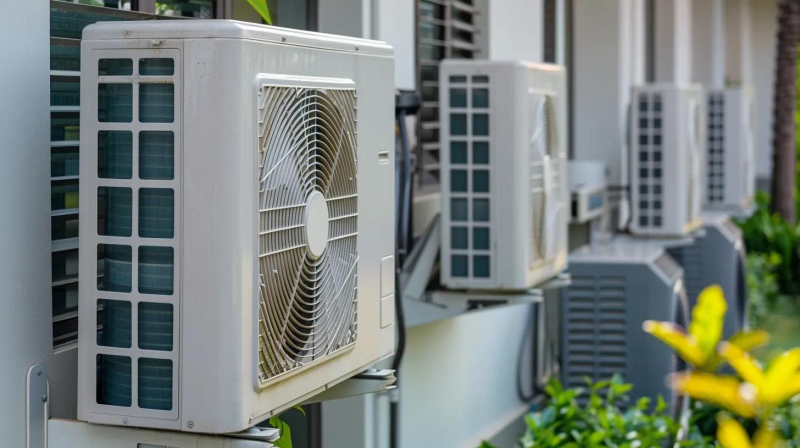
Choosing an AC can feel overwhelming, with a wall of white boxes and strange acronyms like BTU. We’re here to cut through that noise and turn confusing jargon into plain English. The goal is to give you the confidence to pick the perfect model for your space and budget in about ten minutes.
First, we’ll find the right type of unit for an apartment without central air, then show you how to match its power to your room size. Finally, we’ll explain efficiency ratings to help you save money on your electric bill, giving you a clear path to selecting one of the best apartment air conditioning units with total confidence.
Table of Contents
Window vs. Portable: Which AC Type Is Right for Your Apartment?
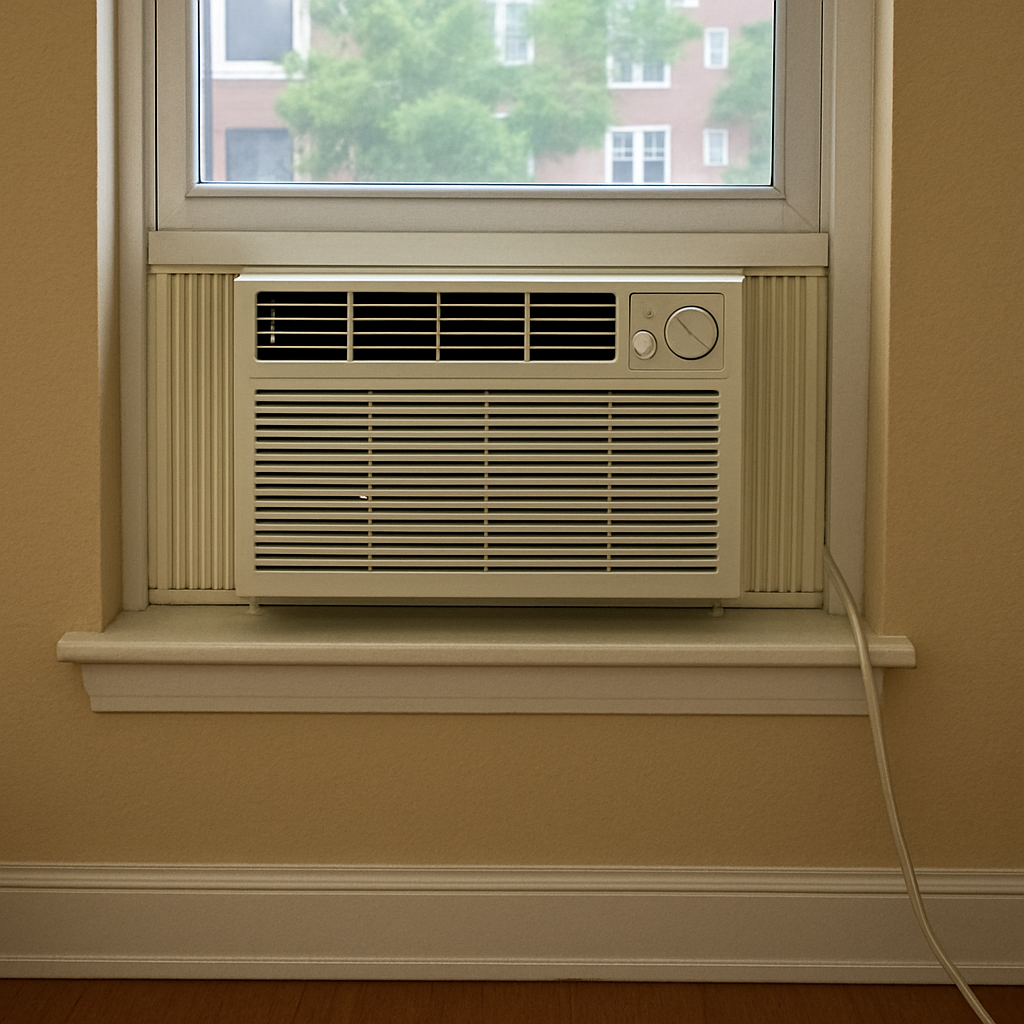
When you think “air conditioner,” you probably picture a Window AC unit—the classic box that sits securely in a window frame. These are popular for a reason: they offer the most cooling power for their size and are very energy efficient. The big catch for apartment dwellers, however, is that they aren’t always allowed. Many building policies restrict them for safety or aesthetic reasons, so you must check your lease before buying one.
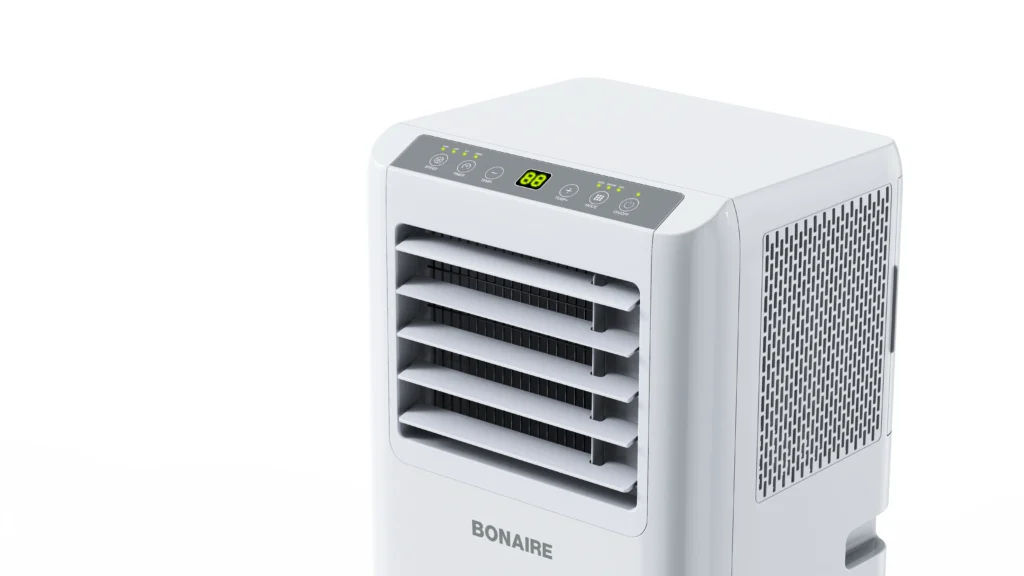
If window units are a no-go, your best bet is a Portable AC unit . This is a freestanding machine on wheels that stays inside your room, venting hot air outside through a large hose attached to a window kit. Its main advantage is flexibility. Since nothing hangs outside your building, it’s a fantastic window AC alternative for renters with strict rules and can even be used with sliding doors or crank-style windows. The trade-off is that portables are less efficient and take up valuable floor space.
For pure performance in the portable AC vs window unit for apartment debate, window units win. They are simply better at getting heat out of the room and use less electricity to do it. A portable unit, however, is an excellent solution when rules or window types limit your options. A slightly less efficient AC is infinitely better than no AC at all on a sweltering August night.
The right choice ultimately comes down to your building’s rules and your priorities.
- Choose a Window AC if: Your building allows it and you want the most cooling for your money.
- Choose a Portable AC if: You have strict landlord rules or non-standard windows that won’t support a window unit.
What Size AC Do I Need? Decoding BTUs for Your Exact Room Size
After you’ve picked your AC type, the single most important decision is choosing the right size. This is measured in BTUs, or British Thermal Units. Think of BTUs as horsepower for your air conditioner; it’s simply a measure of cooling power. More BTUs mean more power to cool down a bigger space, but surprisingly, bigger isn’t always better.
Getting the size wrong creates problems. An undersized unit will run constantly without ever making the room truly cool, wasting electricity. But an oversized unit is just as bad. It will blast the room with cold air and shut off too quickly, failing to run long enough to properly dehumidify the space. This leaves you in a room that feels cold but clammy—not the crisp, dry comfort you want. This constant on-and-off cycling also strains the machine and wastes energy.
To find your perfect fit, match the BTUs to your room’s square footage. You can get a rough estimate by multiplying your room’s length by its width. For example, a 12-foot by 15-foot bedroom is 180 square feet. For a room this size, or for a typical small studio apartment, a 5,000 to 6,000 BTU unit is usually the sweet spot. Nailing this calculation is key to effective cooling without inflating your electric bill.
How to Save Money on Your Electric Bill: Understanding Energy Efficiency (EER/CEER)
Knowing your BTUs ensures your room gets cold, but it doesn’t tell you how much it will cost to keep it that way. For that, you need to look at the Energy Efficiency Ratio (EER) or Combined Energy Efficiency Ratio (CEER). Think of this number as the “miles-per-gallon” rating for an air conditioner. A higher number means the unit does its job more efficiently, using less electricity to produce the same amount of cool air. A unit with an EER of 12 is significantly more efficient than one with an EER of 10.
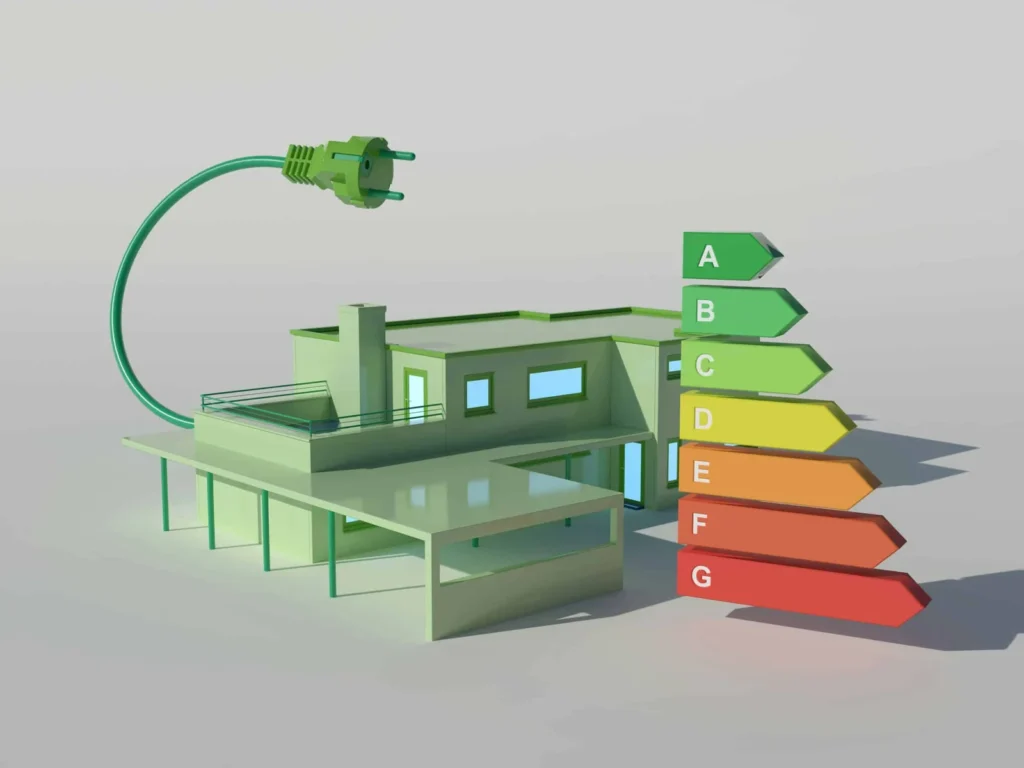
The difference between two EER numbers might seem small, but it adds up on your monthly bill. Choosing a model with a high EER over a less efficient one with the same BTUs could easily save you $20-$40 over a single summer. You’ll find this rating on the bright yellow EnergyGuide sticker on every new AC, making it easy to compare models. This number is the key to understanding the true long-term cost of any air conditioner.
This efficiency rating often explains why a seemingly identical energy efficient window AC unit might cost $50 more than another. While it’s tempting to grab the cheapest box, that slightly more expensive, high-EER model can often pay for its price difference in electricity savings within just a couple of seasons. It’s a classic case of spending a little more now to save a lot more later.
The Search for Silence: Finding the Quietest Air Conditioner for Your Bedroom
An efficient air conditioner is great for your wallet, but not if it sounds like a jet engine. Noise level is a critical factor, especially for light sleepers. Sound is measured in decibels (dBA), and the lower the number, the better. For context, a normal conversation is about 60 dBA, while a quiet library sits around 40 dBA. When hunting for the quietest air conditioner for your bedroom, aim for a model that operates below 55 dBA on its lowest setting.
The secret to this whisper-quiet performance often lies in “inverter technology.” Traditional apartment AC units run on an on/off cycle—the compressor kicks on at full blast, then shuts off completely, creating that familiar, jarring rumble. An inverter AC, however, works more like cruise control in a car. Its compressor runs continuously at a low, steady speed, making subtle adjustments to maintain the temperature. This not only avoids the noisy start-up jolt but also makes it a more energy efficient window AC unit.
By combining these factors—power (BTUs), efficiency (EER), and noise (dBA)—you can find your ideal cooling companion. A model with a low decibel rating and inverter technology is a strong contender that will keep you cool and let you sleep in peace.
Our Top 5 Apartment AC Units for 2024
Finding one single “best” air conditioner is impossible because every apartment dweller has different priorities. Your top concern might be saving money on electricity, while your neighbor might be focused on finding a unit quiet enough for a nursery.
This list of the top apartment AC units is organized by what matters most. We’ve selected winners for specific situations—from the most energy efficient window AC to the best portable air conditioner for a small room—so you can find the perfect match for your exact needs.
Top Pick #1: The Quiet Sleeper
If your biggest fear is an AC that sounds like a jet engine, this one’s for you. The Midea U-shaped Inverter Window Air Conditioner is legendary for a reason: it’s one of the quietest air conditioners you can buy, making it perfect for a bedroom or home office.
Its brilliant U-shaped design lets you slide your window almost completely shut between the front and back of the AC. This simple but revolutionary change means the loud compressor stays outside, and the closed window itself acts as a massive sound barrier.
This clever engineering delivers incredible performance without the racket. The extremely low dBA rating is quiet enough to fade into the background, while its best-in-class efficiency rating means it sips electricity. For light sleepers who refuse to choose between staying cool and getting rest, this is the clear winner.
Key Specs:
- Cooling Power: 8,000 BTU (for rooms up to 350 sq. ft.)
- Efficiency: 15.0 CEER (Extremely high)
- Noise Level: 42 dBA (Whisper quiet)
Top Pick #2: The Renter’s Lifesaver
When your building has a strict “no window units” rule, you don’t have to suffer. Portable air conditioners are fantastic window AC alternatives for renters, and the Whynter ARC-14S Dual Hose Portable Air Conditioner is a long-standing favorite because it actually works well.
The secret is its dual-hose system. Many cheaper portables use one hose, which pulls cool air from your room to cool the machine and vent it outside, creating negative pressure that draws in warm air. A dual-hose model like the Whynter uses one hose to pull outside air in and the second to vent hot air out. It’s a much smarter design that cools your room faster and more efficiently.
While it’s not as quiet as a U-shaped window unit, this model delivers serious cooling power for large living rooms or stuffy, sun-baked studios. If your lease ties your hands, this is the best portable air conditioner to get you through the summer.
Key Specs:
- Cooling Power: 10,000 BTU (SACC) (for rooms up to 400 sq. ft.)
- Type: Dual-Hose Portable AC
- Best For: Apartments where window units are banned
Top Pick #3: The Budget Champion
Sometimes, you just need to cool a small bedroom or home office without draining your bank account. For that, the GE AHEC05AC Window Air Conditioner is our budget champion. It’s a classic, compact unit that does one thing well: makes a small room comfortable. As long as your apartment AC rules permit window units, this model provides incredible value.
The catch? At this price point, you’re trading quiet operation and top-tier efficiency for affordability. It’s noticeably louder than premium models, and while its efficiency rating is solid, it’s not the most energy-efficient unit you can buy. However, for a secondary room or a first apartment, the performance is more than enough to justify the small bump on your utility bill.
This GE model proves you don’t have to spend a lot to stay cool. It’s a simple, effective workhorse for small spaces.
Key Specs:
- Cooling Power: 5,000 BTU (for rooms up to 150 sq. ft.)
- Efficiency: 11.0 CEER (Good)
- Price Point: Typically under $200
Top Pick #4: The Living Room Powerhouse
Cooling a small bedroom is one thing, but an open-plan living room or a spacious studio requires serious power. The LG LW1222IVSM Dual Inverter Smart Window Air Conditioner is our pick for these large, hard-to-cool spaces, answering the question, “What size AC do I need for my main room?”
This unit’s massive 12,000 BTU output handles areas up to 550 square feet while maintaining an excellent 12.0 CEER rating, delivering powerful cooling without being an energy hog. Its Wi-Fi connectivity lets you turn it on from your phone on your way home, ensuring you walk into a cool oasis. It’s the perfect blend of raw power and modern convenience for an energy-efficient window AC unit.
While it’s a significant investment, this model provides the performance needed to make your largest living areas genuinely comfortable.
Key Specs:
- Cooling Power: 12,000 BTU (for rooms up to 550 sq. ft.)
- Efficiency: 12.0 CEER (Excellent)
- Feature: Wi-Fi enabled
Top Pick #5: The Dehumidifying Duo
Sometimes, the enemy isn’t just heat—it’s the humidity that makes a room feel unbearable. While all apartment air conditioning units remove some moisture, some models are specifically designed to tackle that sticky, heavy air.
The Midea 6,000 BTU U-shaped Air Conditioner is a standout for this very reason. Its clever design and dedicated “Dry Mode” allow it to pull an impressive amount of water from the air, leaving your room feeling crisp and comfortable, not just cold. This feature is a game-changer for anyone in a humid coastal area, a rainy region, or a stuffy basement apartment where dampness is a constant battle.
By prioritizing moisture removal, this unit prevents that clammy feeling and can even help reduce musty odors. It’s the perfect choice when you need to fight both heat and humidity.
Key Specs:
- Cooling Power: 6,000 BTU (for rooms up to 250 sq. ft.)
- Feature: Strong dehumidification via a dedicated “Dry Mode”
- Best For: Humid climates or basement apartments
How to Install a Window AC Safely (Without Losing Your Security Deposit)
Before you even open the box, check your lease for specific apartment AC rules and regulations, or call your landlord directly. Confirming you have the green light will save you from a major headache and a potential penalty later.
Once you’re cleared, your top priority is making sure the unit is secure without drilling into the window frame. A support bracket is your best friend here. Instead of screws, these renter-friendly devices use tension and leverage to brace the AC’s weight against your building’s exterior wall. This provides a sturdy, damage-free foundation that prevents the unit from falling, protecting people below and your security deposit.
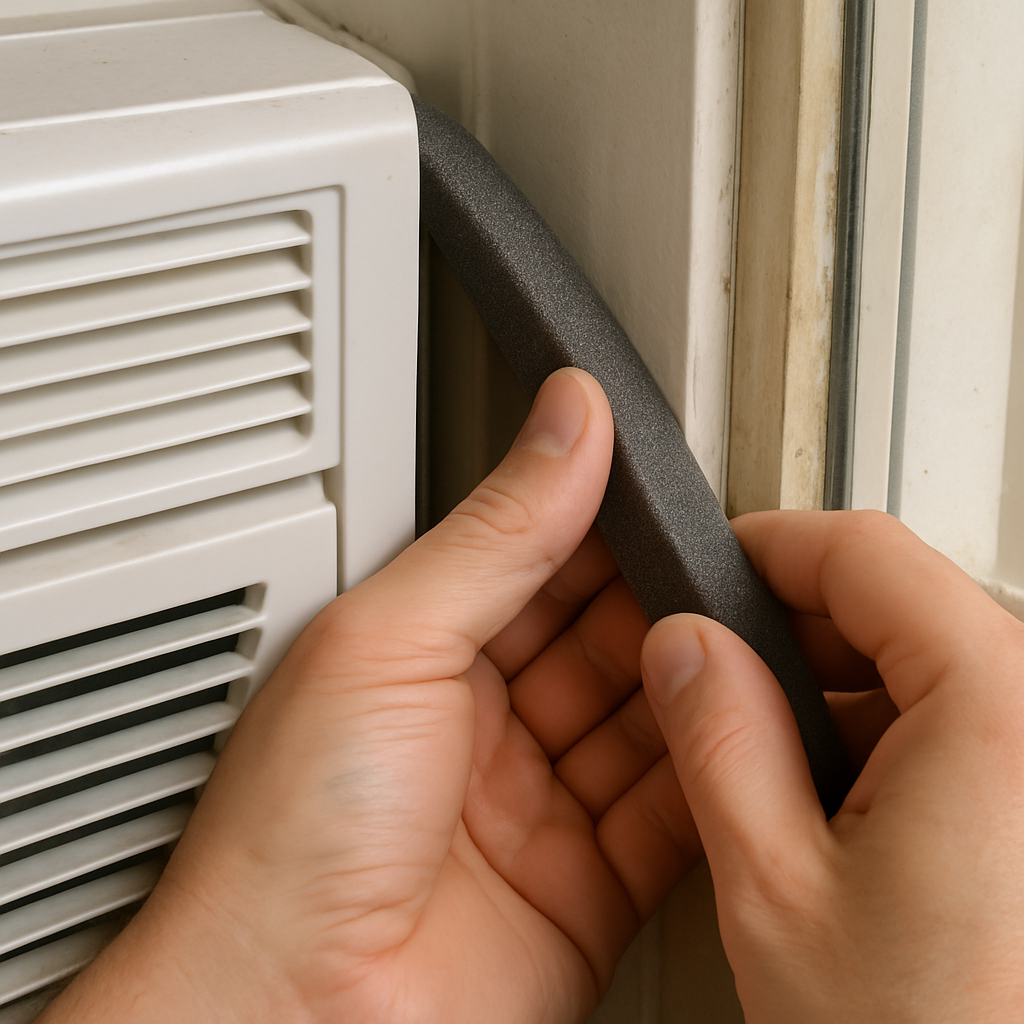
With the unit in place, you’ll probably notice gaps around the side panels. Don’t ignore them—they’re an open invitation for hot air, humidity, and pests. An easy, non-permanent fix is to use foam insulation. This soft material can be cut to size and pressed firmly into the gaps to create an airtight seal. It’s an inexpensive trick that peels right off at the end of the season, leaving no trace.
Keep Your Cool: 3-Minute Maintenance for a Longer-Lasting AC
If your AC suddenly feels weak, the most common culprit isn’t a mechanical failure—it’s a dirty filter. Think of the air filter as your AC’s lungs; this mesh screen behind the front panel catches dust, pet hair, and pollen. When it gets clogged, your AC can’t “breathe” properly, forcing it to work harder and driving up your electricity bill while delivering less cool air.
Luckily, cleaning the filter is one of the easiest seasonal air conditioner maintenance tips. Doing it once a month takes less than five minutes and makes a huge difference.
Your Monthly 3-Minute AC Checkup:
- Pop off the front grille or panel of the unit.
- Slide out the thin mesh screen—that’s the filter.
- Rinse it under warm water in your sink until clean.
- Let it air dry completely, then slide it back in.
While you’re at it, do a quick water check. It’s normal for apartment air conditioning units to drip water outside as humidity is removed from your room. However, if you see water pooling inside, turn the unit off and check that it’s tilted slightly backward to allow for proper drainage.
Your Apartment AC Pre-Purchase Checklist: Buy with Confidence
You now have the tools to look past the marketing noise and find the right unit. Use this checklist as your secret weapon when choosing an AC, whether you’re browsing online or comparing models in a store.
Your 5-Point AC Shopping Checklist:
- My Apartment’s Rule Is: (Window units OK / Portables only)
- My Room’s Square Footage Is: sq. ft.
- My Target BTU Is:
- My Priority Is: (Quietness / Budget / Power)
- My Target Efficiency Is: EER/CEER of 11.0 or higher
By matching power, efficiency, and type to your exact space, you’re investing in your comfort with precision. That cool, quiet room won’t be an accident—it will be the direct result of the smart decisions you are now ready to make.
This guide helps you pick the best apartment AC unit by comparing popular options, explaining their benefits, and showing what works best for different spaces and cooling needs.
FAQ:
What types of apartment AC units are best for cooling small spaces?
Window and portable AC units are often the best choices for apartments because they’re easy to install and don’t require major modifications to your space.
Are mini-split systems worth it in an apartment?
Mini-split systems are efficient and quiet, making them ideal for apartments with limited ductwork — but you may need landlord approval and professional installation.
Can a single AC unit cool an entire apartment?
A single portable or window AC can cool one room or a studio effectively, but for larger or multi-room apartments, you may need multiple units or a more robust system.
How do I choose the right cooling capacity for my apartment AC unit?
Choose an AC with the right BTU rating based on your apartment’s square footage — higher BTUs cool larger spaces more effectively.
What maintenance do apartment AC units require?
Regular maintenance includes cleaning or replacing filters, checking vents for obstructions, and ensuring good airflow to keep the unit efficient and extend its lifespan.
Are portable AC units less efficient than other types?
Yes — portable ACs are generally less energy-efficient than traditional window or mini-split units but offer flexibility and convenience where installation options are limited.