
A commercial maintenance contract for a small building is a list of specific tasks, on a specific schedule, with a written report after each visit. If a proposal does not name the tasks and the interval, you are buying a promise to show up, not maintenance. This post is for the owner of a strip retail building on Colorado Boulevard, the manager of a two-story medical office in Pasadena, CA, or the person responsible for a small warehouse in the San Fernando Valley: what to put in the contract and what to watch for.
What small commercial buildings are running
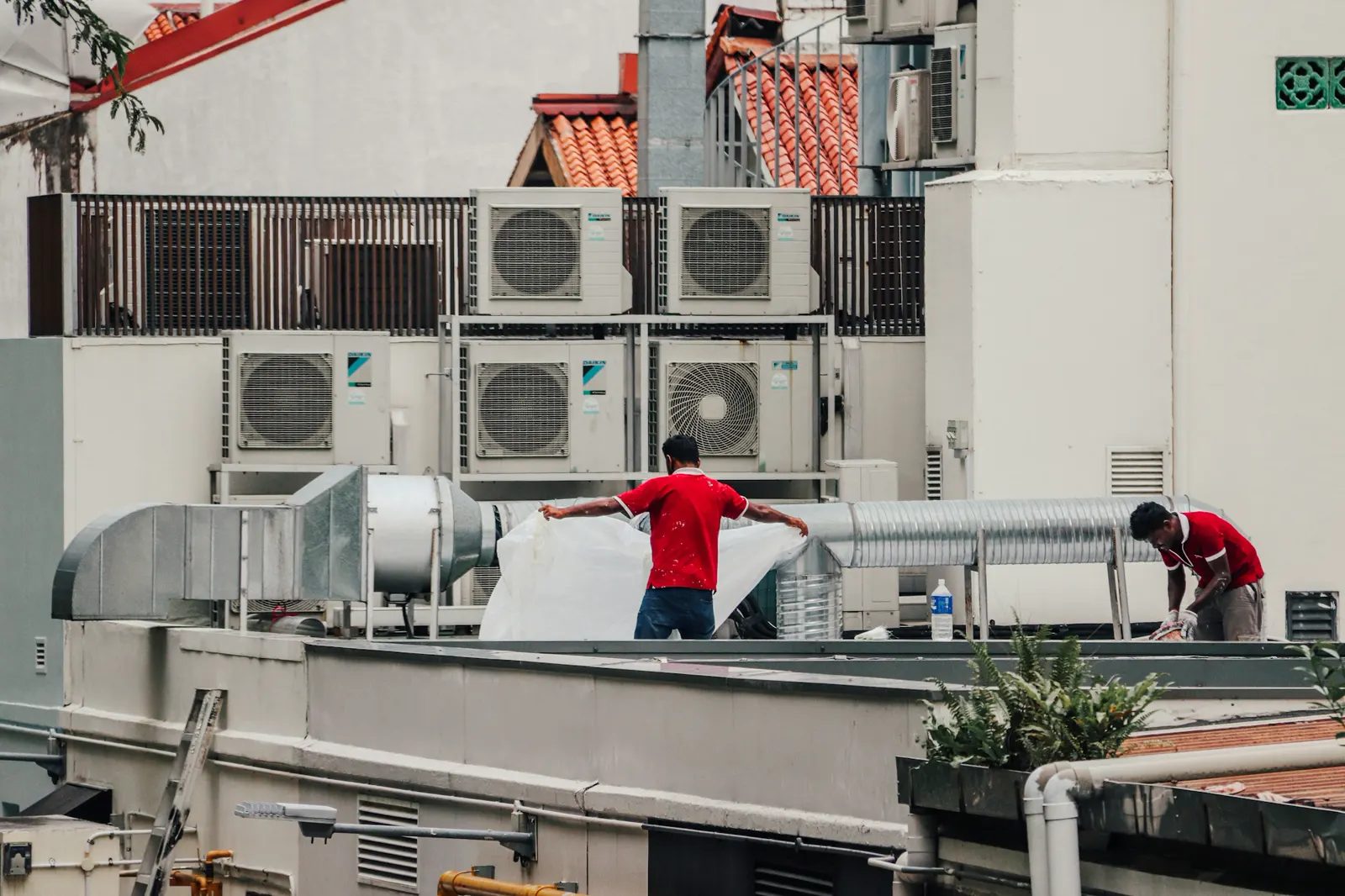
Most small commercial buildings across the San Gabriel Valley and the Valley have rooftop package units on a flat roof. Each unit is a complete system in one cabinet, one per tenant space or one per zone, ducted down through the roof. A four-tenant strip building usually has four to six of them; a small office two or three.
That equipment sits in full sun on a roof that hits well over 130°F on a summer afternoon. It runs long hours during a cooling season that stretches from May into October. It breathes whatever is on the roof: dust, Santa Ana grit, exhaust from a restaurant hood, cottonwood in spring. That is why commercial maintenance is a schedule, not a yearly courtesy visit.
What the contract should cover, per visit
Quarterly is the usual interval for small buildings. Some tasks happen every visit, some once a year.
Every visit:
- Filter change on every unit. Commercial units use bigger filters and more of them, and a restaurant tenant loads them faster than an office.
- Belt inspection on belt-drive blowers, which most rooftop units still have. Tension, glazing, cracks. Pulley alignment.
- Condensate drain checked and cleared. A blocked drain on a rooftop unit overflows onto the roof, and a blocked drain on an indoor unit overflows onto a tenant's ceiling tile.
- Thermostat or control check for each zone. Confirm the schedule matches the tenant's hours.
- Visual on the cabinet, panels, and roof curb. Loose panels, missing screws, rust, bird nests.
- Listen to each unit run and note anything that changed.
Twice a year, before cooling and before heating:
- Refrigerant charge measured on each unit, with the readings on the report.
- Capacitor readings and amp draw on compressors and motors, compared against the data plate.
- Contactors and electrical connections inside the unit inspected and tightened.
- Economizer check. Many commercial units in California have an economizer, a damper that brings in outside air when it is cooler than inside. They fail stuck open, which floods the space with 100°F air in August, or stuck closed, which does nothing and nobody notices. A tech should cycle it and confirm the damper moves and the sensor works.
- Heating section check before winter: burners, ignition, flame sensor, heat exchanger, gas pressure on gas units.
Once a year:
- Condenser coil chemical cleaning on every unit. A hose rinse is not this. The coils on a rooftop unit take the full dust load of the roof, and a coated coil is the number one reason a unit cannot keep up in August. Budget this as its own line item; a real coil cleaning takes time.
- Evaporator coil and blower wheel inspection and cleaning as needed.
- Duct connections at the roof transition inspected for separation and leaks.
What the paperwork should look like
- A per-unit log. Each rooftop unit has a tag number, and each visit's readings go on that unit's page. Over two years, the log tells you which unit is drifting and which tenant space is going to be a problem.
- Readings, not checkmarks. Charge by superheat or subcooling, capacitor microfarads, amps. "System OK" is not a reading.
- A written quote for anything found, before it is done. Maintenance is the contract; repairs are approved separately. Any contract that lets the contractor do repairs without sign-off is a blank check.
- A response commitment for calls between visits, stated in hours, and a statement of who to call. Tenants call the manager; the manager calls one number.
What you can check yourself
Property managers and owners can do more than they think, especially between visits.
- Walk the roof once a season, if it is safe to access. Look for standing water around the curbs, panels that have come loose in the wind, debris against the coils, and anything that sounds different.
- Ask tenants. The tenant knows which unit is loud, which space is hot at 3pm, and which thermostat nobody can figure out.
- Check the filters yourself on a unit or two, mid-quarter. If they are packed, the interval is too long for that tenant.
- Read the report. If the numbers on unit 3 have not changed in four visits, in a hot climate, somebody is not measuring.
- Read your leases. Many commercial leases in this area put HVAC maintenance on the tenant, some on the landlord, and some split it. Know who owns the contract before a unit fails.
Leave the electrical compartments, the gas train, and the refrigerant circuit to the tech. Roof safety is its own issue: a rooftop unit near an unguarded edge is not a place for a quick look.
When to call a licensed tech
Between scheduled visits, call for: a tenant space that will not cool, water on a ceiling tile, a unit that is silent when it should be running, a breaker that trips, a smell from the registers, or a unit that is short cycling. Left for a month, any of those becomes a compressor or a ruined ceiling.
For the contract itself, ask for a proposal that lists every task above with an interval. Our HVAC maintenance work on small commercial buildings follows this list, and a maintenance plan puts the visits on the calendar with a per-unit log. Every finding gets a written quote before we do anything beyond the contract scope.
Roof membrane, curb flashing, and roof drainage are a roofer's trade. We note what we see around the curbs on the report, but we do not do roofing.
Common questions
How often should commercial HVAC be serviced?
Quarterly filter and belt visits, with the full measurement visit twice a year, is the standard for small buildings in a long cooling season. A restaurant or a building on a dusty lot may need filters more often. An office with two units and light use might get by with three visits a year, but not one.
Does maintenance actually reduce breakdowns?
The parts that fail on rooftop units in this climate are capacitors, contactors, belts, and coils that have been allowed to coat over. All four are things a quarterly visit catches. What maintenance does not prevent is age; a unit at the end of its life will still need replacing, but the contract tells you which one is next so it is not a surprise in August.
Should the contract include repairs?
Not as a blanket. Include the maintenance tasks and the response commitment. Keep repairs on separate written quotes. That way you see every repair before it happens, and the contractor has no reason to find work that is not there.
If you manage a small building and want a maintenance proposal that names the tasks, book a $69 diagnostic on the first unit. We tell you the fee before booking and credit it toward the work. Call Boost Services Heating and Cooling at 818-277-5056 or send us a message and we will usually get to you within a few hours to a day. More on our commercial HVAC service.
Written with AI assistance by Boost Services, Heating and Cooling team, and reviewed by our licensed technicians before publishing. Boost Services Heating and Cooling, C-20 #1119892.