
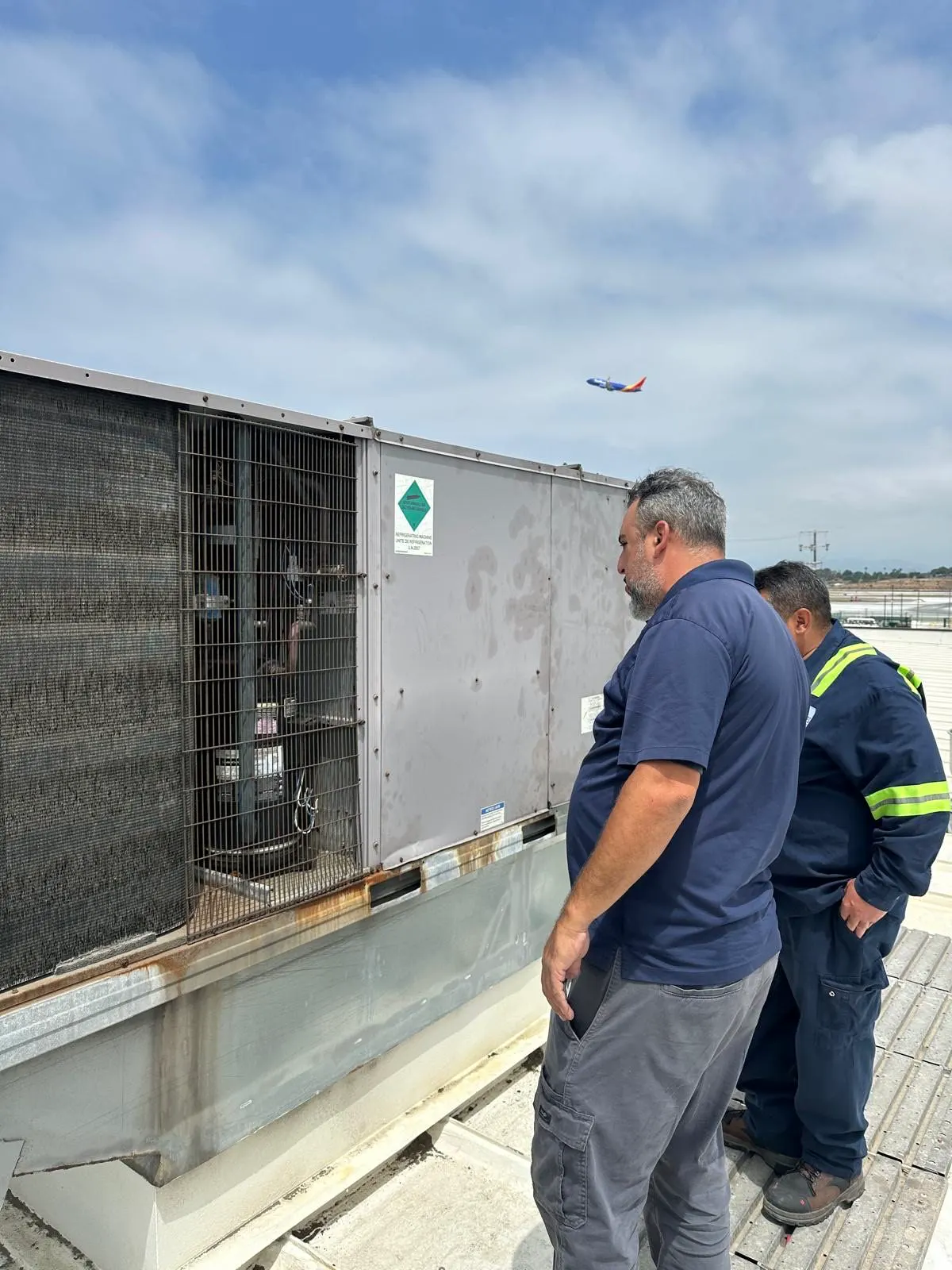
A rooftop package unit is the whole air conditioning and heating system in one metal cabinet, sitting on a curb on a flat roof, with supply and return ducts dropping straight through the roof deck underneath it. There is no indoor air handler and no outdoor condenser, because both are in the box. It is the standard equipment on strip retail, small offices, and restaurants across Pasadena, CA and the San Fernando Valley, and common on flat-roofed 1950s and 1960s ranch homes in the Valley. What goes wrong with them is mostly about sun, heat, and access.
Package unit versus split system
A split system puts the compressor and condenser coil outside on the ground and the evaporator coil and blower inside, usually in a closet, attic, or garage, with refrigerant lines running between them. A package unit puts everything in one cabinet outdoors.
| Rooftop package unit | Split system | |
|---|---|---|
| Where the parts live | One cabinet on the roof | Condenser outside, air handler inside |
| Refrigerant lines | Factory-sealed inside the cabinet | Field-run between the two pieces |
| Indoor space needed | None | A closet, attic, or garage |
| Access for service | Ladder or roof hatch | Walk up to it |
| Replacement | Crane, usually | Truck and a dolly |
| Where they are common | Flat roofs, commercial, some SFV homes | Pitched-roof homes with attic or closet space |
Package units have one real advantage: the refrigerant circuit is sealed at the factory, so line-set leaks, a common split-system problem, do not exist. Everything else about their location works against them.
What goes wrong on a flat roof
- Heat. A roof in the Valley in August is far hotter than the ground. The cabinet bakes, and the parts inside it, capacitors first, then contactors, then wiring insulation, age faster than the same parts in a shaded side yard. Capacitor failure is the most common single repair we see on rooftop units.
- Belts. Most rooftop units use a belt-drive blower. Belts stretch, glaze, and crack, and a belt that snaps means no airflow at all. A unit that suddenly runs but blows nothing is usually a belt.
- Dirty condenser coils. The coil takes whatever is on the roof: dust, Santa Ana grit, cottonwood seed, restaurant grease if there is a kitchen exhaust nearby. Grease is the worst, because it holds dust and does not rinse off. A coated coil is why a unit cannot hold temperature in the afternoon.
- Economizers stuck open or closed. Many commercial units in California have an outside-air damper that opens when the outside air is cooler than inside. When the actuator fails open, the unit pulls in 100°F air all afternoon and the space never cools. When it fails closed, nobody notices until the tech does.
- Condensate drains. A blocked drain backs up into the cabinet, rusts the pan, and eventually finds its way down the duct into the ceiling below.
- Roof curb and duct transition leaks. The unit sits on a curb, and the ducts pass through the roof inside it. Over years of vibration, the transition between the unit and the ductwork loosens. Cooled air leaks into the curb space and hot roof air gets pulled in.
- Weather and pests. Wind pulls panels off if the screws have backed out. Birds nest in the cabinet in spring. Rain gets in through a panel left ajar.
- Access. Nobody walks past a rooftop unit. Problems a homeowner would notice on a side-yard condenser in a week go unnoticed on a roof for a season.
What you can check yourself
Only if the roof is safe to access, with a proper ladder or hatch, away from the edge. If it is not, skip this section and leave it all to the tech.
- Look at the panels. Are they all on, and are the screws in? A panel that is ajar lets in rain and pulls air around the filter.
- Look at the coil. The condenser coil is the finned surface on the sides of the cabinet. Gray, matted, or shiny with grease means it is time for a cleaning.
- Look around the curb. Standing water, debris, or a visible gap between the unit and the curb.
- Listen. A belt squeal, a rattle, or a hum that is louder than the other units on the same roof.
- From inside the space: Is cool air coming out of the registers while the unit runs? Any water stains on the ceiling tile near the duct drop?
- Check the thermostat schedule. Rooftop units in commercial spaces are often running on a schedule nobody has reviewed since the last tenant.
Do not open the electrical compartment, touch the gas section, or lean over the coil on the edge side. Reset the breaker once if it has tripped; if it trips again, leave it off.
When to call a licensed tech
Call for: a unit that runs but delivers no air, a space that will not cool in the afternoon while the unit runs, water on the ceiling below, a breaker that trips, a new noise, or a smell from the registers when the heat comes on. Our AC repair visits on rooftop units start with the belt, the capacitor, the coil, and the economizer, because that is where most of the problems are, and every finding gets a written quote before we do the work.
If the transition or the ductwork under the unit is the problem, that is a duct repair: resealing the joints and, where needed, rebuilding the transition so the unit's output actually arrives in the space.
Replacement is a different kind of job. A rooftop unit comes off and goes on by crane, the new unit has to match the existing curb or get an adapter, and every connection underneath it has to be remade in one visit. When a unit has reached that point, an AC replacement is planned around the crane day. We do the heating and air conditioning work: the unit, the curb adapter and the duct connections. Roofing around the curb is a roofer's trade, and anything that changes the building's gas or electrical service is that trade's.
Common questions
How long does a rooftop package unit last?
Roughly 15 years is the common trade figure for a package unit that has been maintained, and it can be shorter on a hot roof with no maintenance. A cabinet rusted through around the pan is at the end regardless of the data plate.
Are package units worse than split systems?
No, they are a different tool. For a flat roof with no indoor mechanical space, they are the right answer. What makes them fail early is neglect, because they are out of sight. On a quarterly maintenance schedule they hold up as well as anything on the ground.
Can I replace a package unit with a split system?
Sometimes, if the building has room for an indoor air handler and a condenser on the ground. On a strip building the answer is usually no, because the ducts run through the roof and there is no closet. On a flat-roofed house in the Valley it is worth asking, because a side-yard condenser and a closet air handler can be a cleaner install than another crane day.
If a rooftop unit on your building is not doing its job, book a $69 diagnostic. We tell you the fee before booking and credit it toward the work. Boost Services Heating and Cooling answers at 818-277-5056 or send us a message and we will usually get to you within a few hours to a day. More on our commercial HVAC service.
Written with AI assistance by Boost Services, Heating and Cooling team, and reviewed by our licensed technicians before publishing. Boost Services Heating and Cooling, C-20 #1119892.