
A multi-zone mini split is one outdoor unit feeding two or more indoor heads. Each head has its own remote and its own setpoint, so the bedroom can sit at 72 while the living room sits at 76. That part works exactly as advertised. The disappointment comes when the system is sized like central air, laid out as an afterthought, or expected to heat one room while it cools another.
One compressor, shared by every room
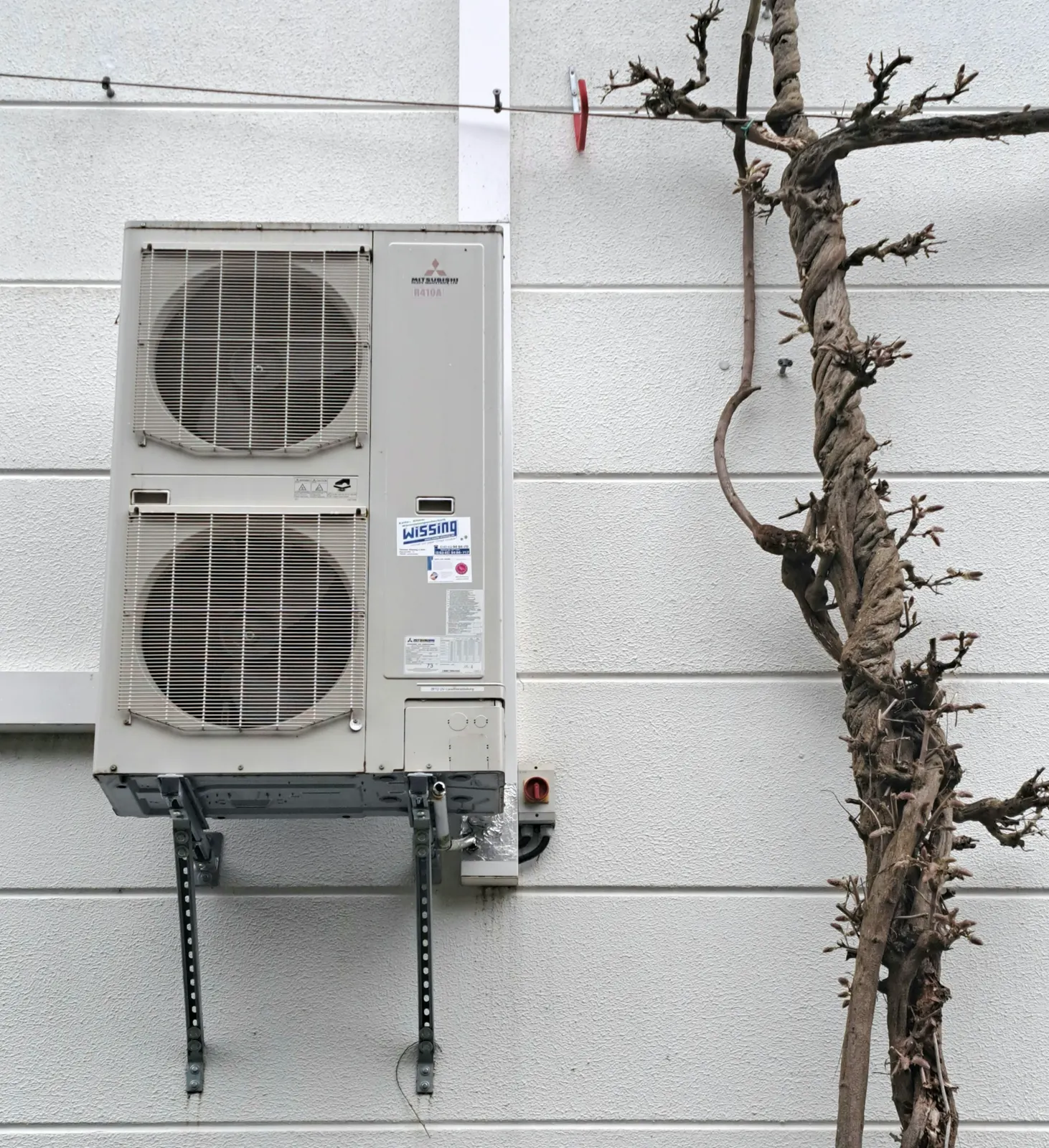
The outdoor unit holds a variable-speed compressor. Instead of switching fully on and fully off, it ramps up and down to match whatever the indoor heads are asking for. When one bedroom head is running at night, the compressor idles along at low speed. When every head kicks on during a September heat wave, it runs near full output.
Each indoor head connects to the outdoor unit through its own pair of refrigerant lines plus a communication wire. Metering valves inside the system decide how much refrigerant each head gets. That is the whole trick: one compressor, several small evaporator coils, and a controller dividing the work between them.
Two things follow from that design, and both surprise people.
- Every head runs in the same mode. On nearly all residential multi-zone equipment, if one head is cooling, the rest can only cool or sit idle. Ask for heat in the back bedroom while the front room is cooling and one of them will show an error or just wait. Equipment that heats and cools at the same time exists, but it is commercial gear.
- The heads share one refrigerant charge. A leak anywhere affects every room. A fault in the outdoor unit takes down the whole house, not one zone.
The mistakes that make them disappoint
Most complaints about multi-zone systems trace back to the design, not the equipment.
Heads that are too big for the room. The smallest head most manufacturers offer is still more capacity than a small bedroom in a 1950s Reseda ranch house needs. An oversized head hits its setpoint fast, closes its valve, and the compressor never settles into the low, steady running that makes these systems efficient. The room feels cold and then warm instead of just comfortable.
Adding up the heads past what the outdoor unit can deliver. Manufacturers allow the connected heads to add up to more than the outdoor unit's rating, on the theory that they will not all run flat out at once. On a 105-degree afternoon with every room occupied, every head calls at once and the outdoor unit cannot keep up. The west-facing living room head loses first.
Mixing one big open room with small closed rooms. A living room and dining room with 1920s single-pane windows has a very different load than a north-facing bedroom. The controller can juggle it, but a wide mismatch means the small rooms overshoot while the big room lags.
Poor head placement. A head mounted above a doorway blows into the hallway. A head aimed straight at the bed gets turned off at night, the room warms up, and the owner concludes the system does not work. The head belongs on a wall where the air can travel the length of the room without landing on someone.
Expecting one head to cover two rooms through an open door. It will not. Mini split air does not carry far. The room with the head is fine and the room next door stays warm.
Multi-zone or several single zones
Pasadena, CA and Altadena are full of Craftsman bungalows with a wall furnace, no ducts, and three or four rooms that need cooling. The question is whether to run them off one outdoor unit or two or three separate ones.
One outdoor unit means one pad, one circuit, one set of penetrations through stucco or shingle siding, and less noise in the yard. That matters on a narrow side yard in Reseda or Northridge where the setback barely fits a single condenser.
Separate single-zone units take more yard space and more outdoor equipment, but each one runs on its own. One can heat while another cools. One failure does not take down the house. And a single-zone unit matched to one head usually runs closer to its sweet spot than a multi-zone unit that has to serve three.
For a two-room ADU or garage conversion, a single zone is almost always the right call. For a whole bungalow, it depends on the rooms, the loads, and where the outdoor equipment can physically go. Our multi-zone mini split page walks through the layouts we see most.
Sizing for a hot attic and old windows
A room-by-room load calculation (the trade calls it a Manual J) is what separates a system that works from one that almost works. Square footage alone misses what drives load in the San Gabriel Valley and San Fernando Valley: west-facing glass, uninsulated 1920s walls, a flat roof over a den, an attic that reaches 130 degrees by mid-afternoon.
Sizing is also where head selection gets decided. A proper mini split installation starts with that calculation, not with a catalog.
What you can check yourself
- Read the data plate on each indoor head and on the outdoor unit. Add up the head ratings and compare them to the outdoor rating. If the total is well above it, that explains heat-wave complaints.
- Clean the filters in every head. They slide out from under the front cover. Rinse, dry, reinstall. Monthly during cooling season.
- Confirm all heads are in the same mode. A head left in heat mode while the others cool will blink or do nothing.
- Look at the outdoor unit. Clear leaves, jasmine, and anything stacked against it. It needs open air on the intake side and the fan side.
- Listen to the outdoor unit. A healthy inverter compressor changes pitch gradually. Frequent hard starts and stops suggest short cycling.
When to call a licensed tech
- One head blows cold and another blows warm in the same mode.
- Ice on the refrigerant lines or on an indoor coil.
- An error code that a power cycle does not clear.
- Water dripping from a head.
- You want to add a head. That needs a check of the outdoor unit's spare capacity and port count, plus refrigerant work that requires a licensed contractor with EPA certification.
- The system was installed without a load calculation and has never performed well. A tech can measure what each head is actually delivering.
Anything past filters and clearing the outdoor unit is mini split service work.
Common questions
Can one head heat while another cools?
On standard residential multi-zone equipment, no. The outdoor unit runs in one mode and every head follows it. If you need both at once, the answer is separate single-zone units for those rooms.
How many heads can one outdoor unit run?
Residential outdoor units typically support two to five heads, with larger models going higher. The port count sets the hard limit. The capacity rating sets the practical limit, and that one matters more on a hot day.
Is a multi-zone mini split more efficient than central air?
It can be, because you cool only the rooms in use and the inverter compressor spends most of its time at low speed. A badly sized multi-zone system gives that advantage back. The design decides it, not the label.
If your multi-zone system has never quite kept up, or you are deciding between one outdoor unit and several, we do a $69 diagnostic, credited toward the work. Boost Services Heating and Cooling answers at 818-277-5056 between 6am and 10pm, any day, or send us a note.
Written with AI assistance by Boost Services, Heating and Cooling team, and reviewed by our licensed technicians before publishing. Boost Services Heating and Cooling, C-20 #1119892.