
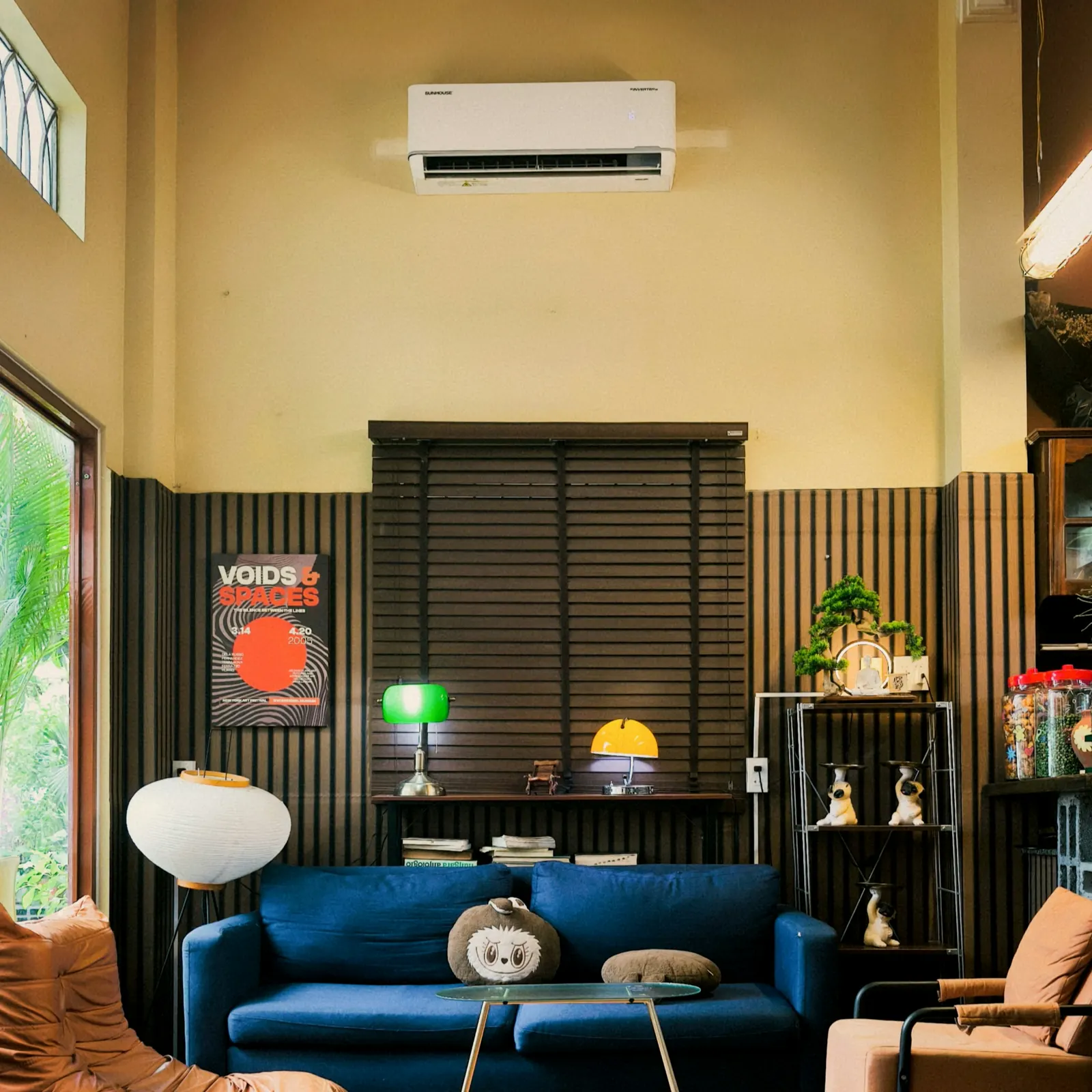
Start with the remote. A real share of "mini split not cooling" calls turn out to be a head in fan or dry mode, an active timer, or a setpoint that got bumped. After that come the things that choke airflow: the filter, the coil, the outdoor unit. Refrigerant is on the list, but it is last for a reason.
Check the mode before anything else
Mini split remotes are small and the icons are easy to misread. Walk through these in order.
- Mode. The snowflake is cool. The sun is heat. The water drop is dry mode, which runs the coil gently to pull humidity and feels cool for a while and then does not. The fan icon just moves room air. Auto picks a mode based on the setpoint, and on a cool morning it can decide to heat.
- Setpoint. It has to be below the room temperature. Some remotes show the setpoint, not the room temperature, and the two get confused.
- Fan speed. Set it to auto or high while troubleshooting. Quiet and low settings limit how much cold air reaches the room.
- Timer and sleep modes. A sleep mode raises the setpoint by a degree or two every hour. A timer shuts the unit off. Both look like a system that quit.
- Eco or energy-saving settings. These cap output. Turn them off while you test.
- Vane position. A vane aimed at the ceiling in a room with a ceiling fan blowing down can leave you feeling nothing at seated height.
- Multi-zone conflicts. If another head in the house is in heat mode, this one may refuse to cool. All heads on one outdoor unit have to agree.
- Remote batteries. Weak batteries send partial commands. The display looks fine right up until it does not.
If the head responds to the remote and the mode is right, move on to airflow.
Airflow: the filter, the coil, the blower wheel
The mesh filter under the front cover catches the big stuff. Fine dust gets through and lands on the coil fins behind it, and on the long barrel-shaped blower wheel that pushes air out. After a few seasons the coil is coated and the wheel carries a layer of grime on every blade. Airflow drops, the coil runs colder than it should, and eventually it ices.
The symptoms are a weak breeze from the head, air that is cool but not cold, and sometimes a musty smell on startup. Pull the cover and look. Frost on the fins means the coil is starved. A gray fuzz on the fins or on the wheel means it needs a proper cleaning, not just a filter rinse.
The outdoor unit
The outdoor unit's job is to dump heat, and it can only do that with clear air on both sides. Side-yard condensers in Reseda and Northridge get boxed in by a fence, ivy, stacked patio furniture, or a dryer vent blowing lint straight at the coil. Units on a west-facing wall or a flat roof sit in full sun all afternoon.
Look at it while the head is calling for cooling. The fan should spin and the air coming off the top should feel warm. If the fan is still, the compressor is humming without starting, or the coil fins are matted with cottonwood fluff and dust, the head inside has no chance.
When it is the refrigerant
A mini split does not use up refrigerant. If it is low, it leaked, and the leak is often at a flare fitting where the line set meets the outdoor unit. Signs that point this way:
- Ice on the larger, insulated copper line or on the indoor coil with a clean filter.
- Cooling that has faded over weeks or months rather than failing overnight.
- The outdoor unit running constantly without the room reaching setpoint.
- A hissing sound at the head or at the outdoor unit.
- An error code on the head that references pressure or temperature sensors.
The fix is finding the leak, repairing it, pulling the system into a vacuum, and weighing in the correct charge. Topping off a leaking system every summer is not a repair, and the DIY cans sold for cars have no place in a mini split.
Sometimes the room is the problem
A west-facing room in a 1920s Pasadena, CA bungalow at four in the afternoon on a 108-degree day has uninsulated walls, single-pane glass, and an attic above it that is hotter than the outside air. A correctly working head can lose that fight if it was sized off square footage instead of the actual load.
You can tell the difference with a thermometer. Air leaving the head should be roughly 15 to 20 degrees colder than the air going into the return at the top. If it is, the head is doing its job and the room is overwhelming it. If the split is small with good airflow, the equipment has a problem.
What you can check yourself
- Remote: cool mode, setpoint below room temperature, fan on auto or high, timer and sleep off, eco off.
- Every head on the system in the same mode.
- Fresh batteries in the remote.
- Clean the filter. Rinse, dry, reinstall.
- Lift the cover and look at the coil for frost or fuzz.
- Outdoor unit: clear anything within a couple of feet, confirm the fan spins, confirm the disconnect switch and the breaker are on. Reset a tripped breaker once. If it trips again, stop.
- Temperature test: a thermometer at the intake and at the outlet, ten minutes into a cooling cycle.
When to call a licensed tech
- Frost on the coil with a clean filter.
- The outdoor fan does not spin, or the compressor hums and does not start. Often a capacitor, sometimes the motor, and both live behind a sealed panel.
- An error code that survives a power cycle.
- A small temperature split with strong airflow.
- The coil and blower wheel need a deep clean. That means partially disassembling the head, bagging it, and flushing it, which is a mini split maintenance visit.
- Anything involving refrigerant. Licensed contractors with EPA certification only.
- The unit has never kept up since it went in. A tech can measure output and tell you whether it is the equipment, the install, or the sizing.
Most of these are mini split repair calls. If you have not settled on a system yet, our mini splits page covers what to weigh before buying.
Common questions
Why does it blow cold for a few minutes and then warm?
The compressor is shutting down while the indoor fan keeps running. Causes range from an overheating outdoor unit to low refrigerant to a protective shutdown. An oversized head reaching setpoint quickly can look the same, but that one repeats on a short, regular cycle.
Should I add refrigerant myself?
No. Mini splits hold a small, precise charge, the refrigerant requires certification to handle, and a guess in either direction damages the compressor.
How often does a mini split need a deep clean?
Filters monthly during cooling season. A professional coil and blower cleaning roughly every one to two years for most homes, sooner if you are near a freeway, have pets, or just came through a smoke season.
If the filter is clean, the mode is right, and the room is still warm, we do a $69 diagnostic, credited toward the work, with a written quote before any work starts. Call the Boost Services team at 818-277-5056 between 6am and 10pm, any day, or contact us online.
Written with AI assistance by Boost Services, Heating and Cooling team, and reviewed by our licensed technicians before publishing. Boost Services Heating and Cooling, C-20 #1119892.