
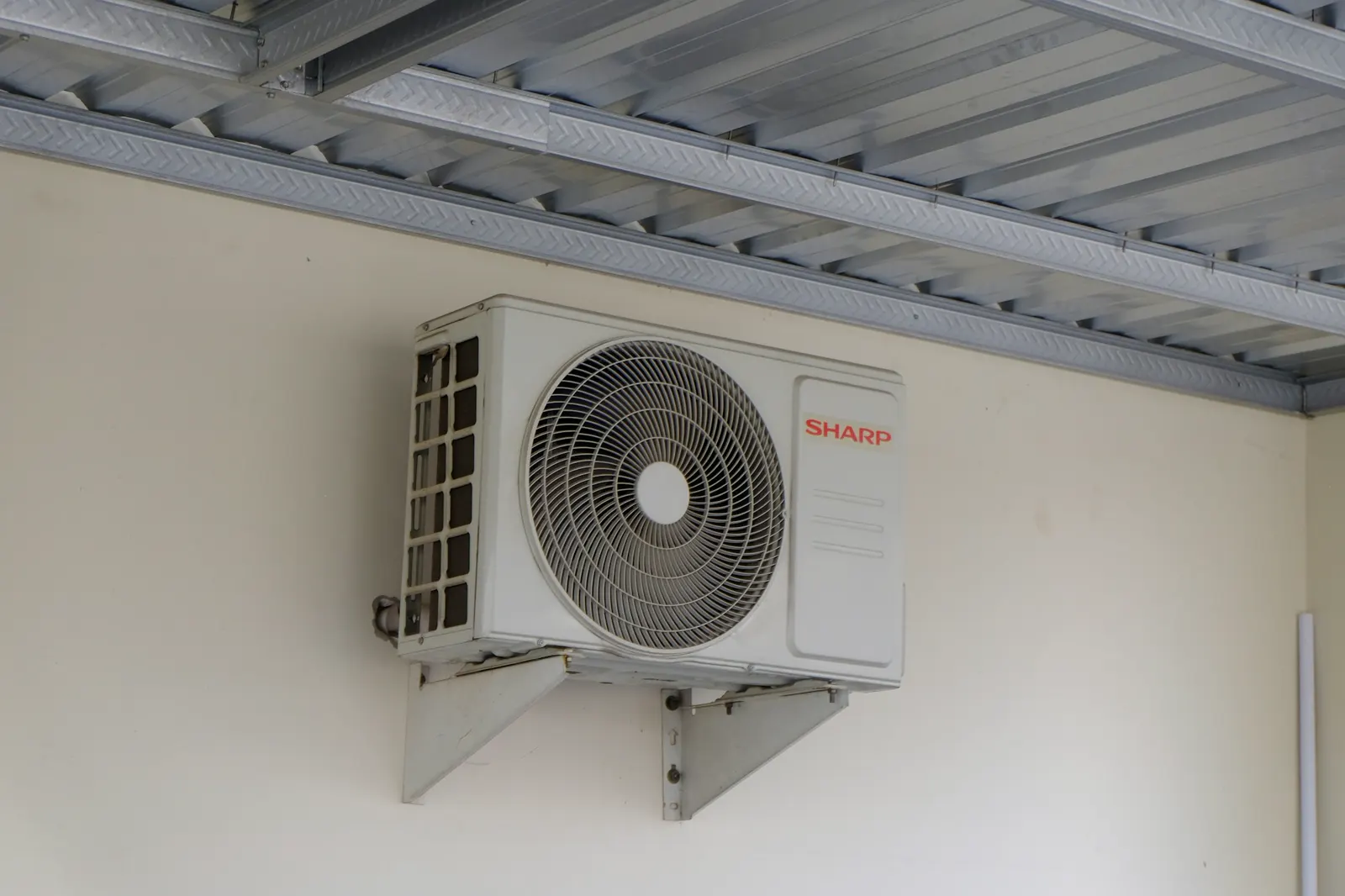
A mini split is the usual way to heat and cool a garage conversion or a backyard ADU: no ducts, its own zone, heating and cooling from one unit. Most of the ADUs going up across the San Gabriel and San Fernando valleys get exactly this. The decisions that matter are the size, where the two pieces go, and whether the space is ready for it.
Why mini splits fit this job
Tying a detached ADU or converted garage into the main house's ducted system means long duct runs, a zone damper, and a system that was sized for the house, not the house plus 500 square feet. A window unit cools but heats poorly and is loud. A mini split solves that:
- No ducts. A refrigerant line set through one small hole in the wall.
- Its own thermostat. The tenant or the home office runs it independently of the main house.
- Heating and cooling. It is a heat pump. One unit covers July and January.
- Quiet and efficient at small loads. The compressor is outside, and it runs at partial speed instead of cycling.
Garage versus converted garage: not the same job
Be clear about which one you have.
A garage that is still a garage (workshop, gym, band practice) has an uninsulated door, often no wall insulation, a slab floor, and gaps everywhere. A mini split will cool it, but it will work hard on a 100-degree afternoon in Reseda with the west sun on the door. Expect long run times and keep the door closed. If insulating the walls or the door is on the table, that is a separate licensed trade, and doing it first changes the size of the unit you need.
A permitted garage conversion or ADU has insulated walls and ceiling, a proper door, and windows. That is a normal room and sizes like one. The permit process in Los Angeles and Pasadena, CA requires the heating and any cooling equipment to be shown on the plans and in the Title 24 energy documentation, so the mini split gets designed into the build rather than added afterward.
Sizing: the mistake almost everyone makes
Bigger is not safer. An oversized mini split reaches temperature in minutes, shuts off, and repeats. The room never dehumidifies, the temperature swings, and the compressor wears from cycling. A correctly sized unit runs longer at low speed and holds steady.
What drives the size:
- Square footage, and ceiling height. A converted garage with a vaulted ceiling holds a lot more air than the footprint suggests.
- Insulation and windows. Single-pane glass or an uninsulated roll-up door adds load.
- Which way it faces. A west wall in the SFV in August is a different load from a north wall.
The right way to size is a load calculation using those inputs, which a proper mini split installation starts with. Square footage alone is how a 300-square-foot ADU ends up with a unit meant for one twice its size.
Where the indoor head goes
A wall head throws air across the room, so it wants a long wall with a clear path in front of it, mounted high. Things to avoid:
- Directly over a bed or a desk chair. Cold air straight down on a sleeping person is the top complaint in ADUs.
- A short wall in a long room. Air has to reach the far end.
- A wall with no path outside. The line set and condensate drain need to reach the outdoor unit, and the shorter and straighter the route, the better.
For a studio ADU, one head is plenty. For a one-bedroom with a door that closes, one head in the main room leaves the bedroom warm at night. That is a two-head job, on one outdoor unit or on a shared multi-zone system if the main house is going ductless too.
Where the outdoor unit goes
The outdoor unit is small, but it has to sit somewhere with airflow, drainage, and access.
- Clearance. Roughly two feet in front of the coil and room to open the panels. Not inside a fence pocket with no airflow.
- Setbacks. Most cities require a minimum distance from the property line for mechanical equipment, and a narrow side yard may not have it.
- Noise and neighbors. Even a quiet outdoor unit is not silent, and ADUs sit close to the neighbor's fence. Do not aim it at their bedroom window if there is any other option.
- Condensate. The head drips in cooling; the outdoor unit drips during winter defrost. Both need somewhere to drain that is not the neighbor's yard.
The circuit, the disconnect, and the permit
A mini split needs its own dedicated circuit and a disconnect at the outdoor unit. The disconnect and the connection to the unit are part of the HVAC install. The new circuit from the panel, and any panel work to make room for it, is a separate licensed trade, and on a detached ADU that often means a sub-panel is already part of the build. Ask early; "the panel is full" is a common surprise on older homes.
Expect a mechanical permit. Skipping it is a problem at the ADU's final inspection and again when you sell. A licensed install includes it.
The internet DIY kit question
You can buy a mini split online with pre-charged line sets. Before you do:
- Refrigerant handling requires EPA certification, and a leak from a poor connection is your problem.
- Many manufacturers tie their warranty to installation by a licensed HVAC contractor, so a self-install can cost you the coverage on the most expensive parts. Read the warranty before you buy.
- Mounting, line set routing, the drain, the disconnect, and the permit are still on you.
The part you cannot do yourself is the part that matters if it leaks.
What you can check yourself
- Measure the space and the ceiling height, and note which walls face west and south.
- Check what is in the walls and ceiling: insulated or not.
- Look at the panel door label for an open slot. Do not open the panel cover.
- Check whether the ADU permit already specifies the system.
When to call a licensed tech
Call for the load calculation, the equipment match, the line set and drain design, the refrigerant work, the disconnect, and the permit. If the ADU is under construction, call at the framing stage, when the line set can run inside the wall and the head can be placed around the furniture. After drywall, everything runs on the outside of the building.
Common questions
Can one mini split cool a garage and the house?
A single-zone unit serves one space. To serve the conversion and rooms in the house, you need a multi-zone system with a head in each. Whether that beats a separate single-zone unit depends on distance and whether the house is going ductless anyway.
Does a mini split heat well enough for an ADU in winter?
Yes. Winter nights here are mild, and a mini split's heating capacity at those temperatures is close to its rated output. It is the same heat pump technology used for whole houses.
How big of a mini split do I need for a 400-square-foot ADU?
It depends on the insulation, windows, ceiling height, and orientation, which is why square footage alone gives the wrong answer. A load calculation is part of a proper quote.
If you are planning an ADU or garage conversion, we can look at the space and give you a written quote for the right system. Call Boost Services Heating and Cooling at 818-277-5056 or send us the details here.
Written with AI assistance by Boost Services, Heating and Cooling team, and reviewed by our licensed technicians before publishing. Boost Services Heating and Cooling, C-20 #1119892.