
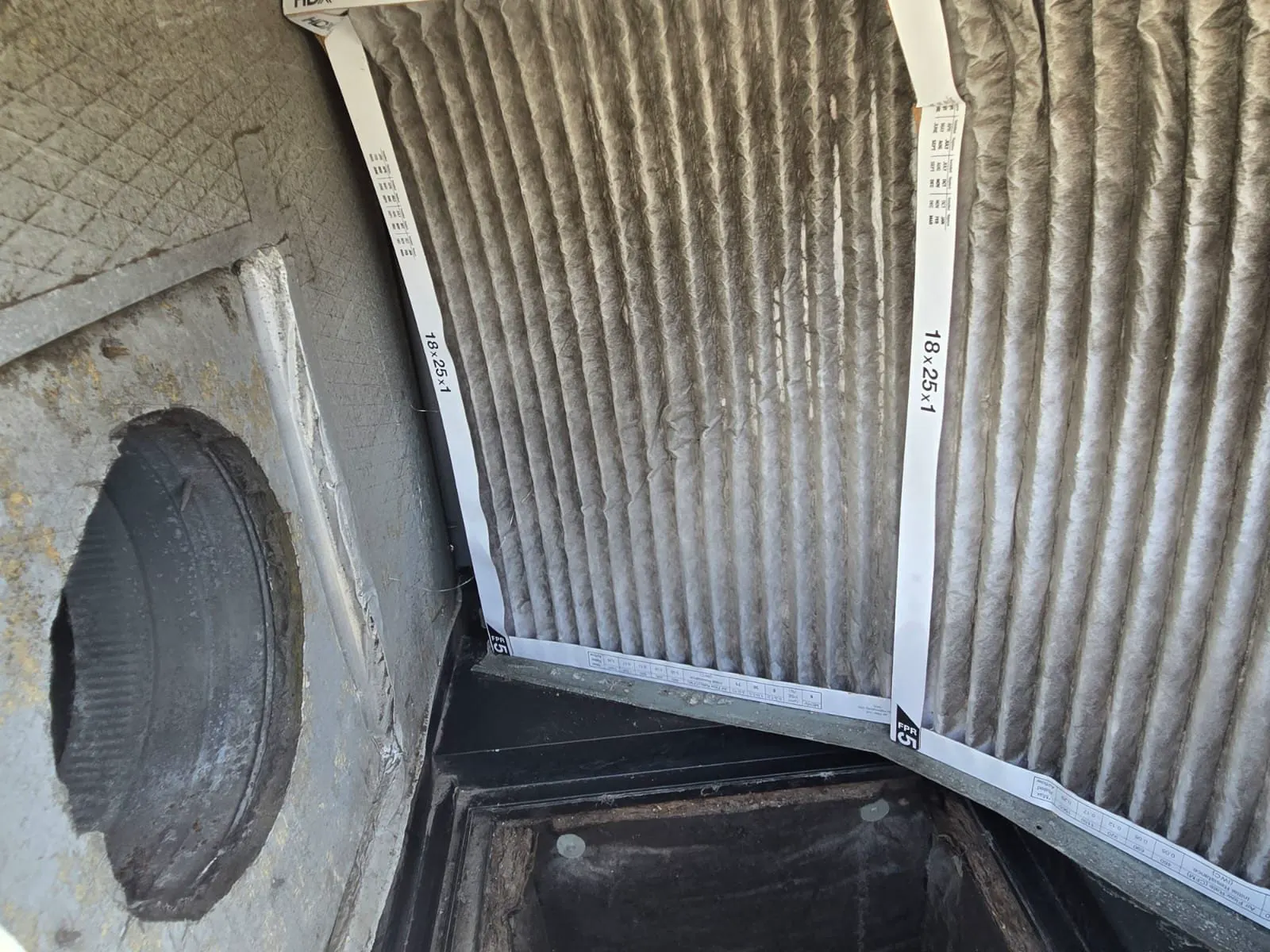
MERV is a 1-to-16 scale for how well a filter catches particles of different sizes. Higher numbers catch smaller particles. The catch is that a filter that stops more also resists airflow more, and your blower and ducts were designed around a certain amount of resistance. The right filter is the highest MERV your system can pull air through without straining, and that number is different for a 1950s Reseda ranch house and a new ADU.
What the numbers mean
The rating comes from an ASHRAE test that measures how much of three particle-size ranges a filter captures: roughly 3 to 10 microns (pollen, dust mites, larger dust), 1 to 3 microns (fine dust, some mold spores, pet dander), and 0.3 to 1 micron (smoke, bacteria-sized particles, fine combustion particles). A filter's MERV is set by the lowest range it handles well.
In practice:
- MERV 1 to 4. The blue fiberglass throwaway. It protects the blower from lint and not much else.
- MERV 5 to 8. The standard pleated filter. Catches most of the 3-to-10-micron range: pollen, household dust, mold spores. A good default for a house with no particular air-quality concerns.
- MERV 9 to 12. Better on the 1-to-3-micron range. Fine dust, dander, the stuff a house near the 210 or the 101 collects.
- MERV 13 to 16. Catches a meaningful share of the 0.3-to-1-micron range. This is the level that matters for wildfire smoke and the one used in many commercial buildings. MERV 13 is where residential filters top out for practical purposes.
You will also see retailer scales on the shelf, like MPR and FPR. Those are store systems, not the industry standard. Look for the MERV number printed on the filter frame.
The airflow trade-off
Every filter creates a pressure drop. The blower has to overcome it, along with the resistance of the ducts, the coil, and the registers. The total is called static pressure, and a system is designed for a certain maximum.
A 1-inch pleated MERV 13 has a much higher pressure drop than a 1-inch MERV 8, and it climbs as the filter loads with dust. On a system with a single small return, which describes most of the ranch houses in the San Fernando Valley and the older tracts in the San Gabriel Valley, that extra resistance can push the system past what it was built for.
The signs of a starved system:
- Weak airflow at the registers.
- Ice on the indoor coil in summer.
- A furnace that heats for a few minutes and shuts off on its high-temperature limit in winter.
- A whistling or roaring return grille.
- A filter that gets sucked into the slot and bows.
The fix is surface area. A 4-inch media filter at MERV 13 has several times the filter material of a 1-inch, so air passes through it at roughly the resistance of a thin MERV 8. That is the normal upgrade path for anyone who wants MERV 13 on an older system. The other fix is a second return, which helps the whole system breathe.
Which MERV for which house
- A typical house, no allergies, no pets. A 1-inch MERV 8 pleated filter, changed on schedule, is a solid floor.
- Allergies, pets, a busy road, or a smoke season every year. MERV 11 in the 1-inch slot if the system tolerates it, or MERV 13 in a 4-inch cabinet.
- A newer variable-speed system. These usually handle higher-resistance filters. The manual lists a maximum pressure drop for the filter. Check it.
- A mini split. Its mesh filter is not MERV rated and mostly protects the coil. Some heads accept small add-on filters. A portable HEPA unit in the room does more.
- Anyone tempted by a HEPA in the return slot. Do not. HEPA is well beyond MERV 16 in resistance and needs its own bypass unit with its own fan.
If the goal is better air throughout the house rather than just protecting the equipment, in-duct options are covered on our air purifiers page.
How often to change it
Dust load decides it. A 1-inch filter in a house in Pasadena, CA with a dog, a Santa Ana wind event, and a remodel next door can be gray in three weeks. The same filter in a clean house with the windows shut lasts three months. Hold it up to a light. If you cannot see light through it, it is done.
A 4-inch media filter goes roughly six months to a year. Running the fan on continuous loads any filter faster, so shorten the interval if you do.
What you can check yourself
- Read the MERV printed on your current filter and note the size.
- Check the fit. A filter with a gap around it lets air bypass, and the bypass air carries the dust the filter was supposed to catch straight into the coil.
- Check the arrow. It points in the direction of airflow, toward the blower.
- Listen at the return grille with the system running. A whistle means restriction.
- Do a quick comparison. With the filter pulled out for a minute and the fan running, is airflow at the nearest register clearly stronger? A large jump means the filter is too restrictive for the system or badly overdue. Put it back in either way.
- Look at the furnace or air handler manual for filter guidance. Many list an acceptable range.
When to call a licensed tech
- You want to know what the system can actually handle. A static pressure reading with a manometer takes a few minutes and gives a real number instead of a guess.
- The coil ices or the furnace trips its limit after a filter change. That is a restriction problem, and if it has iced more than once the coil may need attention, which is an AC repair call.
- You want a 4-inch media cabinet installed or a return added.
- The filter slot itself leaks around the edges. Sealing it is a small job with a real payoff.
- The filter has been neglected long enough that the coil and blower are coated. A filter change does not clean them. That is HVAC maintenance work.
Common questions
Is MERV 13 too much for my system?
In a 1-inch slot on an older system with one return, often yes. In a 4-inch cabinet, almost never. If you are not sure, a static pressure reading settles it.
MERV 8 versus MERV 13: what is the practical difference?
MERV 8 handles dust and pollen. MERV 13 also handles smoke and the finest particles. On an ordinary day in a clean house you will not notice the difference. During fire season, with allergies, or with someone in the house who reacts to fine particles, you will.
Does a higher MERV filter cost more to run?
Slightly. The blower works a little harder against the extra resistance. The larger cost is the damage when a restrictive filter freezes a coil or overheats a furnace, which is why the media cabinet exists.
If your system has never been checked for what filter it can handle, or the coil has iced after a filter change, we do a $69 diagnostic, credited toward the work. Boost Services Heating and Cooling answers at 818-277-5056 between 6am and 10pm, any day, or contact us online.
Written with AI assistance by Boost Services, Heating and Cooling team, and reviewed by our licensed technicians before publishing. Boost Services Heating and Cooling, C-20 #1119892.