
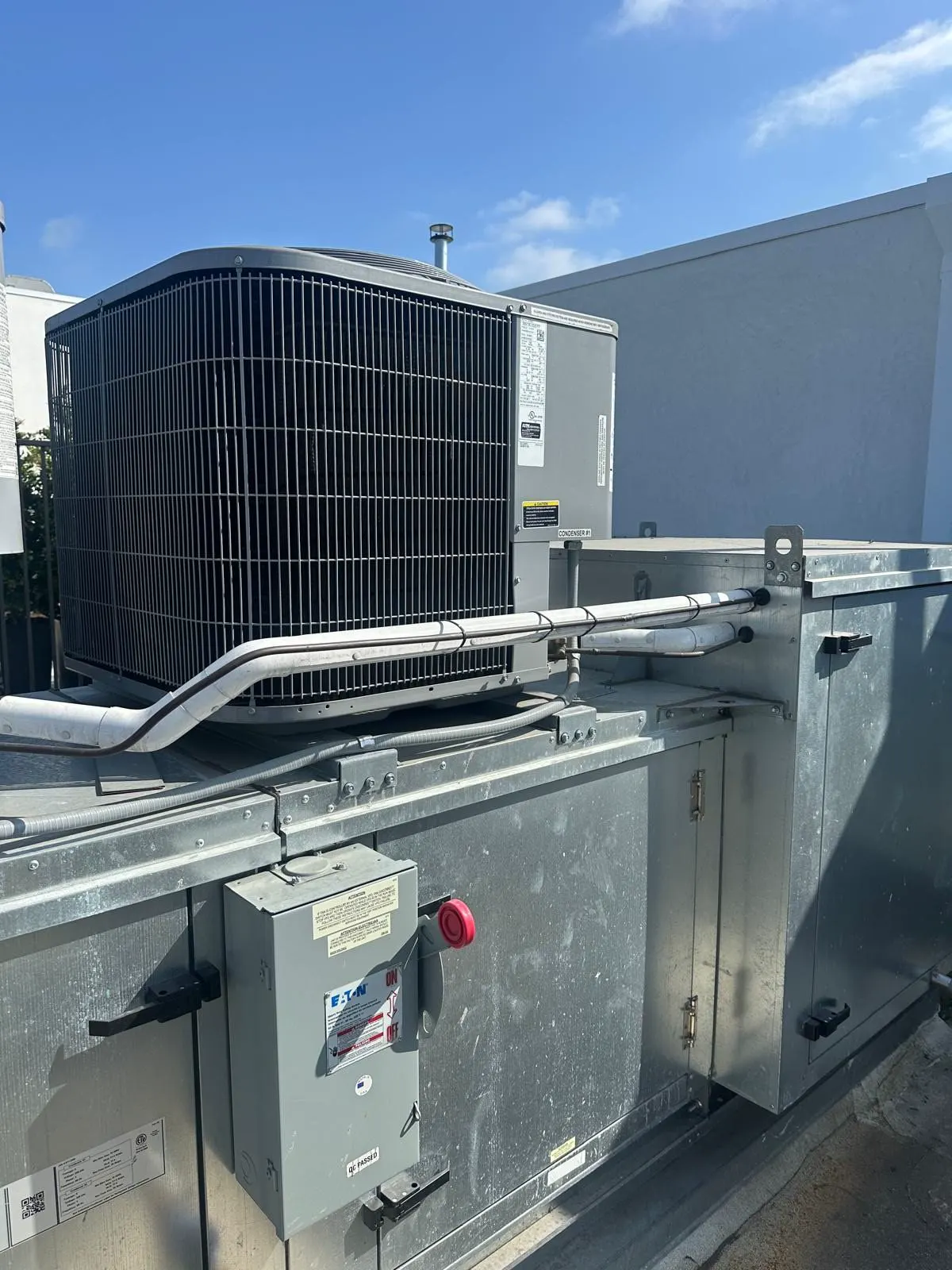
A breaker trips because something on that circuit pulled more current than the breaker is rated for, or because current found a path to ground it should not have. When the AC is the thing on the circuit, that usually means the compressor is working harder than it was designed to, a part that helps it start has weakened, or a wire has come loose and is arcing. One trip on a 105°F afternoon can be a fluke. Two or three in a week is a fault, and the breaker is doing its job by shutting things down.
Why an air conditioner pulls too much current
The outdoor unit has the two big electrical loads in the whole system: the compressor and the condenser fan motor. Both draw a surge of current at startup, then settle down to a running load. Anything that makes the compressor work harder, or makes startup take longer, pushes the current up toward the breaker's limit.
In order of how often we find them:
- Dirty condenser coil. The outdoor coil sheds the heat pulled out of your house. In the San Gabriel Valley it collects dust, jacaranda fluff, cottonwood seed, and dryer lint if the vent is nearby. A coated coil cannot dump heat, so the pressure inside the system climbs and the compressor draws more amps to push against it. On a mild day it gets by. On a 100°F day it trips. This is the most common cause we see on side-yard condensers in Pasadena, CA and across the Valley.
- Weak run capacitor. The capacitor gives the compressor and fan motor the kick they need to start. As it weakens, the compressor struggles to get going and draws high current for longer than it should. Capacitors fail more often in hot climates because heat is what kills them, and a condenser sitting on a west-facing wall in Reseda is in a hard spot.
- Low airflow indoors. A packed filter or a blocked return starves the indoor coil. The coil gets too cold, frost builds, and eventually liquid refrigerant heads back to the compressor, which is not built to pump liquid. The compressor labors and the amps climb.
- Failing condenser fan motor. When the fan slows or seizes, the coil cannot shed heat, and the same high-pressure problem appears. A seized motor also draws a very high current on its own.
- Loose or burnt wiring. The connections at the contactor, the disconnect box, and the compressor terminals loosen over years of heating and cooling cycles. A loose connection arcs, and arcing trips breakers. You can sometimes smell it.
- Compressor going bad. A compressor with shorted windings trips the breaker the instant it tries to start. A compressor with a locked rotor hums, draws locked-rotor current, and trips within a second or two. Both need a tech with a meter to confirm, and both are the expensive end of this list.
- Wrong breaker size. The data plate on the outdoor unit lists a maximum overcurrent protection rating. If someone swapped the condenser for a larger one without changing the breaker, it may simply be undersized. Note that changing a breaker is work inside the panel, which is a separate licensed trade, not HVAC.
What the timing tells you
How fast the breaker trips narrows things down.
- Trips the instant the unit tries to start: short to ground, usually the compressor or a burnt wire.
- Trips after a second or two of humming: compressor cannot get going, often a capacitor, sometimes the compressor itself.
- Trips after running 10 to 30 minutes on a hot afternoon: heat-related, usually a dirty coil, a weak capacitor, or a struggling fan motor.
- Trips only during the hottest hours: the system is at the edge of its capacity. Coil cleaning and a capacitor test come first.
What you can check yourself
Stay outside the electrical compartments. None of this involves opening anything sealed.
- Reset the breaker once. Push it fully to OFF, then back to ON. If it holds and the unit runs, keep an eye on it. If it trips again right away, leave it off and call. Repeated resets can turn a cheap repair into a dead compressor.
- Look at the outdoor unit. Is the fan spinning when the system calls for cooling? Is the coil visibly gray with dust or matted with fluff? Is anything leaning against it or growing into it?
- Change the filter. A filter that has been in since spring is a real cause, not a formality.
- Check the registers and returns. Furniture pushed against a return grille cuts airflow more than most people expect.
- Check the thermostat. Make sure it is actually calling for cooling and the fan is set to AUTO, so you know the unit was trying to run when it tripped.
- Look at the disconnect box on the wall by the unit. If the cover looks scorched or discolored, or smells hot, leave it alone and call. That is a wiring problem.
Do not hose the coil with the power on: pull the block or flip the switch at the disconnect box by the unit first. Do not go into the electrical compartment on the outdoor unit even with the disconnect off. The low-voltage control wiring is fed from the indoor unit and can still be live, and the capacitor holds a charge after the power is cut.
When to call a licensed tech
Call when the breaker trips more than once, when it trips instantly, when you hear humming or clicking from the outdoor unit without the fan starting, or when you smell anything burnt near the disconnect or the unit. A tech will measure the capacitor, check amp draw on the compressor and fan against the data plate, inspect the contactor and every connection in the unit, and check refrigerant pressures. That order matters, because a compressor that trips on a dirty coil tests fine once the coil is clean. Our AC repair visit covers all of that, and if the coil is the problem, a proper coil cleaning with the right chemical and a rinse from the inside out usually ends the tripping.
If the breaker itself is the suspect, meaning it is warm to the touch, trips at loads it used to hold, or is the wrong size for the unit, that is a job for an electrician. We can tell you what the data plate calls for, but panel work is outside a C-20 license.
Common questions
Is it safe to keep resetting the breaker?
Once, yes. After that, no. Each trip on a compressor that is struggling to start puts heat into the windings. Enough of those and the windings fail, which turns a capacitor swap into a compressor replacement.
Why does it only trip in the afternoon?
Because the outdoor unit is working hardest when the air around it is hottest. A coil or capacitor that is marginal at 85°F is over the line at 102°F. Attic temperatures matter too; ducts in a 130°F attic mean the system runs longer to hit the setpoint, so it spends more time at peak draw.
Could the thermostat cause this?
Not directly. The thermostat only sends a low-voltage signal. But a thermostat that short-cycles the system, turning it on and off every few minutes, makes the compressor start far more often than it should, and every start is a current spike. A tech will notice that pattern during the visit. Annual HVAC maintenance catches a weak capacitor and a dirty coil before either becomes a tripping breaker.
If the breaker has tripped more than once, book a $69 diagnostic. We tell you the fee before booking and credit it toward the work. Call Boost Services, 818-277-5056 or send us a message and we will usually get to you within a few hours to a day.
Written with AI assistance by Boost Services, Heating and Cooling team, and reviewed by our licensed technicians before publishing. Boost Services Heating and Cooling, C-20 #1119892.