
Most AC calls in Pasadena, CA come down to a short list: a thermostat problem, a tripped breaker, a packed filter, a dirty outdoor unit, a clogged drain line, or low refrigerant. The first five you can check in under an hour with no tools beyond a garden hose and a shop vac. The last one needs a licensed tech. Work through them in this order, because each one rules out the next.
Start at the thermostat
A blank screen usually means dead batteries. Pop the cover; most take AA or AAA cells. If the screen is on, run the one-minute check:
- Mode is set to cool, not off or heat.
- Fan is on auto. "On" runs the blower continuously and circulates room-temperature air between cooling cycles, which feels like the AC is blowing warm.
- The set temperature is below the current room temperature.
If the thermostat is in afternoon sun or on a wall that backs onto a hot garage, it reads high and cycles the system oddly. That is a placement problem, not an AC problem.
Check the breaker, once
If the system is dead silent and the thermostat is dark, look at the electrical panel. The AC breaker is usually a double breaker labeled "AC," "Air Cond," or "HVAC." A tripped breaker sits in the middle, neither on nor off. To reset it, push it firmly all the way to off, then back to on. A brief power event on a hot afternoon can trip it once.
If it trips again, leave it off and call. A breaker that keeps tripping is protecting you from a failing compressor, a shorted motor, or a wiring fault. Do not keep resetting it.
The filter, which is the usual answer
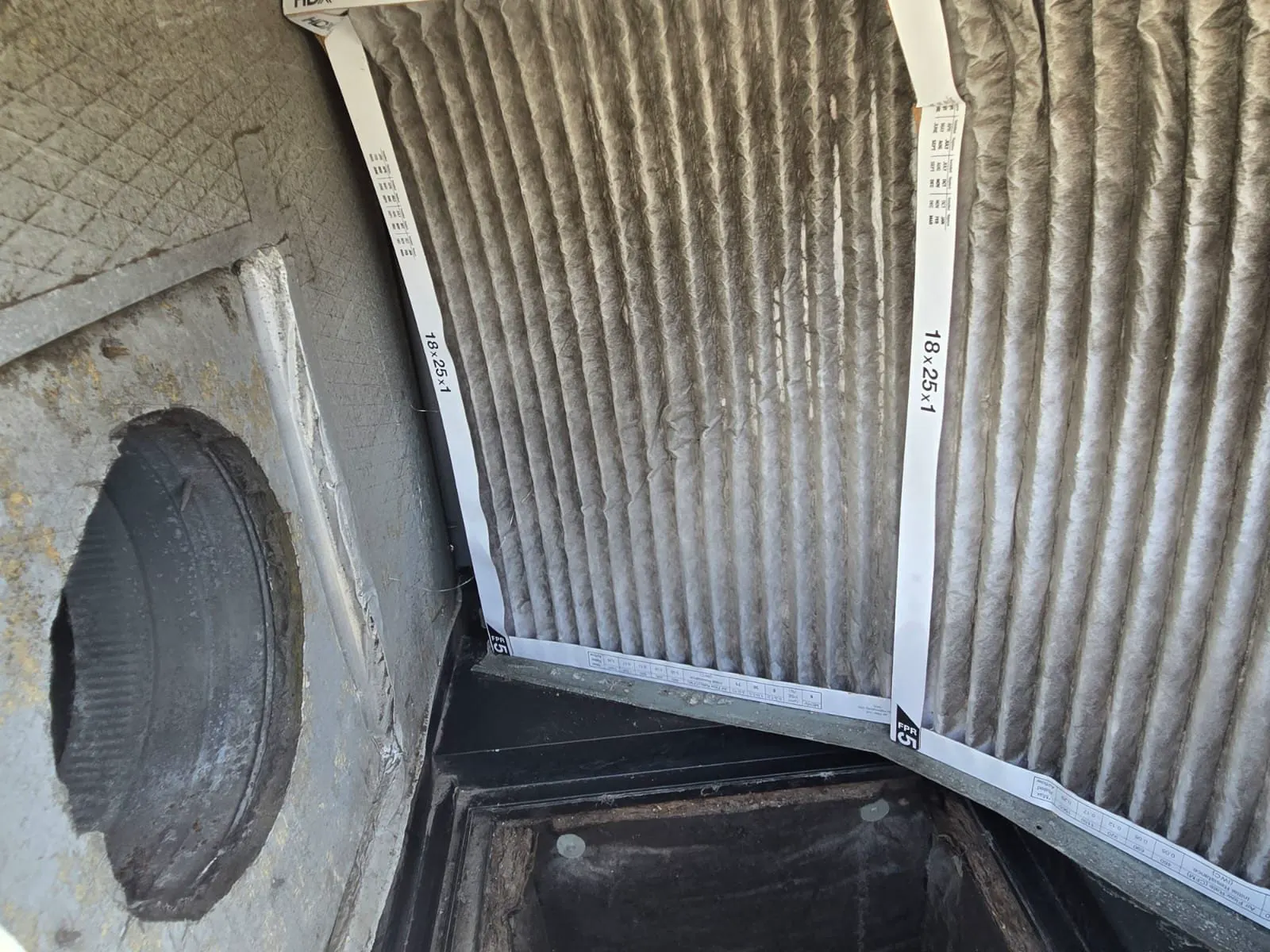
The most common reason an AC blows warm air in this area is a filter that is choking the system. Your air conditioner has to pull a large volume of house air across the indoor coil to cool it. A packed filter forces it to breathe through a blanket. Airflow drops, the coil gets too cold, and in bad cases it freezes.
The filter lives in a slot at the side or bottom of the indoor furnace or air handler (garage, attic, or closet), or behind a large return grille on a wall or ceiling. Slide it out and hold it to a light. If you cannot see through it, replace it. Note the size printed on the frame and point the arrow on the new one toward the unit. In Pasadena's dust, a filter can load up in a month during summer.
If a fresh filter brings the cold air back, you are done. If not, go outside.
Rinse the outdoor unit
The outdoor unit sheds the heat pulled out of your house through the thin metal fins around it. Dust, cottonwood fluff, dryer lint, and dog hair cake those fins and trap the heat inside. Side-yard condensers in the San Fernando Valley that sit against a fence with a foot of clearance do this every August.
Shut the power off first at the disconnect box on the wall near the unit: pull the block or flip the switch to off. Then spray the fins gently with a garden hose from top to bottom. Never use a pressure washer; it flattens the fins and blocks airflow permanently. Clear leaves and trim plants back to give the unit a couple of feet on every side. Let it dry, restore power, and test.
Water inside the house: the condensate line
A puddle at the indoor unit is alarming but usually simple. The AC pulls moisture out of the air, and it drains through a small PVC pipe. Over a long cooling season that line grows algae and sludge, backs up, and overflows the pan. Many systems have a float switch that shuts the AC off when the pan fills, so "AC stopped and there is water" often means one clog.
Find where the drain line exits the house, typically a white or black PVC stub near the outdoor unit. Seal a wet/dry vacuum hose over the end and run it for a minute or two. That pulls most clogs out. Afterward, pour a cup of white vinegar into the capped cleanout on the drain line near the indoor unit every couple of months to keep growth down.
If you cannot find the line or the vacuum does not clear it, stop. Drywall and flooring repairs cost more than a service call.
Ice or hissing: stop and call
Ice on the copper lines on a 100°F afternoon, often with a faint hiss, is the classic sign of a refrigerant leak. Refrigerant is not a consumable. If it is low, there is a leak, and the fix is finding it, repairing it, and charging the system by weight. Adding or removing refrigerant legally requires EPA Section 608 certification, so there is no homeowner version of this repair.
Running low on refrigerant overworks the compressor, the most expensive part in the system. That is why the ice is worth a same-day call rather than a wait-and-see.
Repair or replace an aging system
If the diagnosis is a failed compressor on a unit past its parts warranty, or a leak on a system that uses R-22 (production and import ended in 2020, and the data plate on the outdoor unit will say which refrigerant it uses), the honest conversation turns to replacement. Plenty of other faults on older units are worth fixing: capacitors, contactors, fan motors, drain problems. The pattern to watch is two significant repairs in two years on a system that is already up in years. A tech should put the repair number and a replacement number side by side and let you decide.
What you can check yourself
- Thermostat batteries, mode, fan setting, and setpoint.
- The breaker, reset once.
- The filter, replaced if you cannot see through it.
- The outdoor unit, cleared and rinsed with the power off at the disconnect.
- The drain line, vacuumed at the outlet.
- Every supply register open and every return grille clear.
Do not open the electrical compartment on the outdoor unit, touch the capacitor, or try to add refrigerant.
When to call a licensed tech
Call when the breaker trips a second time, when there is ice on the lines or hissing, when the outdoor unit hums but the fan does not spin, when the system short-cycles every few minutes, when you smell anything burning, or when water keeps coming back after you cleared the drain. A repair visit covers the electrical readings, refrigerant pressures, airflow, and the drain, and ends with a written quote before any work starts. A spring maintenance visit catches most of this list before the first heat wave.
Common questions
Why does my AC run all day and never catch up?
Usually airflow: filter, dirty outdoor coil, or leaking attic ducts cooling the attic instead of the house. Sometimes it is a system that was undersized or a house that has changed since it was installed. A tech can measure the temperature drop across the coil and tell you which.
Is it normal for the AC to run constantly during a heat wave?
On a 105°F day, yes. A properly sized system may run nearly nonstop and still hold the setpoint. Constant running on an 85°F day is not normal.
How often should I replace the filter?
Check it monthly during cooling season. Most homes here need a new one every one to three months, sooner during wildfire smoke or construction dust.
If your checks point past the easy fixes, book a $69 diagnostic. You are told the price before we schedule, and it is credited toward the work if you go ahead. Call Boost Services, 818-277-5056 or send us a message and we will usually be out within a few hours.
Written with AI assistance by Boost Services, Heating and Cooling team, and reviewed by our licensed technicians before publishing. Boost Services Heating and Cooling, C-20 #1119892.