
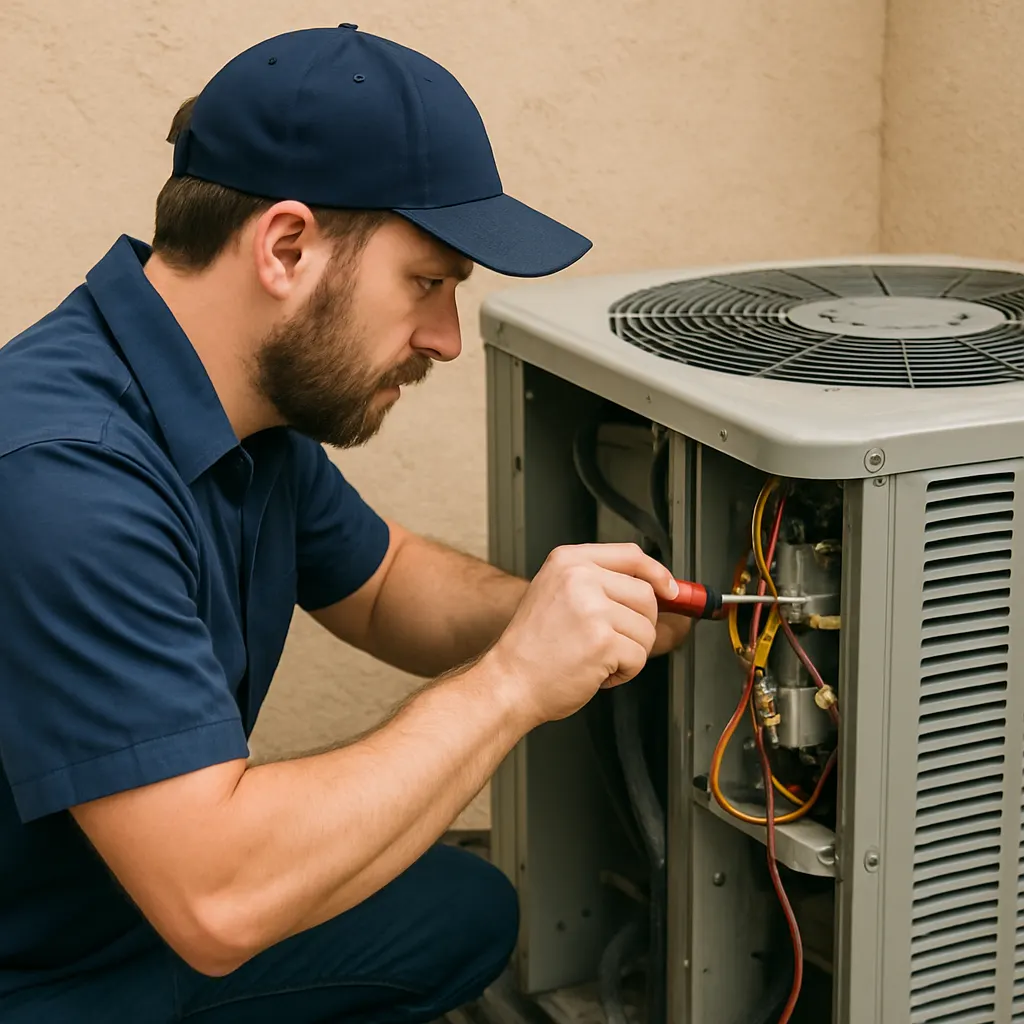
The outside unit is where most air conditioner failures show up first, because it holds the parts that work hardest: the compressor, the condenser fan, the capacitor, and the contactor. Most of the signs below trace back to one of those four, or to a coil packed with dust from a Santa Ana wind. Here is what each symptom usually means in a Pasadena, CA or Valley home, what you can safely check, and when to stop and call.
What the outside unit does
House air never touches it. Refrigerant carries heat from the indoor coil out to the condenser, the fan blows outdoor air across the coil to dump that heat, and the compressor pumps the refrigerant around. If any of those three stalls, the indoor blower keeps running and the house slowly warms up. That is why "the AC is running but not cooling" is so often an outside-unit problem.
The signs, and what is usually behind them
1. It will not turn on at all
The indoor blower runs, the thermostat is calling, and the outdoor unit sits silent. Usual causes, roughly in order:
- A tripped breaker or a pulled disconnect at the unit.
- A failed capacitor. This is the most common part failure we see in July and August.
- A failed contactor, the relay that sends power to the compressor and fan.
- A float switch at the indoor unit that shut the system down because the condensate drain clogged. This one fools people because the problem is inside.
- A thermostat or low-voltage wiring fault.
2. The fan is not spinning but you hear a hum
A hum with a stopped fan is the classic weak or dead capacitor. The motor is getting power but not the kick it needs to start. It can also be a seized fan motor. Do not reach in and spin the blade with a stick; if the capacitor is marginal the fan may start and then fail again on a 100°F afternoon, and if the motor is seized the stick does nothing.
3. It runs, but the air inside is not cold
- A dirty condenser coil. Dust, cottonwood fluff, and dry leaves pile against the fins after windy days, and the coil cannot shed heat. Side-yard units in Reseda and Northridge collect it fast.
- Low refrigerant from a leak. The system does not "use up" refrigerant; if it is low, it leaked. Look for oily residue at the line fittings.
- A compressor losing capacity.
- An airflow problem indoors, like a clogged filter or a frozen evaporator coil, which makes the whole system look weak.
4. New noises
- Buzzing that is louder than normal often means an electrical part on its way out: capacitor, contactor, or a motor straining.
- Grinding or screeching points at fan motor bearings.
- Rattling is usually loose panels, a loose fan blade, or debris inside the cabinet.
- Hissing or bubbling at the unit or the line set can be a refrigerant leak.
- Loud banging on startup is a stop-and-call sound. Shut it off.
5. Ice on the lines or the unit
Ice on the copper lines in summer is not normal. It usually means low refrigerant or restricted airflow indoors. Turn the system off, set the thermostat fan to "On" to thaw the coil, and call. Running it iced can damage the compressor.
6. It starts and stops every few minutes
Short cycling wears out the contactor and the compressor. Causes range from an oversized system to a failing capacitor, a dirty coil that trips the high-pressure safety, or a thermostat placed where a supply register blows on it.
7. The breaker keeps tripping
Once, on a hot afternoon, can be a nuisance trip. Repeatedly means a shorted motor, a failing compressor, a weak capacitor making the motor pull too much current, or wiring damage. Reset it once. If it trips again, leave it off.
8. What you can see
Bent fins over a large area, heavy debris on the coil, oil stains at the fittings, scorched or loose wires, a wobbling fan, or a unit that has settled off level on its pad.
Why heat waves bring the failures
A week of 100°F+ days means the unit runs from noon to midnight. Capacitors dry out faster in heat, motors run hotter, and a coil that was only a little dirty in May cannot keep up in August. Most of the calls we get during a heat wave are for units that showed one of the signs above in June. A spring HVAC maintenance visit, with the coil washed and the capacitor tested under load, catches most of them.
What you can check yourself
- Thermostat set to Cool, fan on Auto, setpoint below room temperature.
- The breaker for the outdoor unit. Reset it once if it tripped. If it trips again, stop.
- The disconnect box on the wall next to the unit. Make sure the pull-out is in.
- The indoor filter. Replace it if it is gray.
- Clearance. Pull back plants and clear leaves so there is roughly two feet of open space around the unit and nothing on top of it. Check the manufacturer's clearance if you are landscaping.
- Rinse the coil. With the disconnect pulled, a gentle rinse from a garden hose from the outside of the cabinet, top to bottom, clears dust. No pressure washer, and do not bend the fins.
- Look for water at the indoor unit. A full drain pan explains a silent outdoor unit.
Do not open the electrical access panel on the unit. The capacitor holds a charge with the power off, and the contactor terminals are live whenever the breaker is on.
When to call a licensed tech
- The fan hums but will not spin, or the unit will not start after one breaker reset.
- Ice on the lines, or a hissing sound.
- Any burning smell, smoke, or scorched wiring you can see through the grille.
- The unit runs but the house is not cooling after you have replaced the filter and rinsed the coil.
- Short cycling or repeated breaker trips.
- The unit is old enough to use R-22. Production and import of R-22 ended in 2020, and a leak on an R-22 system is usually the point where an AC replacement quote makes sense alongside the repair quote.
An AC repair visit for a capacitor or contactor is one of the shorter jobs we do. A compressor is not, which is why the earlier signs are worth acting on.
Common questions
Why does the outside unit run but the air is warm?
Most often a dirty condenser coil, a refrigerant leak, or a compressor that is running but not pumping. Indoors, a frozen coil or clogged filter produces the same complaint. A tech checks pressures and temperatures at the unit to tell them apart.
Is it safe to hose off the outside unit?
Yes, gently, with the disconnect pulled. Rinse from outside the cabinet, top down. Skip the pressure washer and any coil cleaner you have not read the label on. If the fins are matted with dirt rather than just dusty, that is a job for a coil cleaning with the right chemistry.
Is water around the outside unit a problem?
A little condensation on the lines is normal. A puddle that keeps coming back is usually the indoor condensate line draining nearby, or ice melting off the unit, which is the real problem.
Our diagnostic visit is $69, told to you before booking and credited toward the work. Call Boost Services Heating and Cooling at 818-277-5056 or contact us here.
Written with AI assistance by Boost Services, Heating and Cooling team, and reviewed by our licensed technicians before publishing. Boost Services Heating and Cooling, C-20 #1119892.