
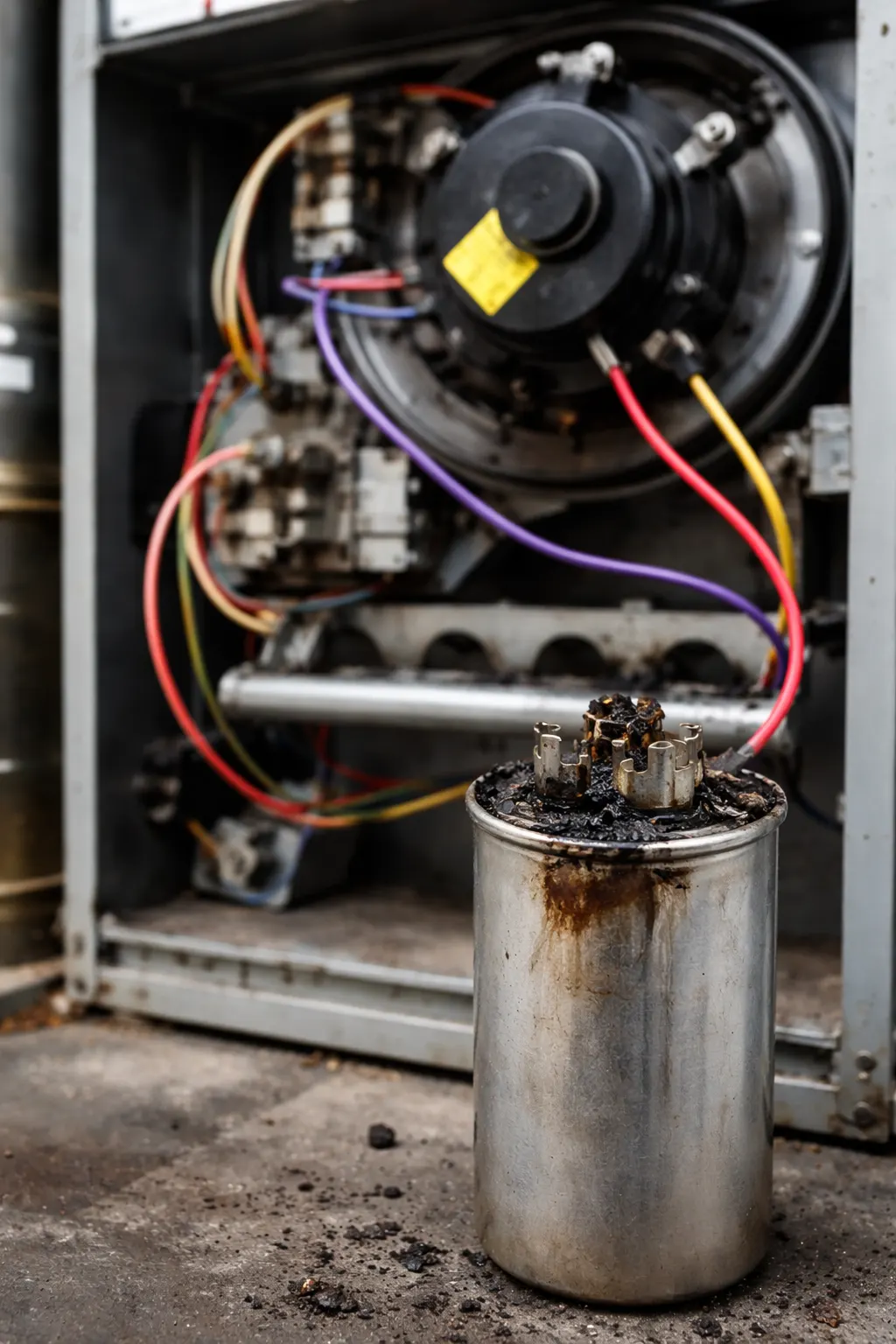
The thermostat clicks, the furnace hums for about half a minute, then everything goes quiet and no air ever comes out of the vents. That pattern points more often than not at the capacitor, a small cylinder that gives the blower motor the shove it needs to start turning. It is a common part, it fails on a predictable schedule, and it sits inside the unit on terminals that stay dangerous after the power is off. You can identify it from the outside. You should not go looking for it.
What the capacitor is actually doing
A blower motor that is standing still has to overcome its own inertia before it can spin. The capacitor stores a charge and releases it as a phase-shifted push that gets the motor moving, then, on a run capacitor, keeps steadying the current while it runs. Same idea as shoving a heavy merry-go-round: the first push is the hard one.
When the capacitor weakens, the motor still gets power. It just does not get the push. So it sits there energized and stuck, which is the hum you hear, until the control board notices the blower never came up to speed and shuts the whole sequence down for safety.
Capacitors weaken with heat and age. An air handler baking in a 130°F Pasadena, CA attic all summer ages one faster than the same part in a hall closet.
Symptom 1: click, hum, silence
This is the signature. Thermostat calls for heat, you hear a relay click at the furnace, a low steady hum starts, nothing moves, and after roughly thirty seconds to a couple of minutes the hum stops and the furnace gives up. Sometimes it will retry two or three times and then lock out.
If you have heard that sequence, you have heard the single most common symptom of a failed run capacitor. It is not proof, because a seized motor sounds much the same, but it is the first thing a tech will meter.
Symptom 2: a blower that starts slowly or only sometimes
A capacitor does not always fail outright. More often it drifts, losing capacity over a season or two, and the symptoms get strange before they get obvious:
- The blower takes several seconds to wind up instead of coming on cleanly.
- It runs fine in the morning and refuses in the evening, or vice versa.
- You hear a rapid series of clicks as the control tries and retries.
- The system heats normally for weeks, then has one bad night, then behaves again.
- The blower runs but the air feels weaker than it used to.
Intermittent is the word that matters. A part that works nine times out of ten is still a part that has started failing, and it will not choose a convenient night to finish.
Symptom 3: the furnace heats, then shuts off on limit
Here is one that gets misdiagnosed a lot. If the burners light but the blower never starts, the heat exchanger has nowhere to send its heat. The high-limit switch does its job and shuts the burners down. From the hallway that looks like a furnace that lights and quits, and people go hunting for an ignitor or a flame sensor. Underneath, the blower never started, and a weak capacitor is one of the reasons.
Repeated limit trips are hard on a heat exchanger. This is not a symptom to keep testing.
What else makes the same noises
A capacitor is a strong suspect, not a diagnosis. Things that produce a similar hum-and-no-airflow:
- Seized or dry blower motor bearings. The motor is trying; the wheel will not turn.
- A failed blower motor or, on a variable-speed unit, a failed motor module.
- A blower wheel jammed by debris or so loaded with dust that it cannot start.
- A failing relay or control board that is chattering rather than closing cleanly.
- Low voltage at the unit, which makes a healthy motor behave like one with a weak capacitor.
Telling these apart means metering the capacitor against its printed microfarad rating, checking motor amp draw and winding resistance, and watching the startup sequence with a meter on it. That is a fifteen-minute job with the right tools and a guessing game without them.
Why this is not a homeowner repair
Two reasons, and both are real.
First, a capacitor stores energy. It can hold a charge after the power is off, and the discharge goes through whatever is touching both terminals. Techs carry a tool and a procedure for exactly this. There is no version of "just be careful" that substitutes for it.
Second, it is inside the cabinet, next to the control board, the line-voltage connections and the gas train. Opening a sealed compartment on a gas appliance is not homeowner territory.
There is also a quieter reason the swap goes wrong even when nobody gets hurt: the replacement has to match the motor's microfarad value and meet or exceed its voltage rating, and a dual run capacitor has separate terminals for the blower and, on a package unit, the compressor. A close-enough part from a hardware store runs the motor hot and shortens its life. If the capacitor blew because the motor is drawing too much current, replacing only the capacitor buys a few weeks.
What you can check yourself
None of this involves opening the unit.
- Set the thermostat several degrees above room temperature and confirm it is on Heat, not Cool or Off.
- Replace the thermostat batteries if it takes them. A dead battery produces a furnace that does nothing at all.
- Pull the filter and look at it. A blocked filter causes limit trips that mimic other faults.
- Check the switch on or beside the furnace, the one that looks like a light switch. People turn it off and forget.
- Reset a tripped breaker once. If it trips again, leave it off and call.
- Stand near the unit and listen through one full cycle. Does it click? Hum? For how long? Does the blower ever come up to speed? Write it down.
Then, when you call, say what you heard: "It clicks, hums for about thirty seconds, then goes quiet and the fan never runs." That sentence saves a technician real diagnostic time and tells them what to bring on the truck.
When to call a licensed tech
Call for any of the three symptoms above, for a humming furnace, for a blower that will not start or starts slowly, for repeated lockouts, or for a breaker that keeps tripping. All of it is ordinary heating work for someone with a meter and the right part on the truck. Call immediately, and stop using the system, if you smell something burning or electrical, see scorching, or a carbon monoxide alarm sounds.
A capacitor is one of the more straightforward furnace repairs once the fault is confirmed, and confirming it is most of the job. If the unit is due anyway, a maintenance visit includes metering the capacitor and the motor's amp draw, which is how a weak one gets caught in October instead of January.
Common questions
How long does a furnace capacitor last?
There is no fixed number. Heat is what kills them, so an attic air handler in the San Fernando Valley typically gives less service than the same part in a conditioned closet. Many run for years, then drift over a season. Age plus intermittent behavior is the combination worth acting on.
Can I tell it is the capacitor by looking at it?
Not from outside the cabinet, and we are not going to tell you to open one. A failed capacitor sometimes bulges at the top or leaks, but plenty of them fail while looking perfectly normal, which is why the real test is a meter reading against the printed rating, not a glance.
Will a bad capacitor damage the blower motor?
It can. A motor that repeatedly tries to start without enough push draws high current and heats up, and that shortens its life. It is a good argument for fixing it in the first week rather than living with a furnace that works most of the time.
If your furnace is humming and the fan never starts, book a $69 diagnostic. You hear the price before we schedule, it is charged for the visit whatever we find, and it is credited toward the work if you go ahead. Call Boost Services, 818-277-5056 or send us a message. We are open 6am to 10pm, seven days, and usually out within a few hours.
Written with AI assistance by Boost Services, Heating and Cooling team, and reviewed by our licensed technicians before publishing. Boost Services Heating and Cooling, C-20 #1119892.