
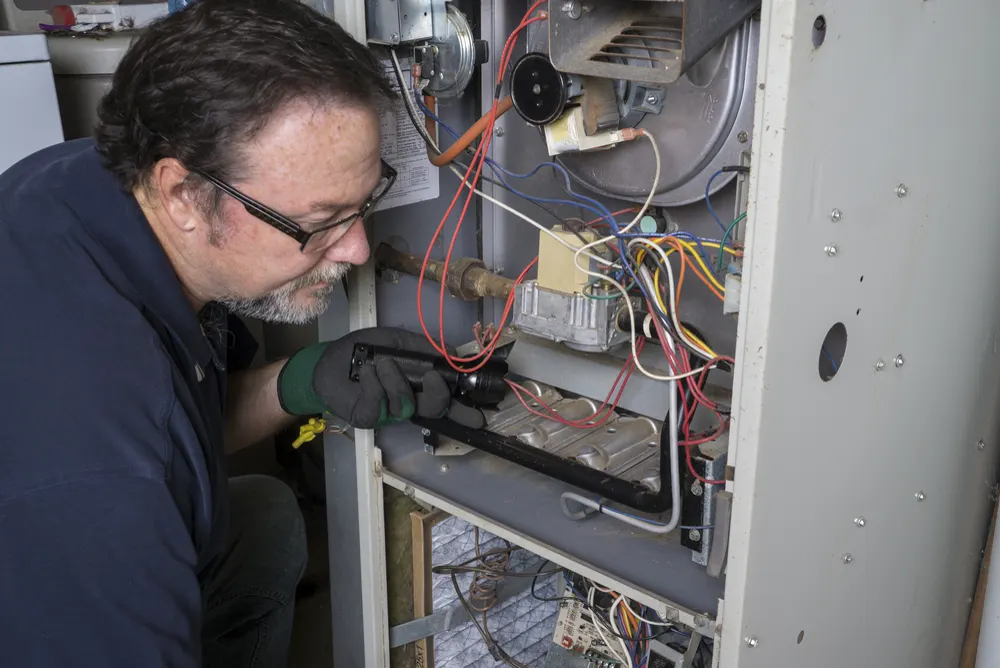
If your furnace clicks, the fan runs, and no heat comes, the ignitor is the first suspect and usually the right one. It is a small ceramic part that has to glow bright orange every single cycle, and it eventually cracks. The good news is that you can tell a bad ignitor from its neighbors, a dirty flame sensor or a control problem, by standing next to the furnace and paying attention for one minute. Here is what to listen for, what it means, and where the line is between watching and touching.
What the ignitor is
Most gas furnaces installed in the last few decades use a hot surface ignitor: a flat, dark gray blade or a thin coil on a white ceramic base, mounted at the front of the burners. When the furnace calls for heat, electricity runs through it until it glows orange, the gas valve opens, and the gas lights off the hot surface. Think of a toaster element that lights a stove.
Some furnaces use a direct spark ignitor instead, which makes a rapid tick-tick-tick spark like a gas grill. And older wall and floor furnaces in Pasadena and Altadena bungalows usually have a standing pilot, a small flame that burns all the time; those have a thermocouple rather than an ignitor, and their problems are a different post.
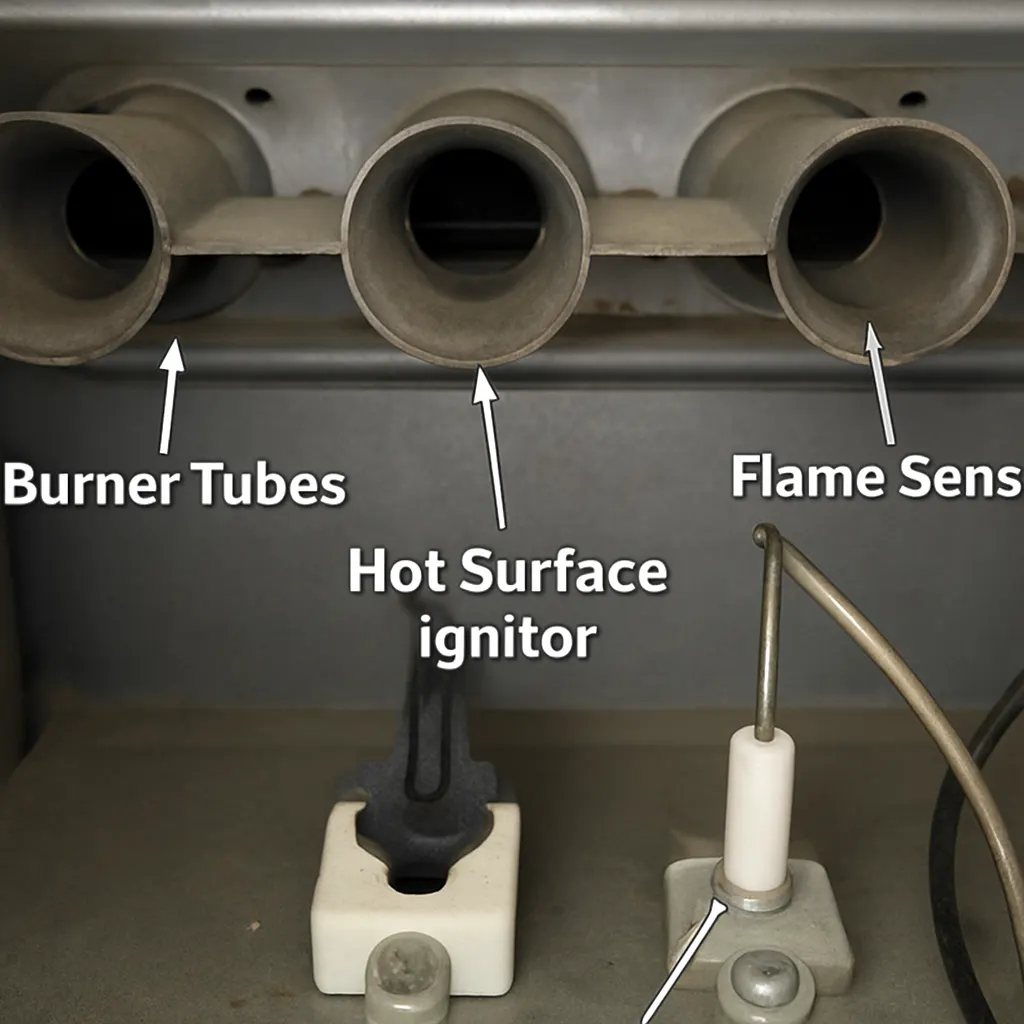
Sitting on the other end of the burners is the flame sensor, a thin metal rod that pokes into the flame. People confuse the two. The ignitor starts the fire; the flame sensor proves to the control board that the fire is there. When the sensor cannot see a flame, the board shuts the gas off within seconds.
The one-minute observation test
Turn the thermostat up a few degrees and stand by the furnace. Leave every panel on. Many furnaces have a small sight glass in the burner door; if yours does not, your ears will do. A normal startup goes like this:
- A small fan, the inducer, starts with a soft hum. It clears the heat exchanger and proves the vent is open.
- After several seconds to about a minute, the ignitor glows orange. Through a sight glass you see the light; without one you may hear nothing.
- A click as the gas valve opens.
- A soft whoosh as the burners light, then a steady blue flame.
- Half a minute or so later the main blower starts and warm air reaches the registers.
Whichever step is the last one that happens tells you where to look.
Reading the result
The fan runs, nothing glows, the furnace gives up. Fan on, no glow, and after a while the whole thing shuts down and tries again. That is the classic failed ignitor. It can also be the step before it: a pressure switch that never closed because the vent or inducer has a problem, or a control board that is not sending power to the ignitor. A tech tells these apart in a few minutes with a meter.
It glows, the burners light, then the flame dies after a few seconds. Your ignitor is fine. This is almost always a dirty flame sensor, coated with a film that keeps it from sensing the flame. The board thinks there is no fire and closes the gas valve. The furnace usually tries three times and then locks out until power is cycled. Cleaning the sensor is a routine part of a furnace maintenance visit.
Clicking but no light. The gas valve is opening and closing, or the spark ignitor is firing, but nothing catches. Gas supply, a weak spark, or a cracked hot surface ignitor that glows too dimly to light off.
Rapid repeated clicking, or a blinking light on the control board. The board is reporting a fault code. The pattern is printed on the inside of the door. That is a call.
What a bad ignitor looks like
When a tech pulls the burner door, a failed hot surface ignitor often shows a hairline crack across the blade, like a broken filament in an old light bulb, or a blistered, chalky white spot where the material has worn out after thousands of cycles. Some fail with no visible mark and only a resistance test finds it.
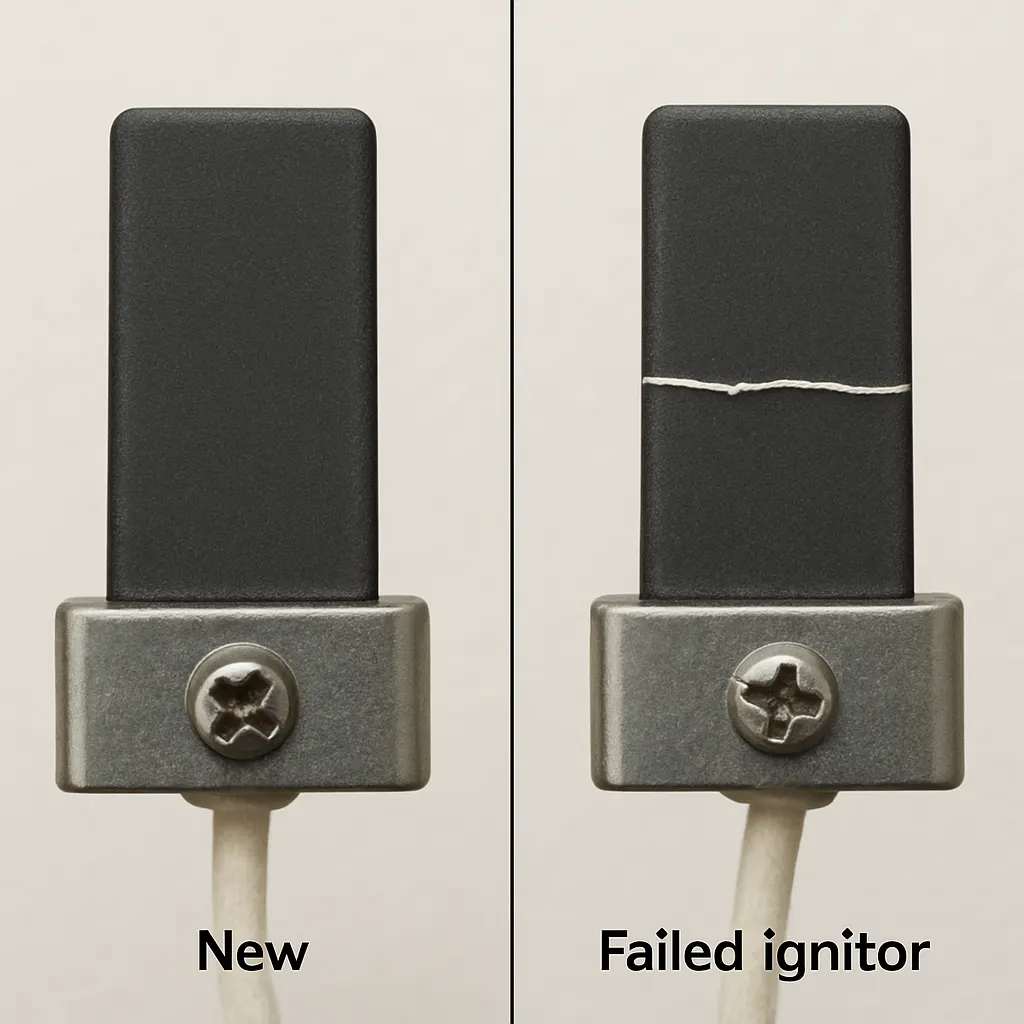
Ignitors are brittle. Skin oil on the surface shortens their life, which is one reason to leave them to the person with the replacement in the truck.
Never light a furnace by hand
When the ignitor fails, the control board does not know it. It still opens the gas valve for a few seconds expecting instant ignition. If you hold a lighter to the burners during that window, the gas that has already pooled in the combustion chamber can light all at once. Delayed ignition on a furnace causes real injuries. The safety logic exists to shut the gas off when the flame does not appear; bypassing it removes every safeguard. The fix for a bad ignitor is a new ignitor.
What you can check yourself
- Thermostat on Heat and set above room temperature. On a heat pump thermostat, make sure it is not on Cool or Off.
- The furnace switch. Most furnaces have a light-switch-style switch on or near the cabinet. Someone flips these by accident.
- The breaker labeled Furnace or FAU. Reset it once.
- The filter. A choked filter overheats the furnace and trips the high limit, which looks like an ignition failure from the hallway.
- Every panel in place and latched. The blower door has a safety switch, and the furnace will not run with it open.
- Do the observation test above and write down the last step that happened. That sentence saves diagnostic time when you call.
What not to do: remove the burner door, touch the ignitor, test parts with a meter yourself, or relight the furnace with a flame.
When to call a licensed tech
- No glow and no heat after one breaker reset.
- The flame lights and dies more than once. It will lock out on a cold night.
- Any gas smell. Leave the house and call SoCalGas first, then us.
- The ignitor has been replaced before and failed again within a couple of years. Repeat failures point at a voltage problem, the wrong part, or a furnace overheating from restricted airflow.
- The furnace is a closet or attic unit you cannot see clearly. A furnace repair visit for an ignitor is short; a tech carries the common universal ignitors.
- The heater is a wall or floor furnace with a pilot that keeps going out. If the pilot is out, relight it once following the instructions on the furnace's label. If it won't stay lit, call. That is a wall and floor furnace repair, and the fix is usually a thermocouple or a cleaning, not an ignitor.
Common questions
How long does a furnace ignitor last?
Several years is typical, and it varies a lot with how many cycles the furnace runs and whether the airflow is good. Ours is a short heating season, November to March, so ignitors here often outlast the same part in a cold climate.
Can a dirty filter cause the furnace not to ignite?
Yes, indirectly. Restricted airflow overheats the heat exchanger, the high-limit switch cuts the burners, and after a few of those the board may lock out. Replace the filter before assuming the ignitor is bad.
The furnace lights, runs a few seconds and shuts off. Is that the ignitor?
No. A flame that lights and dies means the ignitor did its job. The usual cause is a dirty flame sensor, occasionally a weak gas supply or a board fault.
Our diagnostic visit is $69, told to you before booking and credited toward the work. Call the Boost Services team at 818-277-5056 or contact us here.
Written with AI assistance by Boost Services, Heating and Cooling team, and reviewed by our licensed technicians before publishing. Boost Services Heating and Cooling, C-20 #1119892.