
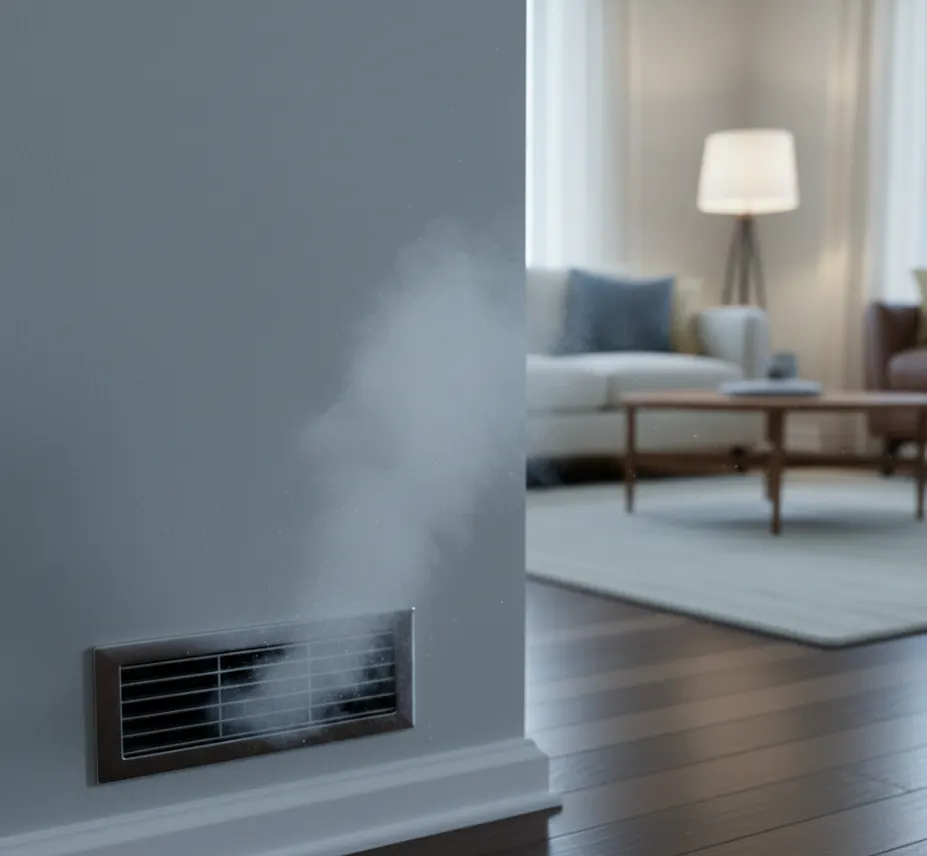
Cold air from a heater vent usually has a boring cause. The fan is set to ON instead of AUTO, the filter is clogged and the furnace is shutting itself off on its high-limit switch, the pilot or igniter is not lighting the burners, or the ducts in the attic are pulling in cold air on the way to the room. Here is how to tell which one you have, in the order that costs you the least.
Why the vent goes cold
A furnace does two things: it makes heat, and it moves air. Cold air at the vent means one of those two is happening without the other. Either the blower is running while the burners are off, or the burners are lit but the heat is being lost before it reaches you.
- Fan set to ON. The blower runs continuously and, between heating cycles, pushes room-temperature air through the vents. It feels cold because it is moving. Set the fan to AUTO and it only runs when there is heat to deliver.
- The warm-up delay. Most furnaces run the blower a short time before the heat exchanger is fully hot. Thirty seconds to a minute of cool air at the start of a cycle is normal.
- Dirty filter and the high-limit switch. A clogged filter starves the furnace of airflow, the heat exchanger overheats, and a safety switch cuts the burners while the blower keeps running to cool it down. You get a burst of heat, then cold air, then heat again. That pattern is the giveaway.
- Pilot light out or ignition failure. Older wall and floor furnaces in Pasadena and Altadena bungalows still use a standing pilot. If it goes out, the blower (if there is one) runs but nothing lights. Newer furnaces use a hot-surface or spark igniter; if it fails, or the flame sensor is dirty, the burners light and drop out within seconds, and the furnace eventually locks out.
- Leaky or crushed attic ducts. In the 1950s to 80s ranch homes across the San Gabriel and San Fernando valleys, supply ducts run through an attic that is cold on a January night. A split seam or a disconnected boot loses the heat before it reaches the register, and the return can pull attic air straight into the system.
- Heat pump defrost. If your heat is a heat pump, it periodically reverses to melt frost off the outdoor coil. For a few minutes the vents blow cool. That is normal, and a well set-up system runs backup heat during it.
- Thermostat set wrong. Mode on COOL, a program that dropped the setpoint, or dead batteries. Common after the first cold night of the season when nobody has touched the thermostat since May.
What you can check yourself
- Thermostat: mode on HEAT, fan on AUTO, setpoint above the room temperature. Replace the batteries if it has them. If a schedule is running, check what it is set to right now.
- Filter: pull it and hold it up to a light. If you cannot see light through it, replace it. Then give the furnace a full cycle and see whether the hot-cold-hot pattern stops.
- Registers and returns: open every supply register, move furniture and rugs off the returns. Closing vents in unused rooms does not save money on a forced-air system and can push it into the same overheat trip.
- Breaker and furnace switch: a furnace has a light-switch-style disconnect near the unit and a breaker in the panel. Make sure both are on. Reset a tripped breaker once. If it trips again, stop and call.
- Pilot light on an older wall or floor furnace: look through the viewing window. If it is out, the printed label on the unit gives the relighting steps. If you are not comfortable with them, or it goes out again, that is a thermocouple or gas valve fault for a tech. If you smell gas at any point, do not light anything. Leave the house and call the gas company.
- Ducts you can see: if you can safely look into the attic from the hatch, a duct that has fallen off a boot or a plenum is obvious. Do not crawl the attic or start taping things. Note what you saw and tell us.
When to call a licensed tech
Anything inside the furnace cabinet is licensed work: the igniter, flame sensor, gas valve, high-limit switch, blower motor, and control board. So is a pilot that will not stay lit, a furnace that lights and drops out, a breaker that trips more than once, and any smell of gas or burning. Furnace repair starts with a diagnostic that finds the actual fault instead of swapping parts, and the older gravity units in Pasadena bungalows get the same treatment under wall and floor furnace repair.
If the furnace runs fine but the far bedrooms stay cold, the problem is in the attic, and duct repair is the fix. Sealing is done with mastic, not cloth duct tape; a Department of Energy guide for contractors says cloth-backed tape can dry out and fail within months.
Common questions
Why does my heater blow warm, then cold, then warm again?
That is the high-limit switch cycling the burners because the heat exchanger is overheating, almost always from restricted airflow. Change the filter first. If it continues with a clean filter, the blower may be failing or the ducts may be too restrictive, and that is a tech visit.
Is cool air from a heat pump normal?
In defrost mode, yes, for a few minutes at a time. Heat pump air is also cooler at the register than furnace air even when it is working, because it delivers steady, moderate heat rather than short blasts. Cool air for a long stretch with the outdoor unit running is a different story and worth a call.
Can a dirty filter really make the heater blow cold?
Yes, and it is one of the first things we rule out. The furnace protects itself by shutting the burners off, and the blower keeps running. It can also crack a heat exchanger over time, so it is not a fault to live with.
If the checks above do not bring the heat back, book a $69 diagnostic. You are told the price before we schedule and it is credited toward the work. Call Boost Services Heating and Cooling at 818-277-5056 or send us a message. We work 6am to 10pm, seven days, and are usually out within a few hours.
Written with AI assistance by Boost Services, Heating and Cooling team, and reviewed by our licensed technicians before publishing. Boost Services Heating and Cooling, C-20 #1119892.