
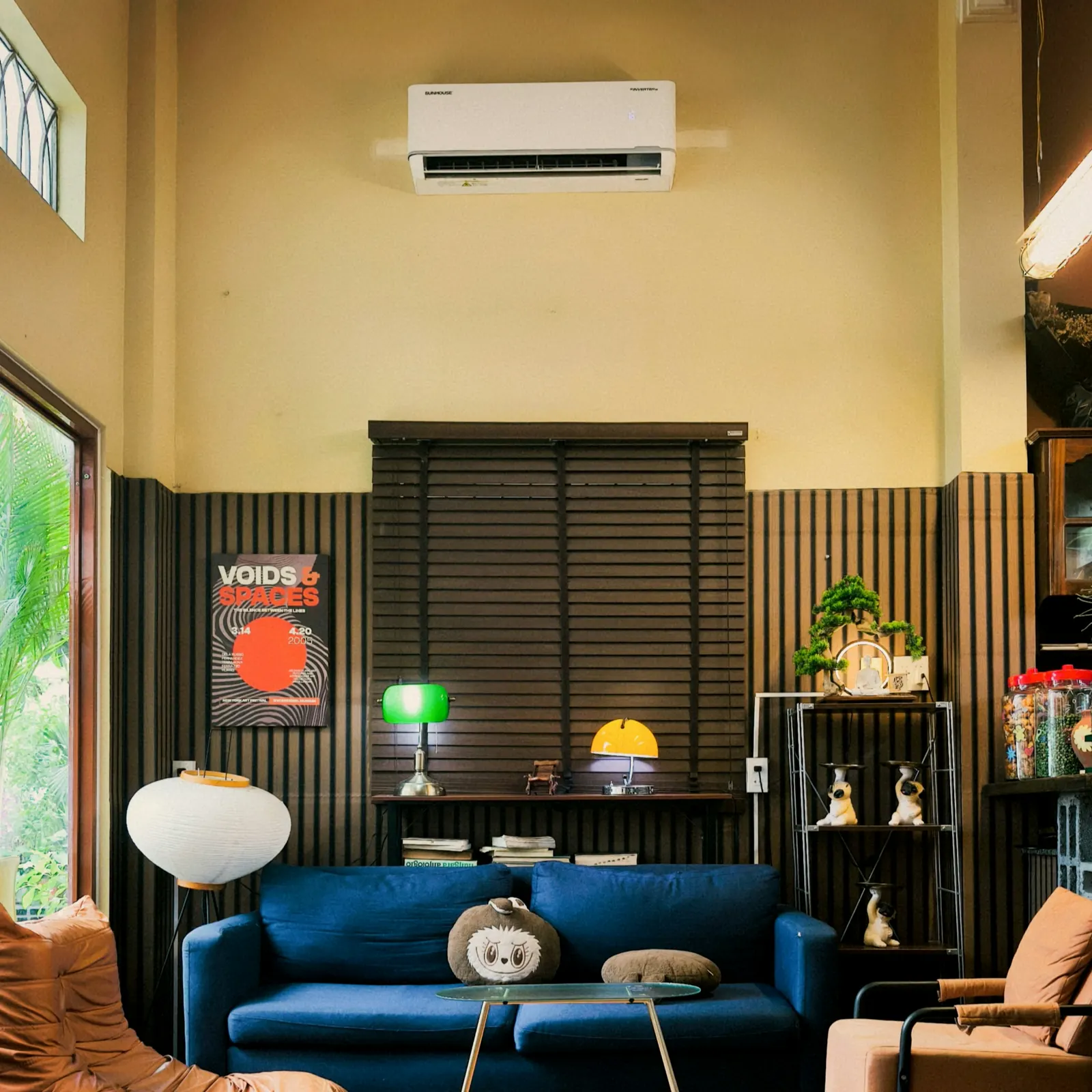
A heat pump is one machine doing both jobs: it moves heat out of the house in July and into it in January. That suits Pasadena, CA, where winters are mild and cooling is the hard work. Most of what decides whether the install is a good one happens before anyone picks up a tool, in the sizing and in the state of your ducts.
What gets replaced, and what stays
Swapping a gas furnace and air conditioner for a heat pump usually means:
- A new outdoor unit, which looks much like a condenser but runs in both directions.
- A new indoor air handler where the furnace used to be, in the closet, the garage or the attic.
- A new line set, or a flushed and pressure-tested existing one, depending on age and refrigerant.
- A new thermostat, because heat pumps need controls that understand a reversing valve and a defrost cycle.
- Duct work: sealing, repairs, sometimes a new return or new runs.
What usually stays is the duct layout and the registers. Homes with no ducts at all, and there are plenty in Pasadena, Altadena and South Pasadena, go the ductless mini split route instead.
Sizing is the decision that matters most
An oversized system is the most common installation mistake in this trade, and it is invisible on paper. Too much capacity means short cycles: the system satisfies the thermostat quickly, shuts off, comes back a few minutes later. You get temperature swings, poor humidity control, more wear on the compressor, and none of the efficiency you paid for.
Proper sizing means a load calculation, not a rule of thumb per square foot. The industry method is ACCA Manual J, which accounts for orientation, window area and type, insulation levels, ceiling height, air leakage and the design temperatures for your location. A 1920s bungalow with single-pane windows and a west-facing wall has a very different load from a 1960s Reseda ranch of the same floor area.
Ask how the contractor arrived at the tonnage. "Same size as the old one" is not an answer; the old one may have been wrong, and if windows or insulation have changed since, the load has too.
Your ducts decide half the result
This is where a lot of installs quietly underperform. A perfectly sized heat pump feeding attic ducts with open joints delivers a good share of its output to the attic.
California's Energy Code has a view on that, and it applies to your job. Under the 2025 Energy Code (document CEC-400-2025-010-F, in force for permits applied for on or after January 1, 2026), Section 150.2(b)1E says that when a single-family system is altered by installing or replacing the air handler, the outdoor condensing unit of a split system air conditioner or heat pump, or a coil, "the duct system that is connected … shall be sealed, as confirmed through field verification and diagnostic testing."
So replacing the equipment triggers a duct leakage test. It passes at total leakage of 10 percent or less of air handler airflow, or leakage to outside of 7 percent or less, or, where neither is achievable, by sealing all accessible leaks and verifying with a visual inspection and a smoke test. Three exceptions are named: ducts previously sealed and documented with verified testing, duct systems under 40 linear feet, and existing ducts containing asbestos.
The tester used to be called a HERS Rater; the 2025 code renames the role ECC-Rater. Same test, new name.
If more than 25 feet of new or replacement duct goes into unconditioned space, Section 150.2(b)1D and Table 150.2-D put the insulation at R-8 in our climate zones. A San Gabriel Valley attic is unconditioned space and can run 130°F or hotter in August, which is why that number is not a formality.
Budget attention, and time, for the duct side. Duct repair and replacement is often the difference between a system that hits its ratings and one that does not.
The power side
A heat pump draws more current than a gas furnace did, because it now does the heating too. Part of that work sits inside the HVAC scope: the disconnect at the outdoor unit, the whip, the low-voltage thermostat wiring. Part may not. If your main panel turns out to be full or undersized for the new circuit, that is a separate licensed trade. Find out early, because it affects the schedule and the quote.
What installation day looks like
A straightforward changeout is typically one day, two if there is duct work or panel work.
The crew recovers the refrigerant from the old system, pulls the old condenser and furnace, sets the new equipment, runs or reuses the line set, brazes and pressure-tests it, pulls a deep vacuum to get moisture out of the lines, charges the system, wires the controls, and starts it up. Startup is not the end of it. Measuring superheat and subcooling, checking the temperature split across the coil and verifying static pressure in the ducts are what turn a running system into a correctly charged one.
Then the walkthrough: how the new thermostat works, why heat pump air feels cooler than furnace air even when it is heating correctly, what the defrost cycle sounds like on a cold morning so you do not think it has broken, and where the filter goes.
The permit and the duct test close out after the install. That paperwork proves the work met code, and it matters when you sell the house.
What drives the price
We do not publish numbers; the honest answer is that it depends on the house. What moves it:
- The load, and therefore the capacity you need.
- The efficiency tier. Ratings show on the quote as SEER2 and HSPF2; higher tiers cost more up front and less to run.
- Single-stage, two-stage or variable-speed.
- The state of your ducts, and whether new runs or a new return are needed.
- Access. An attic air handler behind a small hatch is not the same job as a garage install.
- Line set condition, pad work, thermostat, and whether the circuit needs changes.
We install American Standard, Bryant, Carrier, Daikin, Goodman, Lennox, Mitsubishi Electric and York; the right one depends on the application, not on a ranking.
Financing on new systems runs through Wisetack: monthly plans on approved credit, and checking your options does not affect your credit score. On incentives, Pasadena Water & Power and LADWP have had heat-pump programs; check the current program before you buy, because terms change.
What you can check yourself
- Find the data plate on your outdoor unit and note the model, serial and tonnage.
- Pull your last twelve months of bills, so you have a baseline.
- Open the attic hatch and look at the ducts: crushed runs, hanging sections, open joints, missing insulation.
- Check where the outdoor unit would sit and whether there is clearance and a path for the line set.
- Look at your main panel and note whether there are open breaker spaces.
- Write down the rooms that have never been comfortable. That is load-calculation input, not a complaint.
When to call a licensed tech
Call for the load calculation, for anything involving refrigerant, and before you commit to a size or an efficiency tier. Call early if you suspect the ducts are the real problem, since that changes the design rather than being an add-on. Anyone quoting a heat pump installation without looking in your attic or mentioning the duct test is quoting a different job from the one the code requires.
Common questions
Do I have to give up my gas furnace?
No. A dual-fuel setup keeps the furnace and lets the heat pump heat until the outdoor temperature drops below a set point, where the furnace takes over. In most of the San Gabriel Valley the heat pump handles the season alone, so dual fuel is mainly for homes with a good furnace worth keeping.
How long does a heat pump installation take?
A straight changeout is usually a single day. Add a day when ducts need replacing, when the air handler location changes, or when the circuit needs work. Permitting and the duct leakage test are scheduled around that.
Will a heat pump keep up on a cold Pasadena night?
Yes, for the temperatures we get here. Clear winter nights in the valleys sit well inside a modern heat pump's operating range. Sizing and duct condition decide whether it feels that way in the back bedroom.
If you want a real load calculation and a written quote, start with a $69 diagnostic. You are told the price before we schedule, and it is credited toward the work if you go ahead. Call the Boost Services team at 818-277-5056 or send us a message, and ask about financing while you are on the phone.
Written with AI assistance by Boost Services, Heating and Cooling team, and reviewed by our licensed technicians before publishing. Boost Services Heating and Cooling, C-20 #1119892.