
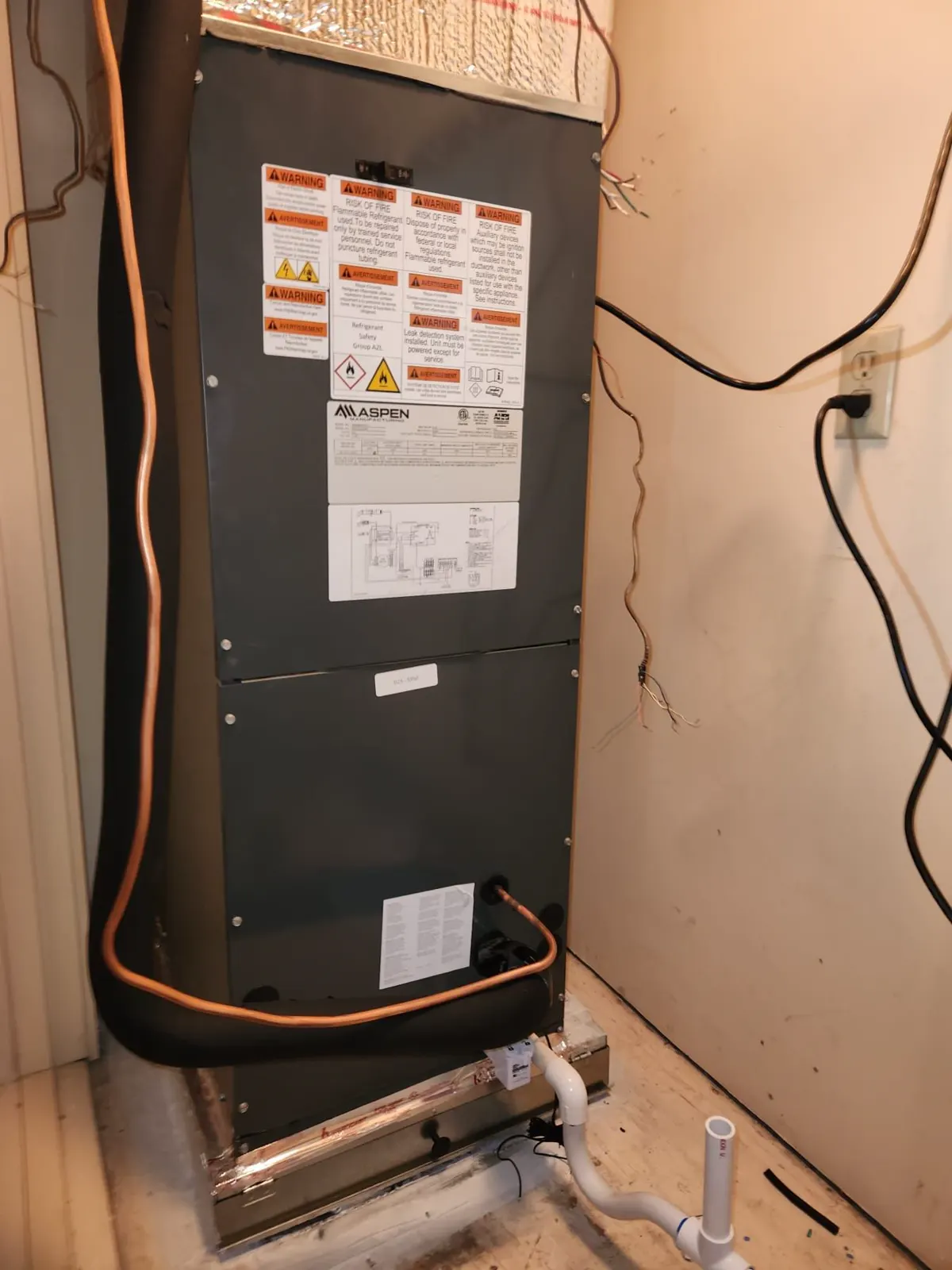
A heat pump is an air conditioner that can run in reverse. Replace your gas furnace with one and the same outdoor unit that cools the house in August heats it in January. For a home in Pasadena, CA or the San Fernando Valley, the switch is more practical than it sounds, because our winters are mild and the cooling side is where the equipment earns its keep anyway. Here is what actually changes.
What comes out and what goes in
Out: the gas furnace, and usually the old AC condenser if you have one, since the heat pump replaces both.
In: a heat pump outdoor unit where the condenser sat, and an air handler where the furnace sat. The air handler holds the blower and the indoor coil. It has no burner, no flue, no gas valve. Most air handlers also hold an electric heat strip that acts as backup on the coldest nights.
The refrigerant lines, the drain, and the ducts stay in place if they are in good condition. The thermostat almost always changes.
The gas line and the flue
The furnace's gas line gets capped at the appliance. The flue, if the furnace had its own, is no longer used. If the flue was shared with another gas appliance, that appliance's venting needs checking, which is a separate licensed trade and something the installer should flag before the job, not after.
The gas meter stays. Any other gas appliances in the house are unaffected.
The electrical side
This is the part that decides whether the job is simple or not. The heat pump itself usually runs on a circuit similar to the AC it replaces. The air handler with a heat strip needs its own circuit, and the size depends on the strip.
Many 1950s and 60s ranch homes in Reseda, Northridge, and Arcadia still have their original panels, and some of those do not have the capacity or the spare slots. When that is the case, panel work is a separate licensed trade. An honest heat pump quote tells you up front whether your panel can take the load or whether an electrician needs to look first.
Ask about a smaller heat strip, or none. In our climate the backup heat runs very little, and sizing it modestly can keep the job within the existing panel.
The ducts
A heat pump moves more air at a lower temperature than a furnace. A furnace pushes air out of the registers at well over 100°F in short blasts. A heat pump delivers air that is warm rather than hot and runs longer, more steadily. That is a comfort gain, not a loss, but it depends on the ducts.
Undersized returns, leaky attic runs, and crushed flex duct that a furnace could brute-force through will show up as rooms that never quite warm up. The original attic ducts in most Valley and eastern San Gabriel Valley homes need at minimum sealing and often resizing before a heat pump will perform. A quote that does not mention the ductwork has skipped the question.
Older Pasadena, Altadena, and South Pasadena homes with a wall or floor furnace and no ducts are a different conversation. There, the choice is between adding ducts and going ductless with a multi-zone mini split, which is also a heat pump.
The thermostat
A heat pump uses different thermostat wiring from a furnace. It needs a reversing valve signal and, if there is a heat strip, a call for auxiliary heat. Most modern thermostats support this, but the old furnace thermostat often does not, and a heat pump on the wrong thermostat wastes energy by running the strips when it should not. A heat-pump-compatible thermostat, set up correctly, is part of the job.
One habit change: do not set back a heat pump the way people set back a furnace. A big overnight setback followed by a big morning call can trigger the backup strips. Small setbacks, or a steady setting, cost less.
What the heat feels like
People coming from a furnace notice the air at the register is not hot. It is warm. The system runs longer and the temperature in the house stays flatter, without the blast-and-coast cycle of a furnace. Most people prefer it after a week. The one thing to expect is defrost: on a cold damp morning the outdoor unit will pause heating for a few minutes to melt frost off its coil, and you may see steam. That is normal.
Cold nights
Our winters have clear nights in the 30s and 40s, and a modern heat pump handles those without help. The heat strip exists for the rare morning below that, and for recovery after a big setback. A properly sized system in this climate runs on the strips for a handful of hours a year.
What you can check yourself
- Find your panel and note its main breaker rating and whether there are empty slots. You are only looking, not touching.
- Look at the furnace's location. A closet furnace is a simpler air handler swap than an attic one.
- Check the ducts through the attic hatch. Sagging, disconnected, or crushed runs need to be part of the quote.
- Check the thermostat wiring count. Pull the thermostat off its base and count the wires. Four or fewer usually means new wire or an adapter is needed for a heat pump.
- Note how your furnace vents. Its own flue or one shared with another appliance.
When to call a licensed tech
Everything past the looking is licensed work: sizing the system with a load calculation, matching the air handler to the outdoor unit, refrigerant, and the HVAC-side wiring. Any panel or circuit work beyond the HVAC disconnect goes to an electrician.
A good heat pump installation starts with a load calculation and a look at the ducts and panel, and you get a written quote that says what happens to each. Pasadena Water & Power and LADWP have had heat-pump incentives. Check the current program before you buy. Financing through Wisetack is available on approved credit, and checking your options does not affect your credit score.
Common questions
Do I need to keep the furnace as backup?
Not in our climate. Some homes use a dual-fuel setup that keeps the furnace for the coldest days, but for the San Gabriel Valley and the San Fernando Valley a heat pump with a modest electric strip covers it.
Will my winter bill go up?
You stop paying for gas heat and start paying for electric heat. Which is lower depends on your rates and how the system is set up. What a heat pump reliably does is heat and cool with one piece of equipment, and cool more efficiently than an old condenser. Ask for both quotes and decide from there.
Can I replace only the AC with a heat pump and keep the furnace?
Yes. That is the dual-fuel arrangement. The heat pump handles cooling and mild-weather heating, and the furnace takes over below a set temperature. It is a reasonable path if your furnace is newer and only the AC has failed.
If you want to know whether your house is a straightforward heat pump job or one with a panel or duct question first, book a $69 diagnostic. You are told the price before we schedule, and it is credited toward the work if you go ahead. Call the Boost Services team at 818-277-5056 or send us a message and we will usually be out within a few hours to a day.
Written with AI assistance by Boost Services, Heating and Cooling team, and reviewed by our licensed technicians before publishing. Boost Services Heating and Cooling, C-20 #1119892.