
A central air conditioner typically lasts roughly 12 to 17 years. Around Pasadena, CA and across the San Fernando Valley, plan on the lower half of that range unless the system has been sized right, kept clean, and serviced. Our cooling season is long, our attics are brutal, and a lot of local systems were installed with shortcuts that quietly shave years off.
Why the number is a range
The compressor is the part that decides the lifespan. Everything else on a split system can be replaced for a fraction of the cost of the whole thing: capacitors, contactors, fan motors, control boards, even the indoor coil. When the compressor goes on a unit past its parts warranty, that is usually the end.
Compressors die from heat, from running with the wrong refrigerant charge, from running with poor airflow, and from electrical stress. Every one of those is worse here than the national average, which is where the 15-to-20-year figures you see online come from.
What Pasadena and the Valley do to an air conditioner
A six-month cooling season. From May to October the system runs most days, and during a heat wave it runs most of the day. A unit here runs far more hours in a season than one in a mild climate, and compressor wear follows runtime.
Attic air handlers. Most 1950s to 80s homes in Arcadia, Temple City, Reseda, and Northridge have the furnace and coil in the attic. Attics here reach 130°F and more. The blower motor and the control board bake all summer, and the ducts leak conditioned air into that heat, which makes the compressor run longer to compensate.
Side-yard condensers with no shade. A condenser rejects heat to the outdoor air. When that air is 105°F and the unit is jammed against a west-facing stucco wall, it works at the edge of its rating. Units with clear space and some afternoon shade run cooler and last longer.
Dust, ash, and Santa Ana winds. Dry air carries grit. Fall winds fill condenser fins with dust and leaves, and smoke days coat them with ash. A coil that cannot shed heat raises head pressure, and high head pressure is hard on the compressor.
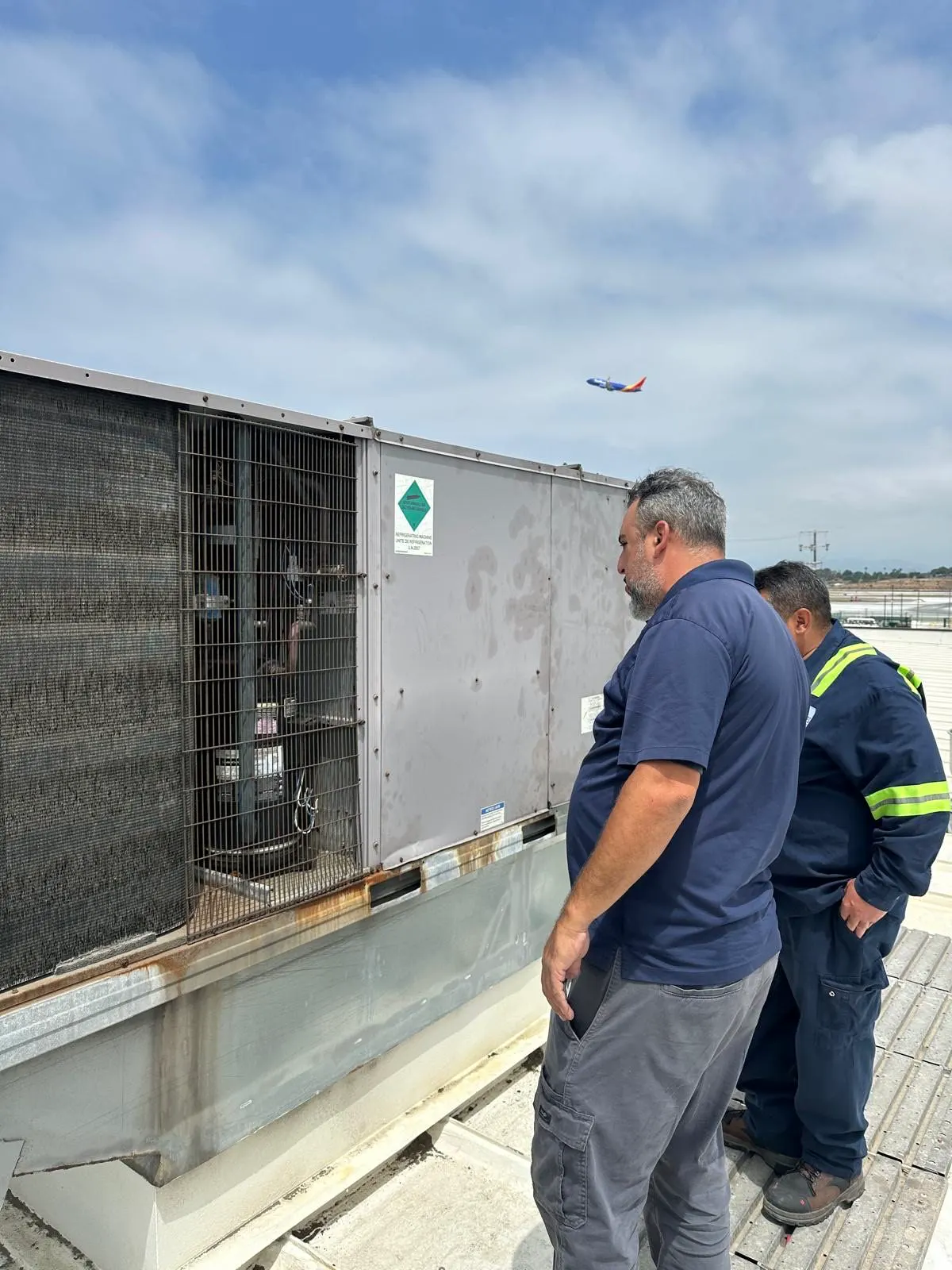
Rooftop package units. Flat-roof homes and small buildings across the San Fernando Valley have everything in one cabinet on the roof, in full sun, with no shade at all. These tend to sit at the short end of the range.
What shortens the life of a system
These are the things a tech sees on a unit that failed early:
- Oversizing. A system that is too big for the house cools the air fast, shuts off, and starts again a few minutes later. Short cycling wears a compressor out faster than steady running does, and it never runs long enough to pull humidity out.
- A low refrigerant charge that was never fixed. Topping off a leaking system every spring is common and it is slow damage. The compressor runs hot and undercooled.
- Dirty coils. The indoor coil packed with dust from years of missed filter changes, the outdoor coil packed with cottonwood and grit. Both force the compressor to work against a wall.
- Bad ductwork. Return ducts that are too small, or supply ducts that leak into the attic, starve the system of airflow. Low airflow means a cold coil, ice, and liquid refrigerant heading back to the compressor.
- Weak capacitors left in place. A capacitor that is out of tolerance makes the compressor draw more current on every start. It is a cheap part. Leaving it in is expensive.
What adds years
The other side of the same list:
- Change the filter on schedule, and more often on smoke days.
- Keep the outdoor unit clear of leaves and growth, and rinse the fins gently from the outside with a garden hose once or twice a season. Never a pressure washer, and never with the panels off.
- Get the refrigerant charge and the electrical readings checked once a year before the heat arrives. A seasonal maintenance visit catches a weak capacitor, a dirty coil, or a slow leak while they are cheap to fix.
- Fix the ducts. In this housing stock, sealing and re-insulating attic ducts is often the single change that does the most for both comfort and equipment life.
- Set the thermostat and leave it. Big swings mean long recovery runs on the hottest part of the day.
What you can check yourself
- Find the age. The serial number on the outdoor unit's data plate encodes the manufacture date. If you are not sure how to read it, write down the brand, model, and serial and ask.
- Check the refrigerant type on that plate. R-22 systems are old by definition and the refrigerant is no longer produced.
- Look at the fins. If you can see dust matted between them, the unit cannot breathe.
- Feel the airflow at the registers. Weak flow in some rooms and strong in others points at the ducts.
- Time a cycle. On a hot afternoon, note how long the system runs before it shuts off and how long until it restarts. Cycles of a few minutes mean oversizing or a fault.
- Listen at startup. A hard start, a hum before the fan spins, or a loud clunk are signs to mention when you call.
When to call a licensed tech
Call when the breaker trips, when the outdoor fan spins but the air is not cold, when ice forms on the refrigerant line, when the unit makes a new noise, or when the system runs all day without reaching the setpoint. Do not open the electrical compartment on the unit or handle refrigerant lines.
If your system is past 12 years and starting to show any of the early-failure signs above, it is worth having someone check it before you commit to another summer. A diagnostic gives you the compressor's electrical readings and the refrigerant charge, which together tell you how much life is left. When the answer is "not much," you can plan a replacement on your own schedule instead of during a July heat wave when every contractor is booked.
For a system with years left, a maintenance plan that puts a tech in front of it every spring and fall is the cheapest way to keep it there.
Common questions
Does a heat pump last as long as an AC?
Usually a little less, because it runs in winter as well as summer. In our mild winters the difference is smaller than in cold climates. Sizing, airflow, and maintenance matter more than the equipment type.
My AC is 20 years old and still works. Should I replace it?
Not because of the number alone. If it holds temperature, the refrigerant charge is stable, and the compressor readings are healthy, keep it. Do check the refrigerant type. If it is R-22, a leak will force the decision, so it is worth having a plan.
Do the newer refrigerants change the lifespan?
The equipment built for R-454B and R-32 is designed for the same service life. The bigger point for an existing system: EPA's rules still let you repair an R-410A system, compressor included. Supply of that refrigerant may tighten over time as it is phased down.
Want to know how much life your system has left? Book a $69 diagnostic. You are told the price before we schedule, and it is credited toward the work if you go ahead. Reach Boost Services at 818-277-5056 or send us a message and we will usually be out within a few hours to a day.
Written with AI assistance by Boost Services, Heating and Cooling team, and reviewed by our licensed technicians before publishing. Boost Services Heating and Cooling, C-20 #1119892.