
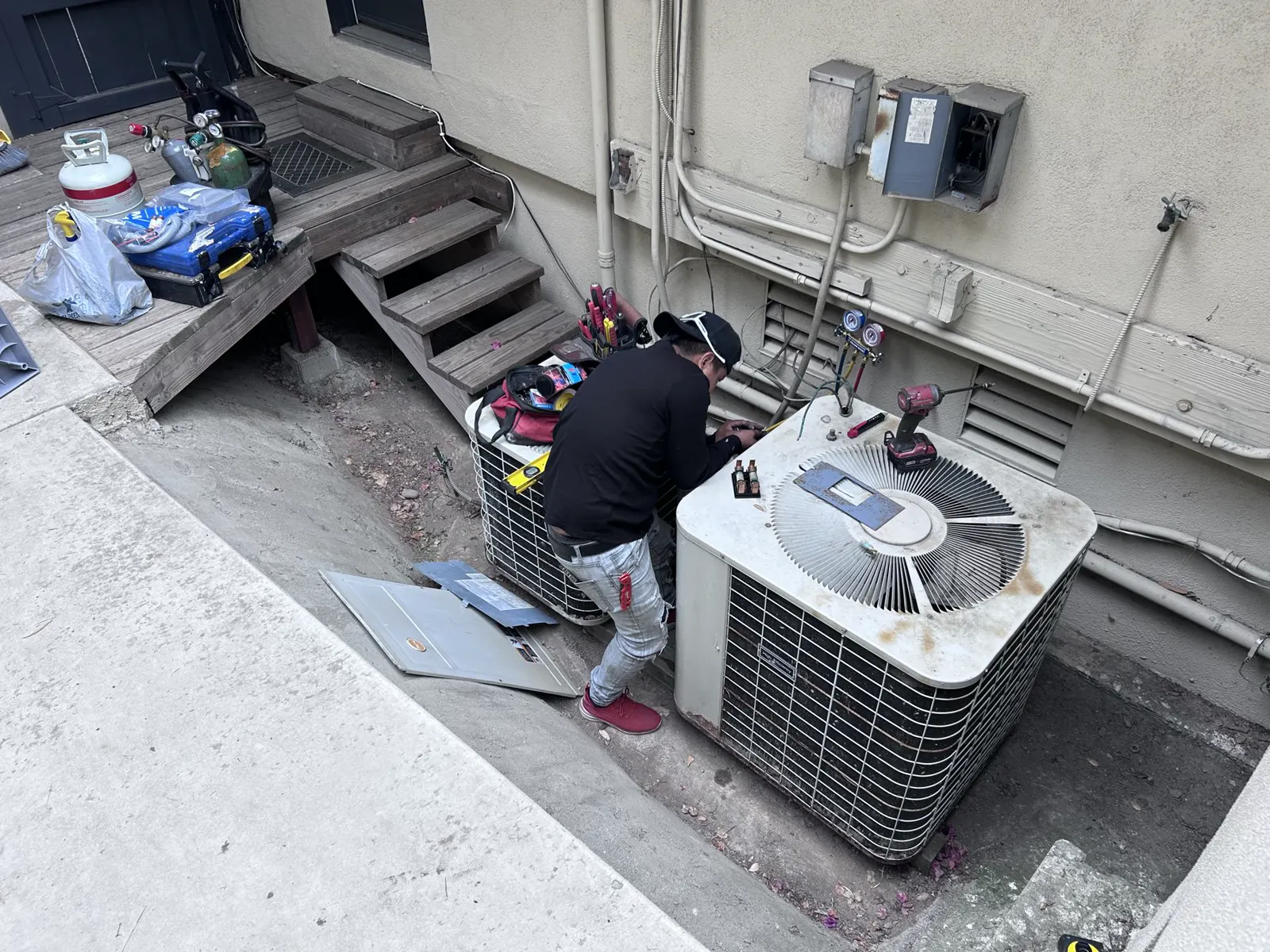
Two rules settle most repair-or-replace calls. First, compare the repair cost against the remaining life of the system, not against the price of a new one. Second, a safety failure or an obsolete refrigerant overrides everything else. Everything a technician tells you at the kitchen table in Pasadena, CA or Reseda comes down to one of those two.
Rule one: repair cost against remaining life
A new system is expensive, so almost any repair looks cheap next to it. That comparison is the wrong one. The right one is: how many more summers does this repair buy, and what does each of those summers cost?
Picture two systems with the same failed part. One is six years old, in warranty, with a healthy compressor. The other is fifteen, out of warranty, with a compressor that draws more current than it should. The repair is the same. The value of the repair is not. On the first system you are buying ten more years. On the second you might be buying one, and the next call may be the compressor.
A tech applies this by looking at the whole system during the diagnostic, not just the part that failed:
- Compressor amperage compared to the rated value on the data plate
- Refrigerant pressures and whether the charge has been stable
- The condition of both coils
- The age from the serial number
- Whether the ducts and airflow are adequate
Then the question becomes: if I fix this part, what is the next thing likely to fail, and how soon? If the answer is "nothing obvious for years," repair. If the answer is "the compressor is on its way," replacing it is the honest advice, even when the repair in front of you is small.
Rule two: some failures end the conversation
A few problems override the math:
- A failed compressor on an older unit. Replacing a compressor means a large part, a lot of labor, and a full refrigerant recovery and recharge, on a system whose other parts are the same age. On a unit still in parts warranty it can make sense. Out of warranty, it rarely does.
- A refrigerant leak on an R-22 system. R-22 is no longer produced or imported. Recharging it is possible but you are pouring a dwindling supply into a unit that will leak again. Fix the leak and recharge once if you must get through a summer. Plan the replacement.
- A cracked heat exchanger on the furnace side of a split system. This is a carbon monoxide risk and the furnace gets shut down. If the AC is old too, this is when both get replaced.
- Water or fire damage to the air handler or control board.
The gray zone
Most calls land between those. A capacitor on a 13-year-old unit. A condenser fan motor on a 15-year-old unit. A refrigerant leak at a valve on a 10-year-old R-410A system. Here is how a tech thinks through them:
Ask what the repair history looks like. One repair in a decade is a good system that had a bad day. A repair every summer is a trend.
Ask whether the system ever did the job. If the house has never held 76°F through a heat wave, the system is undersized or the ducts are bad, and the repair does not fix the thing you actually care about.
Ask about efficiency. New equipment is rated under SEER2 and runs on less power than a system from the mid-2000s. That is a real factor for a system that runs six months a year, but it is a slow return, and it should not by itself push you into replacing a healthy unit.
Ask what the repair is buying you in time. The honest tech says "this repair should get you through this summer and probably a couple more" or "this repair gets you through this summer, and I would start planning."
What you can check yourself
Before the tech arrives, you can set up the decision:
- Find the serial number on the outdoor unit's data plate and note the refrigerant type. R-22 changes the math.
- Collect your repair invoices. The pattern matters more than any single one.
- Check the filter and the outdoor coil. A packed filter or a coil matted with dust can cause symptoms that look like a failing system. Clean or replace and see if the complaint changes.
- Reset the breaker once if the unit is dead. If it trips again, stop there. Repeated resets can turn a small fault into a compressor failure.
- Write down what happened. Did it stop cold, or fade over weeks. Any new noise. Any ice on the line. This shortens the diagnostic.
When to call a licensed tech
Call for anything involving refrigerant, the sealed electrical compartment, or the compressor. Call when the breaker trips repeatedly, when the outdoor unit hums but the fan does not spin, when the air is not cold, or when there is ice on the lines.
A good diagnostic visit ends with two things in writing: the price of the repair, and an honest read on the system's overall condition. You should never feel pushed toward replacement from a repair call. If the tech recommends a new system, ask why, and ask what the repair would buy you if you chose that instead. Both answers should be specific.
If replacement is the right call and the timing is bad, financing through Wisetack offers monthly plans on approved credit, and checking your options does not affect your credit score.
Common questions
Is there a percentage rule for repair versus replace?
You will see one online. Treat it as a starting point, not a rule. It leaves out what matters most: the condition of the compressor and the age of everything else. The two rules above decide it.
Can I replace just the outdoor unit?
Sometimes. The indoor coil must match the new outdoor unit's refrigerant and capacity, so at minimum the coil usually changes. If the air handler or furnace is much newer than the condenser, replacing the outdoor unit and coil can be the right call. If they are the same age, replacing both avoids doing the job twice.
Will a repair on an old system be warrantied?
Our labor carries a 1-year warranty. The part carries whatever the manufacturer offers. A tech should tell you both before the work starts, in the written quote.
Want the two-rule answer for your own system? Book a $69 diagnostic. You are told the price before we schedule, and it is credited toward the work if you go ahead. Call Boost Services, 818-277-5056 or send us a message and we will usually be out within a few hours to a day.
Written with AI assistance by Boost Services, Heating and Cooling team, and reviewed by our licensed technicians before publishing. Boost Services Heating and Cooling, C-20 #1119892.