
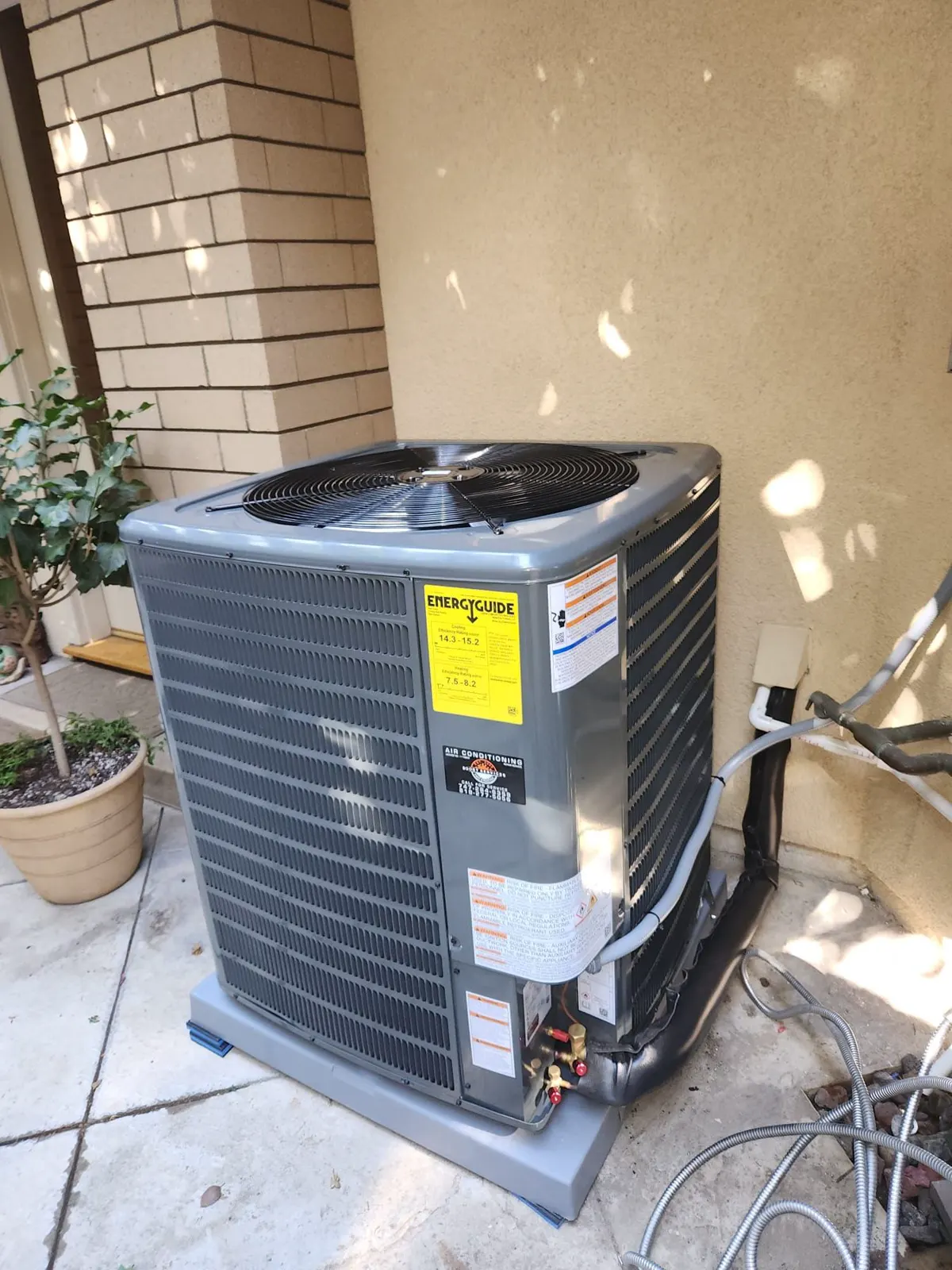
SEER2 is the efficiency rating on central air conditioners and heat pumps built since January 2023. The federal standard keys on when a unit was manufactured, but California sits in the Southwest region, where compliant equipment is what may be installed, so pre-2023 stock cannot legally go into a house here. It replaced SEER, and it is a tougher test, so a SEER2 number is a little lower than the SEER number for the same equipment. For a house in Pasadena, CA or the San Fernando Valley, what matters is the minimum you are allowed to install here, and how much above it is worth paying for.
What the rating measures
SEER stands for Seasonal Energy Efficiency Ratio. It is the cooling output over a simulated season divided by the electricity used over that season. Higher means more cooling per kilowatt-hour. Think of it as miles per gallon for an air conditioner.
Like miles per gallon, it is measured under lab conditions. Your real efficiency depends on your ducts, your attic, your thermostat habits, and how hot it is outside. The rating lets you compare two systems fairly. It does not predict your bill.
SEER2 versus SEER
The Department of Energy changed the test procedure in 2023. The main change is the external static pressure the indoor blower has to push against during the test. The old SEER test used a very low value that almost no real duct system matches. SEER2 uses a higher value that is closer to a real house with real ducts.
Because the test is harder, the same equipment scores lower under SEER2 than it did under SEER. The rule of thumb is that SEER2 is roughly 4 to 5 percent below the old SEER number. A unit that was a 16 SEER is roughly a 15.2 SEER2. The equipment did not get worse. The test got more honest.
Two things follow from that:
- If you are comparing an old quote or an old unit's plate (SEER) to a new quote (SEER2), you are not comparing the same scale.
- Any contractor still quoting plain SEER on new equipment is either using old literature or hoping you will not notice the difference.
The same change happened to the other ratings. EER became EER2 (efficiency at one fixed hot condition, 95°F outdoors) and HSPF became HSPF2 (heating efficiency for heat pumps).
The minimum in California
The DOE sets regional minimums, and California is in the Southwest region, which has the toughest standard because our cooling season is long. For split-system air conditioners under 45,000 BTU per hour (roughly 3.5 tons and smaller), the Southwest minimum is 14.3 SEER2. Larger split systems have a slightly lower minimum. The Southwest region also has an EER2 minimum, which matters here because EER2 is measured at 95°F, and that is a normal August afternoon in Reseda.
Split-system heat pumps, which is what goes into most houses here, have a national minimum of 14.3 SEER2 and 7.5 HSPF2 for heating. Package units and space-constrained equipment carry their own, lower minimums.
Those are floors. Nothing below them can be installed here, so the cheapest system a licensed contractor can legally put in is already reasonably efficient.
What rating you actually need
Here is the honest framing. The minimum-efficiency unit and the high-efficiency unit both cool the house. The difference is how much electricity they use doing it, and how comfortable the house feels while they do.
Go with the minimum, or close to it, if the system does not run that much: a shaded house, a small house, a second system for a rarely used floor, or a rental where you are not paying the bill.
Go higher if the system runs six months a year, if the house takes full afternoon sun, or if you have never been able to hold temperature through a heat wave. High-SEER2 systems are usually two-stage or variable-speed, and the comfort gain from steady, low-speed running is often what people notice more than the bill.
There is a point of diminishing returns. Going from the minimum to the mid-teens is a meaningful step. Going from the high teens to the twenties costs a lot more for a smaller gain, and the ducts start to be the limiting factor.
The rating is not the whole story
A high-SEER2 unit installed on leaky attic ducts does not deliver its rating. In this area that is the rule, not the exception. The 1950s to 80s ranch homes across the San Gabriel Valley and the Valley have original ducts sitting in a 130°F attic, and a fair share of the cooled air never reaches the rooms.
The refrigerant charge, the airflow across the indoor coil, and the sizing all move real efficiency more than a couple of SEER2 points do. A correctly installed 15 SEER2 system will beat a badly installed 18 SEER2 system every summer.
What you can check yourself
- Find your current rating. On older equipment the outdoor unit's data plate or the yellow EnergyGuide sticker shows the SEER. Remember it is on the old scale.
- Look at any quote you have and confirm it lists SEER2, not SEER, and states the tonnage and stage type.
- Check the attic ducts through the hatch. Sagging, crushed, or disconnected ducts belong in any efficiency conversation.
- Note how many months a year the system actually runs. That is the number that decides whether a higher rating pays back.
When to call a licensed tech
Sizing the system, matching the indoor coil to the outdoor unit, and verifying the charge and airflow at commissioning are what turn a rating on paper into a rating in your house. They need a licensed C-20 contractor with the instruments to measure them.
Ask for the AHRI certificate for any matched system you are quoted. It confirms the rated SEER2 for that specific combination of outdoor unit and indoor coil. A mismatched pairing can lose several points of efficiency. Ask to see it for any AC installation or heat pump installation you are quoted, and if you are weighing a replacement, ask for the minimum-efficiency option and the higher one side by side, in writing, so you can compare.
Common questions
Is a higher SEER2 unit always worth it in Southern California?
Not always. It pays back fastest on a system that runs hard for six months. On a lightly used system, the extra cost may never come back. Ask for both quotes and look at the difference.
Does SEER2 apply to mini splits?
Yes. Ductless systems are rated the same way, and because they have no ducts to lose air through, their real-world efficiency tends to land closer to the rating.
Are there incentives for high-efficiency equipment?
Pasadena Water & Power and LADWP have had heat-pump incentives. Programs change, so check the current offering before you buy. Nothing here should be taken as a promise about any specific amount.
If you want to know what your current system is rated at and whether an upgrade would pay, start with a $69 diagnostic. You are told the price before we schedule, and it is credited toward the work if you go ahead. Reach Boost Services at 818-277-5056 or send us a message and we will usually be out within a few hours to a day.
Written with AI assistance by Boost Services, Heating and Cooling team, and reviewed by our licensed technicians before publishing. Boost Services Heating and Cooling, C-20 #1119892.