
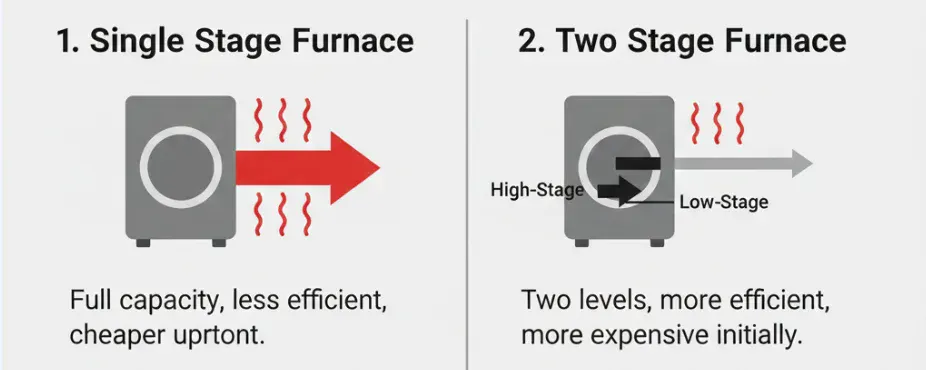
A single-stage furnace has one setting: full output, on or off. A two-stage furnace has two: a low fire it runs most of the time, and a high fire for cold snaps. The difference is not efficiency in the AFUE sense. It is how evenly the house is heated, how loud the furnace is, and how often it cycles. In a Pasadena, CA winter, where the heating season is short and the nights are cool rather than cold, that trade-off lands differently than it does in a cold-climate sales brochure.
How a single-stage furnace runs
The thermostat calls for heat, the burner lights at full capacity, the blower runs at its heating speed, and the furnace runs until the thermostat is satisfied. Then it shuts off and waits. On a mild evening that is a lot of short bursts: the furnace overshoots, the house drifts down, and it fires again. You feel it as a warm blast, then a slow cool-off, then another blast. The rooms nearest the furnace warm first and the far bedroom lags.
It is a simple machine with fewer parts, and simple has real advantages: less to fail, easier to diagnose, and any thermostat can run it.
How a two-stage furnace runs
The first stage is the low fire, typically somewhere around two-thirds of full output. On a call for heat the furnace starts there, and on most of our winter nights it never needs more. If the thermostat is still calling after a set time, or the house is far below setpoint, it steps up to high fire. The run cycles are longer and gentler, which does three things you notice:
- Steadier temperature. Less overshoot, less drift, smaller swings between rooms.
- Less noise. Low fire means a lower blower speed for most of the run.
- More filtration. Air moves through the filter for more minutes per hour, which matters on wildfire-smoke days.
Two-stage furnaces need a thermostat that can control two stages, or a control board that manages staging on a timer. It is worth asking which, because the timer version gives up some of the benefit.
A third option: modulating
Modulating furnaces adjust output continuously across a wide range rather than picking between two settings, usually with a variable-speed blower to match. They are the quietest and most even, and the most expensive. For most homes here they are more furnace than the winter asks for, but they pair well with zoning in a larger two-story house where the upstairs and downstairs never agree.
Efficiency: separate the two questions
Staging and AFUE are different things. AFUE is how much of the gas becomes heat over a season, and a single-stage furnace can be a high-efficiency condensing model while a two-stage furnace can be a standard 80. The staging saves some energy indirectly, through fewer start-ups and less overshoot, but do not let a quote blur the two. Ask for the AFUE number, then ask about staging as a comfort feature. If you want the gas bill to move, AFUE is the lever.
What it means in this climate
In the San Gabriel Valley and the San Fernando Valley the furnace runs on winter nights and mornings for a few months, then sits idle. The comfort benefits of two-stage are real, and the people who notice them most are in larger or two-story homes, homes with long duct runs where the far rooms lag, and anyone who is bothered by the blast-and-wait rhythm of a single-stage furnace. In a small single-story ranch with short ducts, a properly sized single-stage furnace does a perfectly good job, and the money may be better spent on sealing the attic ducts.
Sizing matters more than staging. An oversized single-stage furnace is where most "the heat is uneven" complaints come from. A load calculation on the house, done before the furnace is chosen, fixes more comfort problems than any feature on the equipment.
One more local note: many older Pasadena, Altadena, and South Pasadena homes heat with a wall furnace or floor furnace. Those are single-stage by nature, and the staged option for a house with no ducts is a ductless mini split heat pump, not a furnace.
What you can check yourself
- Which you have. The data plate inside the front panel or the model number will say. Two-stage furnaces often have two gas-valve wires and a thermostat with a W1 and W2 terminal.
- Whether the staging is actually being used. If you have a two-stage furnace and a basic thermostat, the furnace may be running on a timer or in single-stage mode. A thermostat that supports two stages is an inexpensive fix; see thermostats.
- How the house behaves. Note which rooms lag and how long a heating cycle lasts. Short, frequent cycles on a mild night point at oversizing.
When to call a licensed tech
Call when you are choosing a replacement and want the trade-offs laid out for your house rather than in general, when the furnace short-cycles on mild nights, or when a two-stage furnace seems to run only on high. Our furnace installation quotes start with a load calculation, are written before any work, and spell out the model, AFUE, and staging so you can compare them to anyone else's.
Common questions
Is a two-stage furnace worth the extra cost in Southern California?
For comfort and noise in a larger or two-story house, often yes. For the gas bill, the AFUE rating matters far more than staging. In a small single-story home, the extra is hard to justify.
Does a two-stage furnace last longer?
Fewer start-ups and gentler cycles are easier on the heat exchanger and blower motor, so there is a reasonable case that it does. We have not seen a source that puts a number on it, so treat it as a likely benefit, not a promise.
Can I add a second stage to my current furnace?
No. Staging is built into the gas valve, burner, and control board. You get it by choosing a two-stage model at replacement.
If you are weighing single-stage against two-stage for a replacement, or your furnace is cycling in a way that does not seem right, book a $69 diagnostic. We tell you the fee before booking and credit it toward the work. Call Boost Services, 818-277-5056 or send us a message.
Written with AI assistance by Boost Services, Heating and Cooling team, and reviewed by our licensed technicians before publishing. Boost Services Heating and Cooling, C-20 #1119892.