
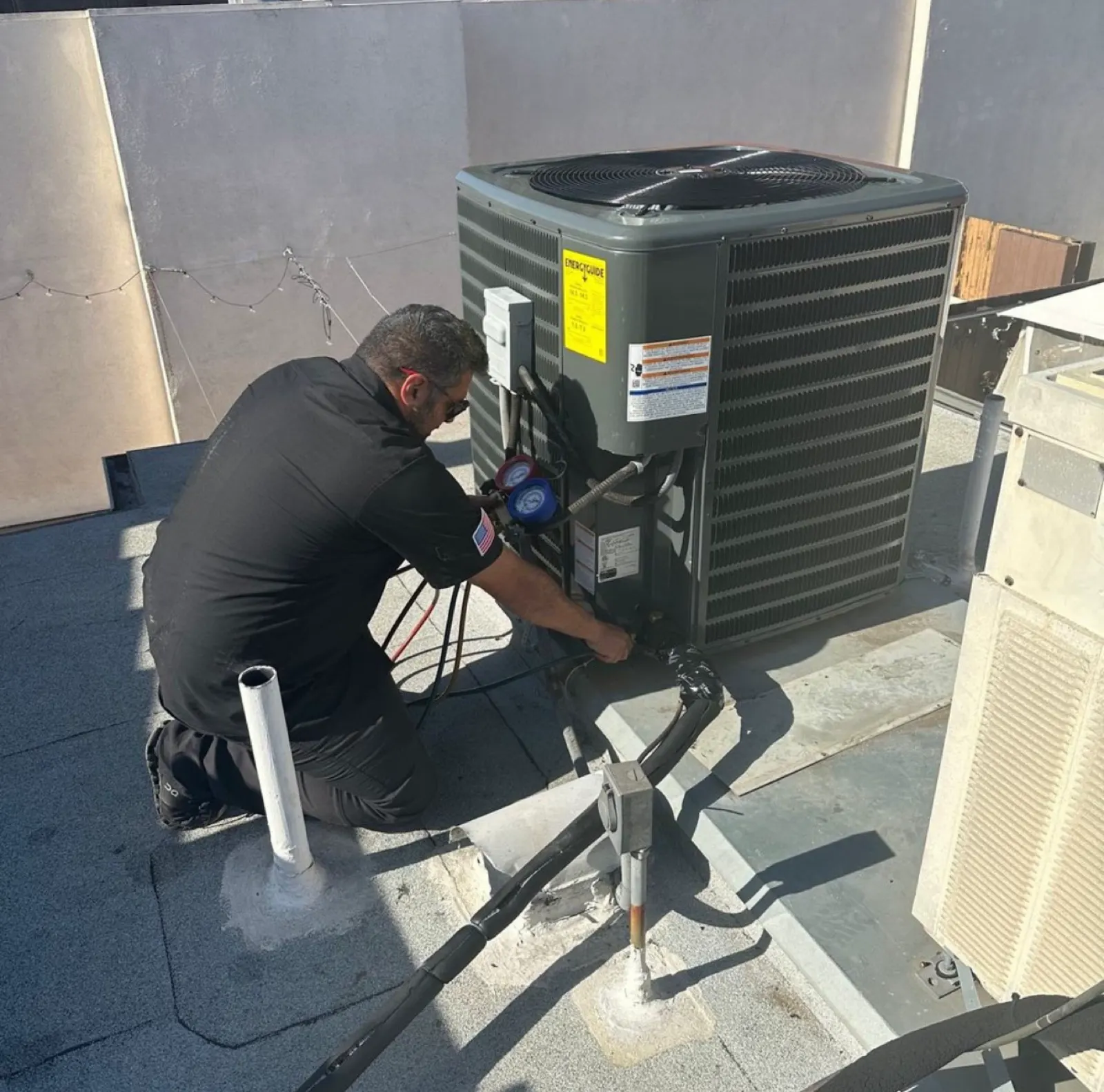
Air conditioner maintenance in Pasadena, CA is mostly about airflow and dirt. The cooling season runs May through October, the air is dusty, summer attics hit 130°F, and there is a smoke season on top. A system that gets a clean filter every month, a rinsed outdoor unit, a clear drain line, and one professional visit a year will run cooler, cost less to run, and last longer than one that is left alone until it stops. Here is what to do, in the order it matters.
Monthly: the filter
The filter protects the indoor coil and the blower, and a packed filter is the single most common reason an AC blows warm air or ices up. Pull it and hold it to a light. If you cannot see through it, replace it. In this area that is typically every one to three months in cooling season, and monthly during wildfire smoke or nearby construction. Note the size printed on the frame and point the airflow arrow toward the unit.
On filter grade: the EPA's home air-cleaner guide says most furnaces and HVAC systems can take a MERV 13 filter without equipment problems, and MERV 13 makes a real difference on smoke days. It also loads faster than a cheap fiberglass filter, so check it more often after upgrading.
A few times a season: the outdoor unit
The outdoor unit sheds the heat from your house through thin fins that clog with dust, cottonwood fluff, dryer lint, and pet hair. Side-yard condensers in the San Fernando Valley that sit against a fence with a foot of clearance overheat every August.
- Shut off the power at the disconnect box on the wall next to the unit.
- Clear leaves, grass clippings, and anything stored against it. Keep about two feet clear on every side and trim plants back.
- Rinse the fins gently with a garden hose from top to bottom. Never a pressure washer; it flattens the fins.
- Let it dry, restore power.
One caveat on that last step. Lennox puts coil cleaning on the licensed-technician list rather than the homeowner one, and Goodman warns that inexperienced hands puncture the tubing. Nothing here is hard to do wrong gently, but if the fins are already bent or the coil is coated rather than dusty, stop and let us handle it — Boost Services cleans it properly as part of a tune-up.
Shade helps, but not a cover or an enclosure that blocks airflow. The unit needs to breathe more than it needs shade.
Every couple of months: the drain line
The AC pulls moisture out of the air and drains it through a small PVC line that grows algae over a long season. When it clogs, water backs up into the pan, a float switch shuts the system down, or water ends up on the floor or through a ceiling. Find the capped cleanout on the drain line near the indoor unit and pour a cup of white vinegar in. If water ever appears at the indoor unit, pull the clog with a wet/dry vacuum at the drain outlet outside.
Thermostat habits
- Fan on "auto," not "on," unless you are running the filter on a smoke day. Continuous fan re-evaporates moisture off the coil and runs the blower all night.
- Pick a setpoint you will actually live with, and leave it. Big swings make the system run flat out to recover during the hottest part of the day.
- On a heat wave day, cool the house early in the morning and let it coast. A system that is asked to drop the house 10 degrees at 4 pm on a 105°F day cannot.
- Replace the thermostat batteries every spring.
Once a year: the professional tune-up
Book it in spring, before the first heat wave, when techs are not running from one breakdown to the next. A real maintenance visit covers:
- Refrigerant pressures and temperatures, and whether the charge matches the data plate.
- The capacitor and contactor under load. Capacitors weaken with heat and fail in the first heat wave.
- The blower motor, the blower wheel, and the amp draw on every motor.
- The indoor and outdoor coils, and coil cleaning if years of dust have built up.
- The drain line and pan, flushed.
- Temperature drop across the coil and airflow at the registers.
- Thermostat operation and the safety controls.
- Electrical connections tightened, and the disconnect checked.
Two visits a year, one for cooling and one for heating, is what a maintenance plan puts on the calendar so you do not have to.
What Pasadena weather does to an AC
Long heat waves mean long run times, so filters load faster and drains work harder than the calendar suggests. Santa Ana winds pack the outdoor coil with dust in a day. Smoke season is the reason for the MERV 13 filter and the extra checks. Cold clear nights in spring and fall are when a system running with a low setpoint can ice its coil. Adjust the schedule above to the season, not the month.
What you can check yourself
- The filter, monthly, replaced when you cannot see light through it.
- The outdoor unit, cleared and rinsed with the power off at the disconnect.
- The drain line, vinegar in the cleanout every couple of months.
- Supply registers open and return grilles clear in every room.
- Thermostat batteries, mode, and fan setting.
- The copper lines at the indoor and outdoor units, for frost.
- The breaker, reset once if it tripped.
Do not open the electrical compartment on the outdoor unit, touch the capacitor, use chemicals on the coils, or add refrigerant. Adding or removing refrigerant legally requires EPA Section 608 certification.
When to call a licensed tech
Call when the air is warm with a clean filter, when there is ice on the lines, when the breaker trips a second time, when the system starts and stops every few minutes, when there is water at the indoor unit that the vacuum did not fix, when you hear grinding or screeching, or when you smell anything burning. And call in spring for the tune-up, before you need it.
Common questions
Does maintenance really lower the bill?
A clean filter, clean coils, and a correct refrigerant charge let the system move the same heat with less run time. How much that saves depends on how dirty it was. A system that has never been serviced usually shows the biggest change.
How long should the system rest between cycles on a hot day?
On a properly sized system in mild heat, cycles run fifteen minutes or more with a rest between. In a 100°F stretch it may run nearly continuously and that is normal. Starting and stopping every few minutes on an ordinary day is not.
What should I do before a heat wave?
Replace the filter, rinse the outdoor unit, pre-cool the house early, close blinds on the sun side, and do not push the thermostat way down at 4 pm. If the system struggled last summer, get the tune-up before the forecast turns.
To get the tune-up on the calendar, or if something on the list above is already wrong, book a $69 diagnostic. You are told the price before we schedule, and it is credited toward the work if you go ahead. Call 818-277-5056 or send us a message and we will usually be out within a few hours.
Written with AI assistance by Boost Services, Heating and Cooling team, and reviewed by our licensed technicians before publishing. Boost Services Heating and Cooling, C-20 #1119892.