
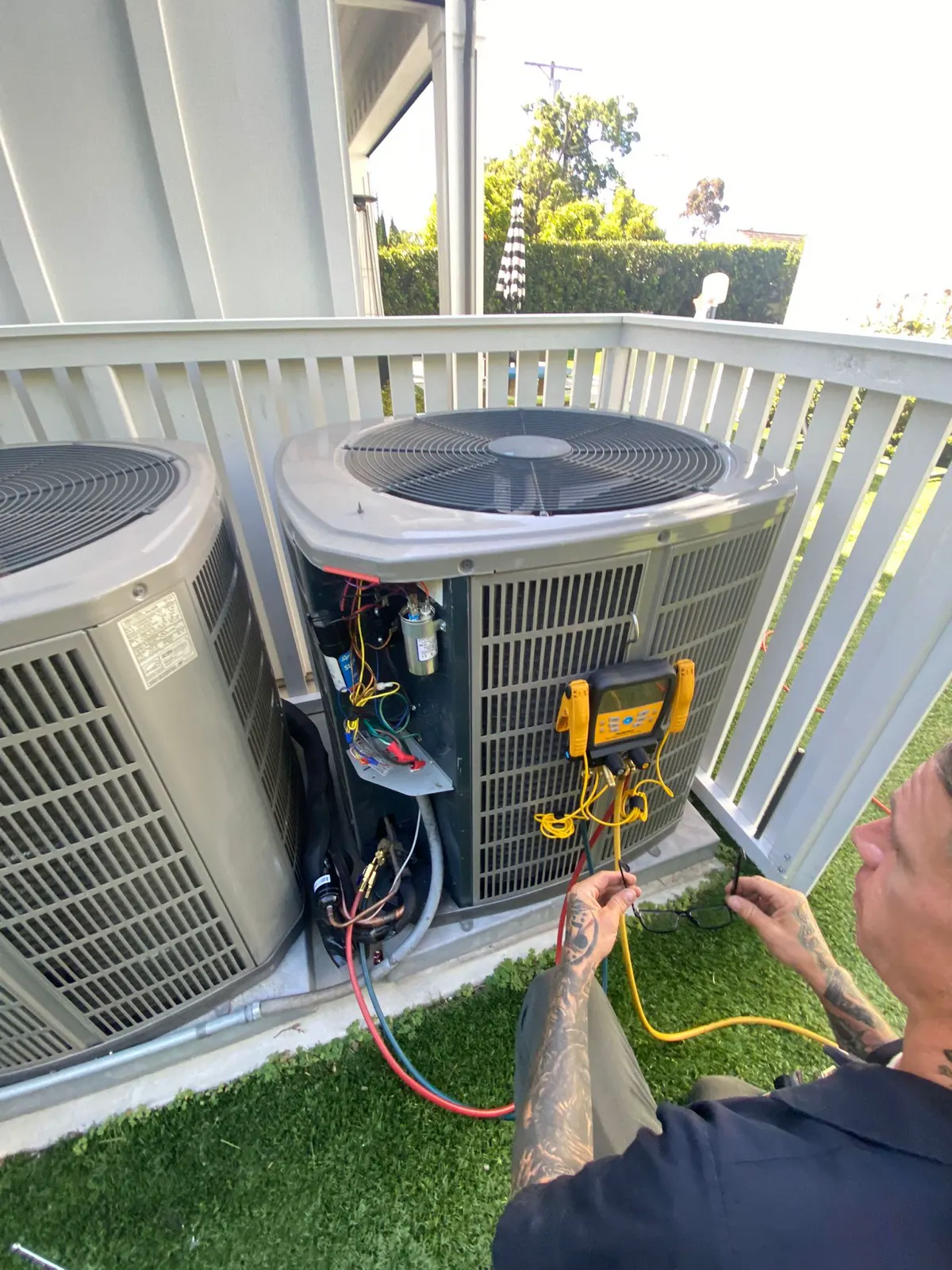
A capacitor booster is the trade's "hard start kit": a start capacitor and a relay wired alongside the run capacitor that gives the compressor a burst of extra torque for the first fraction of a second. It fixes one specific problem, a compressor that struggles to start, and it does that well. It does not fix airflow, refrigerant, or a compressor that is already failing. Here is how it works and how to tell whether yours is a candidate.
What the capacitor does in the first place
Every outdoor unit has a run capacitor, usually a silver can with two or three terminals. It gives the compressor and fan motors the phase shift they need to start turning and then stays in the circuit to keep them running efficiently. Capacitors weaken with heat and age. A weak one lets the compressor start slowly, hum, or trip on overload, and a dead one stops it starting at all. A weak run capacitor is one of the most common summer repairs on a residential condenser.
What the booster adds
A hard start kit is a larger start capacitor plus a potential relay. At the moment the compressor is called, the start capacitor is in the circuit and adds torque. Once the motor is up to speed the relay drops it out and the run capacitor carries on. Newer "two-wire" kits do the same job with the relay built in.
The result is a compressor that reaches speed in a fraction of the time. That means:
- Less current drawn during the start, which is when the motor is under the most stress.
- Less heating of the compressor windings on every cycle.
- Fewer stalled starts on hot afternoons when the outdoor coil is already hot and pressures are high.
- Less voltage sag in the house, which is the reason lights dim when the AC kicks on.
Efficiency claims for hard start kits are mostly marketing. The start lasts a fraction of a second; it is not where your electricity goes. The benefit is reliability and compressor life.
When a booster is the right call
- The compressor hesitates or hums before starting, or trips the breaker on the hottest afternoons and runs fine when it is cooler.
- The lights dim noticeably when the AC starts.
- The system has a thermostatic expansion valve (many newer ones do). Pressures do not equalize between cycles, so the compressor starts against a load, and some manufacturers recommend a kit for that reason.
- An older but healthy unit where the goal is to get more years out of a compressor that is working harder to start.
- Short power interruptions during heat-wave grid events, when the compressor tries to restart against full head pressure.
When it is not
- The run capacitor is weak or dead. Replace it first. A booster on top of a bad run capacitor is a bandage.
- The compressor is drawing locked-rotor current because it is mechanically failing. A kit may get a few more starts out of it; it does not repair it.
- The real problem is airflow or refrigerant. A dirty coil, a clogged filter or low charge makes the compressor run hot and hard, and no start kit helps that.
- The unit is on its last summer anyway. Put the money toward replacement instead.
A tech can tell which of these you have with an amp clamp and a capacitor meter in a few minutes. That is what the diagnostic is for.
What you can check yourself
- Stand by the outdoor unit when the thermostat calls. A healthy start is a click and a smooth ramp-up. A hum, a stutter, or a click followed by nothing means the start circuit is weak.
- Watch a lamp in the room when the AC starts. A brief dim is normal; a heavy dim every time is worth mentioning.
- Note whether the problem happens only on the hottest afternoons.
- Check the filter and rinse the outdoor coil with the power off at the disconnect, because restricted airflow makes every start harder.
Do not open the electrical compartment on the outdoor unit. A capacitor can hold a charge after the power is off, and the contactor is on line voltage.
When to call a licensed tech
Capacitor testing, hard start kit installation, and anything inside the disconnect are licensed work. A kit that is the wrong rating for the compressor, or wired to the wrong terminals, can take the compressor out. As part of AC repair a tech tests the run capacitor, reads the start and running amps against the data plate, checks the contactor, and only then decides whether a kit helps. Regular HVAC maintenance catches a weakening capacitor before it strands you in August.
Common questions
Is a hard start kit the same as replacing the capacitor?
No. The run capacitor is required for the motor to run at all. The hard start kit is an add-on that helps it start. If the run capacitor is weak, it gets replaced; the kit is a separate decision.
Will a capacitor booster lower my electric bill?
Not meaningfully. The start is a fraction of a second. What it saves is wear on the compressor, which is the most expensive part in the system.
Can I install one myself?
No. It connects to line-voltage terminals inside the unit, and matching the kit to the compressor matters. A mistake here costs a compressor.
If your AC hums, stalls, or trips the breaker on hot afternoons, book a $69 diagnostic. You are told the price before we schedule and it is credited toward the work. Call the Boost Services team at 818-277-5056 or send us a message.
Written with AI assistance by Boost Services, Heating and Cooling team, and reviewed by our licensed technicians before publishing. Boost Services Heating and Cooling, C-20 #1119892.