
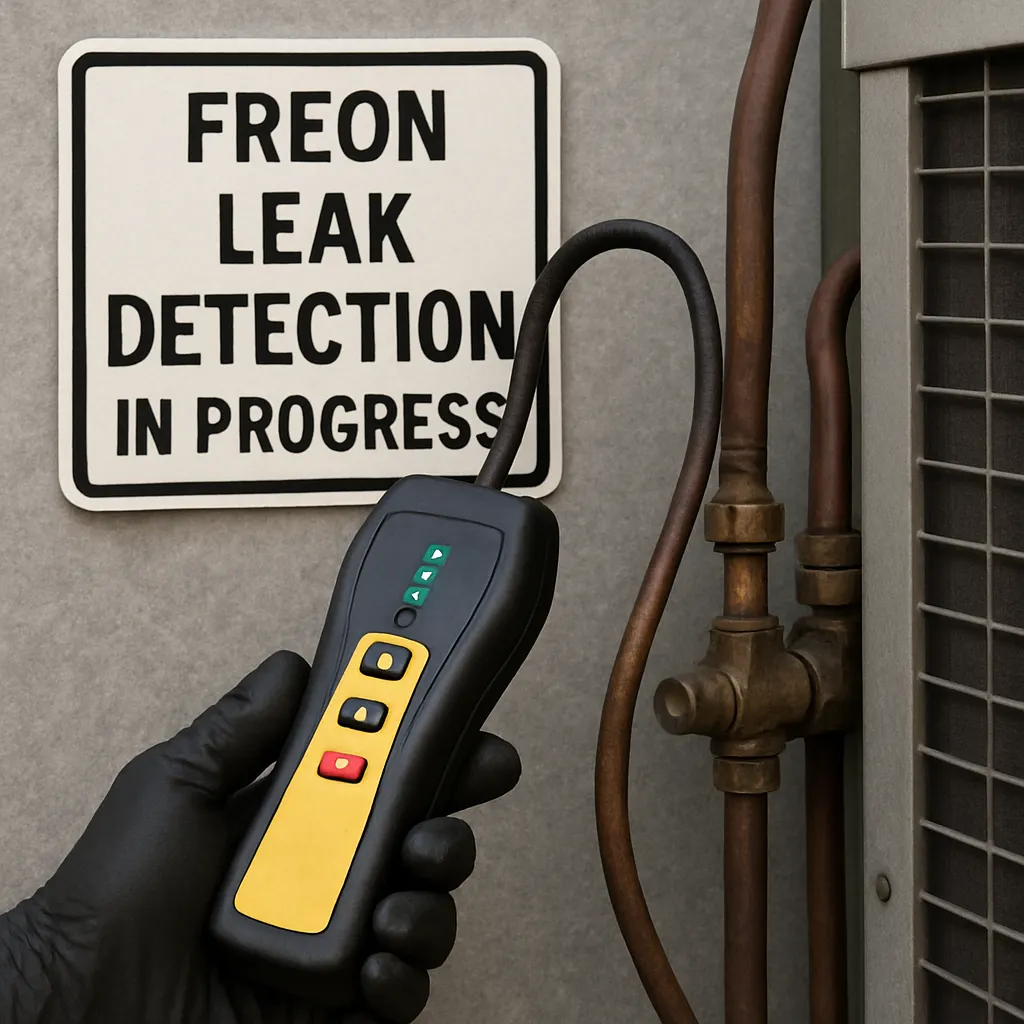
Most refrigerant leaks in a home air conditioner have no smell at all. The refrigerant is nearly odorless, the leak is small, and the first sign is usually a system that cools worse every week, not a chemical smell in the hallway. Some people do report a faint sweet or chemical odor near a leaking coil, and it is worth taking seriously, but the reliable signs are ice on the copper line, a hiss, and fading cooling. This post covers what "Freon" is, how to tell a refrigerant leak from the other smells a Pasadena, CA home produces, what the health risk actually is, and what to do first.
What "Freon" means
Freon is a brand name that became the generic word for refrigerant, the way Kleenex did for tissues. Your system has one of a few: R-22 if it was installed before roughly 2010, R-410A for most systems installed since, and a newer lower-global-warming-potential refrigerant if it went in after the start of 2025, when EPA rules changed what new equipment can use. They behave a little differently in the system, but for the purposes of this post they are alike: colorless, nearly odorless, and a gas at room temperature that is a very cold liquid under pressure.
Refrigerant is not consumed. A system that is "low on Freon" has a leak, somewhere between the outdoor unit and the indoor coil.
Does a refrigerant leak smell?
Usually not. When people do report a smell, it is described as faintly sweet or like a chemical solvent, and it is most often noticed close to the indoor unit. Do not rely on your nose. Rely on these:
- Hissing or bubbling at the outdoor unit, the line set, or the indoor coil while the system runs.
- Ice on the larger copper line at the outdoor unit or on the indoor coil.
- Cooling that has faded over days or weeks, with longer run times and a higher bill.
- Oily residue on the copper lines or fittings. Refrigerant carries compressor oil, and a leak leaves it behind.
Smells that are not refrigerant
Air conditioners produce several smells, and most of the calls we get about "a Freon smell" turn out to be one of these:
- Burning or hot plastic. Electrical. A motor overheating, a wire, or a failing capacitor. Turn the system off at the thermostat and call.
- Musty or dirty socks. Mold or bacteria on a damp indoor coil or in a clogged condensate drain. Common at the start of cooling season. A coil cleaning and drain flush fixes it.
- Rotten eggs or sulfur. That is the odorant added to natural gas. It has nothing to do with the air conditioner. Leave the house and call the gas company from outside.
- Dust burning off. The first heating cycle of the fall, from the furnace, gone in an hour.
The health risk, honestly
Poison Control's position is that briefly inhaling a small amount of refrigerant from a leak is probably not harmful and should not cause long-term effects. The danger is concentration: refrigerant is heavier than air and in a closed space with a large release it can displace oxygen. Symptoms of a significant exposure include headache, dizziness, nausea, impaired coordination, and an irregular heartbeat. Liquid refrigerant on skin or in the eyes causes frostbite, because it boils well below freezing when it escapes pressure.
A slow leak from a residential AC in a normal house is at the low end of that scale. A large release in a closet, a garage, or a small utility room is the scenario to take seriously. If anyone has symptoms, get them to fresh air and call Poison Control at 1-800-222-1222.
Refrigerant is not carbon monoxide. A CO alarm does not detect it, and a refrigerant leak does not produce CO. They are separate risks with separate causes.
What to do in the first ten minutes
- Turn the system off at the thermostat. Running a compressor on low charge damages it, and it stops pushing more refrigerant out.
- Open windows and doors in the room with the indoor unit, and in the garage if the air handler is there.
- Keep people and pets out of small closed spaces near the equipment.
- If anyone feels dizzy or short of breath, get them outside and call 1-800-222-1222.
- Call for a repair. The leak has to be found and fixed before the system is recharged.
Why the leak has to be repaired, not topped up
Federal rules under Section 608 of the Clean Air Act prohibit knowingly venting refrigerant, and require that anyone adding or recovering refrigerant be a certified technician. Recharging a leaking system without repairing the leak is not a real fix: the new charge leaks out on the same schedule, and each recharge is money spent on refrigerant you will lose. On older R-22 systems that refrigerant is now only available as recovered, reclaimed stock, which is why a leak in a 20-year-old system usually turns into a replacement conversation.
Finding a leak takes gauges, an electronic detector, sometimes dye, and time. Some leaks are at a fitting and are repaired on the spot. Others are inside an evaporator coil, and the coil gets replaced.
What you can check yourself
- Look at the copper lines at the outdoor unit for ice or oily spots. Do not touch a frosted line.
- Listen at the outdoor unit and the indoor unit for a hiss with the system running.
- Note how cooling has changed: gradual fade points at a leak, sudden failure points at a part.
- Check the filter and the outdoor coil, because a choked filter freezes a coil without any leak at all.
Do not buy a recharge kit, and do not open any refrigerant valve. Handling refrigerant without certification is unsafe and illegal, and a recharge kit cannot find a leak.
When to call a licensed tech
Call at the first sign: ice, hissing, oily residue, or cooling that keeps fading. Turn the system off while you wait. Our AC repair diagnostic includes pressure readings and a leak search, and the repair is quoted in writing before anything is done. Heat pumps leak the same way and the same rules apply; see heat pump repair. An annual HVAC maintenance visit catches low charge before it becomes a frozen coil in July.
Common questions
Can a Freon leak make my family sick?
A slow leak in a normal house is very unlikely to. A large release in a closed space can cause dizziness, headache, and worse. The practical rule: turn the system off, ventilate, and call if anyone has symptoms.
Will my carbon monoxide detector pick up refrigerant?
No. They are different substances and the detector only responds to CO. Furnaces and gas appliances are the CO risk; the air conditioner is not.
Is it safe to run the AC if I think it is leaking?
Not for long. The house will not cool well, and the compressor is running on low charge. Off until it is repaired is the safe and the cheaper choice.
If you suspect a refrigerant leak, book a $69 diagnostic. We tell you the fee before booking and credit it toward the work. Boost Services Heating and Cooling answers at 818-277-5056 or send us a message.
Written with AI assistance by Boost Services, Heating and Cooling team, and reviewed by our licensed technicians before publishing. Boost Services Heating and Cooling, C-20 #1119892.