
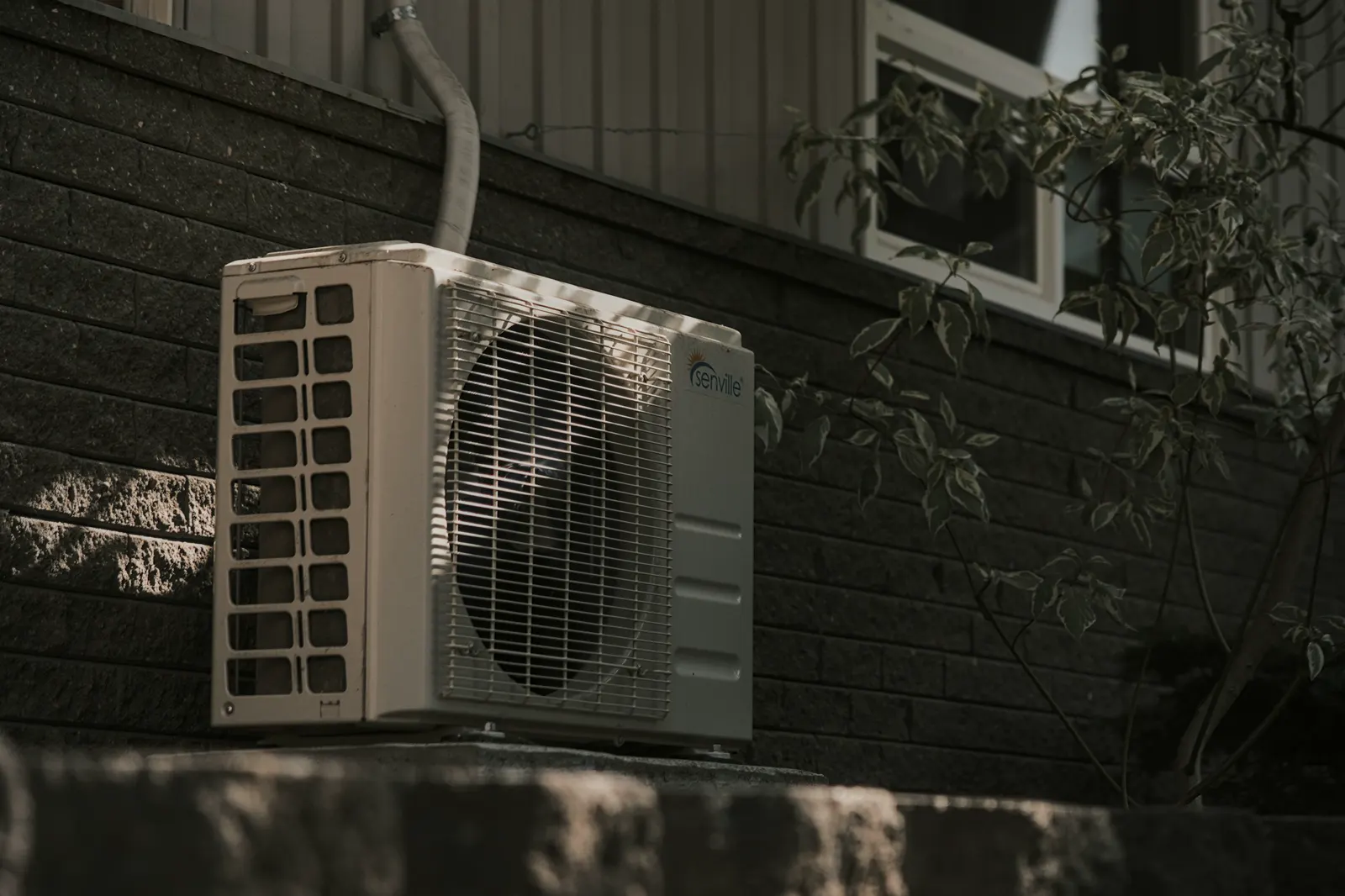
Most heat pump noises are the machine doing its job. The whoosh is the reversing valve, the hum is the compressor, the click is a relay. A short list of sounds means a part is failing, and one or two mean turn it off now. This post sorts them, starting with the ones that scare people for no reason.
If you are new to heat pumps, one thing up front: a heat pump makes more different noises than a plain air conditioner, because it reverses direction, defrosts itself, and on most modern units, changes speed. The variety is normal. What matters is whether a sound is new, louder than before, or continuous.
Normal sounds
Whoosh or swoosh. A rushing sound, sometimes with a soft thud, from the outdoor unit. That is the reversing valve shifting. It happens when the system switches between heating and cooling and every time a defrost cycle starts or ends. On a cold, damp morning in Pasadena, CA, Altadena, or the north end of the San Fernando Valley you may hear it several times before 9 am. Normal, and often followed by a cloud of steam off the unit.
Steady hum. The compressor and the outdoor fan. A variable-speed unit changes pitch as it ramps up and down, so a rising or falling hum through the day is the system matching the load, not a problem.
Click at start and stop. The contactor or a relay pulling in and dropping out. One click when the thermostat calls, one when it is satisfied. Also normal: a click from the thermostat itself.
Gurgle or soft bubbling. Refrigerant moving through the lines, especially right after the unit shuts off or during a mode change. Common on mini splits at the indoor head.
Water dripping. Condensate in cooling mode; melted frost off the outdoor coil during winter defrost.
Sounds that mean a part is wearing out
No need to shut down yet, but book a visit.
Rattling. The most common complaint, and usually the simplest. A loose panel screw, a fan guard that has worked loose, a twig or seed pod in the fan, or a unit that has settled off level on its pad. Side-yard pads in the SGV and SFV shift with the soil and the tree roots. Rattling that changes when you press on a panel is the panel. Rattling from inside the unit is a fan or mounting issue.
Buzzing. A louder, electrical buzz from the outdoor unit. Often a contactor with worn contacts, a capacitor on its way out, or a loose wire vibrating in the electrical compartment. If the buzz comes with the fan not spinning or the compressor not starting, the capacitor is the usual suspect, and the fix is quick if it is caught before the compressor overheats trying to start.
Repeated clicking with no start. The contactor pulling in, the compressor trying and failing, dropping out, trying again. Capacitor or a hard-start problem. Turn the system off at the thermostat until someone looks at it; every failed start heats the compressor windings.
Louder-than-usual hum with weaker airflow. The outdoor coil is probably packed with dust after a Santa Ana wind, and the fan is straining. Clean it and the hum drops.
Sounds that mean shut it off and call
Grinding or metal-on-metal screeching. A fan motor bearing that has failed, or a fan blade hitting something. Run it and you risk losing the motor and the blade. Shut it off at the thermostat, then cut the power at the disconnect box next to the outdoor unit: pull the block or flip the switch. The thermostat only stops the call. The disconnect is what cuts the power.
Loud banging or clanking. From the outdoor unit: a fan blade that has broken or come loose, or something serious inside the compressor. From the indoor unit: a blower wheel that has come loose from its shaft. Either way, off.
Continuous hissing. A short hiss at a mode change is refrigerant equalizing and is fine. A steady hiss that does not stop, especially with ice forming on the lines or weaker cooling, is a refrigerant leak. Turn it off. Running a system with a leak can take out the compressor, and refrigerant is not something to be around in a closed space.
Burning smell with any noise. Off at the breaker, and call.
Mini split heads have their own list
Ductless indoor units sit in the room with you, so you hear things a ducted system hides. Normal for a mini split: a soft click as the louvers move, a creak as the plastic housing expands with temperature, a gurgle after shutdown, and a faint swish as the fan changes speed. Not normal: a rattle from the head, which is usually the cover or a filter not seated; a slapping sound, which is often the drain line or a wire touching the fan; or water dripping from the head. Those are mini split repair visits.
What you can check yourself
- Locate the sound. Outdoor unit, indoor air handler, or ducts. Stand next to each while the system runs.
- Press on the panels. If the rattle stops, tighten the panel screws.
- Look in the outdoor unit from the top. With the power off at the disconnect, look through the fan guard for leaves, twigs, a bird's nest, or a bent fan blade. Remove what you can reach without taking anything apart.
- Note when it happens. At startup, during defrost, all the time, only on hot afternoons. That pattern tells the tech most of what they need.
- Turn it off at the thermostat if the sound is a grind, a bang, a steady hiss, or repeated clicking with no start.
Do not open the electrical compartment on the outdoor unit or the indoor air handler. Capacitors hold a charge with the power off, and that is where the buzz you are chasing usually lives.
When to call a licensed tech
Call for any sound in the last two sections, for a buzz or rattle you cannot trace to a panel or debris, or for any noise that is new and getting louder. A buzzing capacitor caught early is a small part; the same capacitor left until August is a compressor. Noise complaints are also a good reason to keep up with heat pump maintenance, since a spring visit checks the capacitor, tightens the panels, and cleans the coil before any of them start talking. When something has already failed, a heat pump repair visit begins with finding the source before anything gets replaced.
Common questions
Why does my heat pump make a whooshing sound?
The reversing valve is shifting, either because the system switched between heating and cooling or because it started or finished a defrost cycle. It is normal. If it happens every few minutes in mild weather, the defrost control may need a look.
Is it normal for a heat pump to be loud outside?
A steady hum and fan noise are normal, and it gets louder on very hot days when the unit runs at full speed. New sounds, sharp sounds, or a hum that is louder than it used to be are not.
Should I turn off a heat pump that is making noise?
For a grind, a bang, a continuous hiss, or repeated clicking without starting, yes, at the thermostat. For a grind or a bang, also pull the disconnect by the outdoor unit, since the thermostat only stops the call. For a rattle, a buzz, or a hum, you can keep running it while you book a visit.
If a noise has you worried, the diagnostic is $69, quoted before we book and credited toward the work. Call Boost Services Heating and Cooling at 818-277-5056 or describe the sound here and we will get back to you, usually within a few hours to a day.
Written with AI assistance by Boost Services, Heating and Cooling team, and reviewed by our licensed technicians before publishing. Boost Services Heating and Cooling, C-20 #1119892.